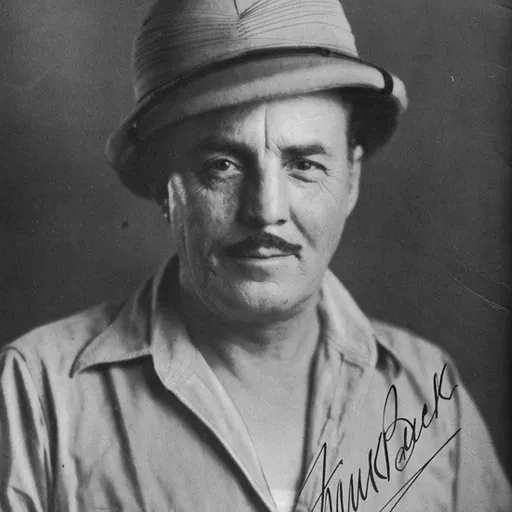
Frank Buck
American hunter, animal collector, actor and author
About Frank Buck
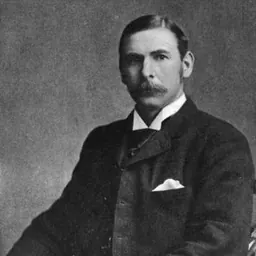
Lived 1884 – 1950 (aged 66). Frank Buck was an American actor, film director, writer, circus performer, radio personality and children's writer.
Frank Howard Buck (March 17, 1884 – March 25, 1950) was an American hunter, animal collector, and author, as well as a film actor, director, and producer. Beginning in the 1910s, he made many expeditions into Asia for the purpose of hunting and collecting exotic animals, bringing over 100,000 live animals back to the United States and elsewhere for zoos and circuses. He co-authored seven books inspired by his expeditions, beginning with 1930's Bring 'Em Back Alive, which became a bestseller.
Between 1932 and 1943, he starred in seven adventure films based on his exploits, most of which featured staged "fights to the death" with various wild beasts. He was briefly a director of the San Diego Zoo, displayed wild animals at the 1933–34 Century of Progress exhibition in Chicago and the 1939 New York World's Fair, toured with Ringling Bros. and Barnum & Bailey Circus, and co-authored an autobiography, 1941's All in a Lifetime. The Frank Buck Zoo in Buck's hometown of Gainesville, Texas, is named after him.
Animal collecting According to Buck, in 1911 Buck won $3,500 in a poker game and decided to go abroad for the first time, traveling to Brazil without his wife. According to a 1957 article about Buck's life, "For years he avoided telling about the poker game that staked him to his first venture in South America, instead claiming he had skimped and saved as an assistant taxidermist in a museum." After an expedition, he would usually accompany his catches on board ship, helping to ensure they survived the transport to the United States.
According to Robison, one day in 1915, Buck visited Robison's shop with an eye to purchasing Lady Gould finches (Chloebia gouldiae) from a shipment that Robison had received from Australia. Robison vividly recalled his first sight of Buck: "He was a slick-looking young fellow. All dressed up. Chamois gloves and spats. A regular fashion plate, and handsome and likable, too." According to the San Francisco Examiner in 1968, Robison initially "gave Buck ideas on the use of tropical birds for added interest at the exposition." with two "very fine chimps" was off to vaudeville with Sid Grauman. "had no money", but Buck suggested Robison let Don Carlos use the orangutan on a percentage basis until the end of the exposition "in a few weeks". According to Robison, the orangutan "was a sensation. Within two weeks Carlos brought in $750 as full payment for it, plus $500 as the pet shop's percentage of the receipts." He states that from this first shipment he sold tigers and birds to Dr. Hornaday, leopards and pythons to Foley & Burke Carnival Company, and "the remaining birds to Robinson [sic] Bird Store and other dealers" for a net profit of $6,000, and three weeks later went back to Singapore. to 1920, According to two passport applications in the archives of the U.S. Department of State, Buck was employed as a traveling agent for Osaka Shosen Kaisha's Official Guide for Shippers and Travelers to the Principal Ports of the World, for the purpose of editorial research and "securing advertisements for the publication" on a commission basis. Buck reported satisfaction and acceptable profits if 70 percent of the birds and 80 percent of the animals survived the sea journey from Asia. made it "prohibitively expensive" to transport animals on American ships. Robison largely ended his import business, and the Robison-Buck connection was severed in 1925.
As the Oakland Tribune put it, Buck went on to fame as the "dashing, dauntless, devil-may-care hero of the big game world".
In 1946, after the end of WWII, Buck told The New Yorker he intended to return to animal collecting in Singapore, saying, "You dig the same old-fashioned pits and use the same old-fashioned knives and come back with the same old-fashioned tigers." It is unclear if Buck ever went animal collecting abroad again between the end of World War II and his death in 1950.
The zoo was still in its early years, having begun as an assortment of animal displays remaining from the 1915–16 Panama–California Exposition held in Balboa Park. It had been granted a permanent site in 1921 (an area of about 140 acres in the park's northwestern quadrant) and most of its initial exhibits had been built over the following year, with a "grand opening" of the new grounds held on January 1, 1923. The zoo was founded by the Zoological Society of San Diego and managed by its board of directors, with founding board member Frank Stephens having served as the part-time managing director without pay since its beginning.
Most of the planning and development was being overseen by Society founder and president Dr. Harry M. Wegeforth, who was the driving force behind the zoo's creation. A strong-willed, hands-on president, Wegeforth walked the zoo grounds daily and had a singular vision for its future, with little room for opposing viewpoints. Wegeforth visited Dr. William Temple Hornaday, director of the New York Zoological Park, hoping Hornaday would recommend someone, but received a cold response. Buck found two female Asian elephants in Calcutta named "Empress" and "Queenie" that were trained to work, and bought them for the zoo.
Buck soon arrived with the rest of the promised animals, including two orangutans, a leopard cub, two gray langurs, two kangaroos, three flamingos, two lion-tailed macaques, two sarus cranes, four demoiselle cranes, assorted geese, and a 23-foot reticulated python named Diablo that became famous when it would not eat and had to be regularly force-fed by a team of men using a feeding tube attached to a meat grinder, a spectacle that attracted thousands of onlookers and became a paid event until the snake's death in 1928.
Buck began his directorship of the San Diego Zoo on June 13, 1923, signed to a three-year contract at an annual salary of $4,000 (equivalent to about $55,500 in 2015). He was enthusiastic at first, telling reporters "We have the best zoo west of Chicago, and we are going to make it even bigger and better." Wegeforth, a physician, took a strong interest in veterinary medicine and personally monitored the health of the animals, and had learned that oiling could cause pneumonia or Bright's disease in elephants. He therefore ordered Buck never to oil Empress and Queenie. He sued Wegeforth personally, and when the matter went to court in February 1924 Buck accused Wegeforth of interfering with "practically everything" related to his job, and of conspiring with the board to "belittle and disparage" his efforts as director.
Board member Thomas Faulconer and other witnesses, however, suggested that the sick tiger had died after a suspicious blow to the head, and flatly denied the snake-killing accusation. The bird was sold to a La Mesa, California, couple who shared it with the zoo.
King Tut appeared in several films, television shows, and theater productions, and was the "official greeter" of the zoo for decades, sitting on a perch inside the entrance to squawk at guests Following King Tut's death in 1990, a bronze statue of the cockatoo was placed in the location of its longtime perch and remains there today, its plaque indicating that the bird "was brought from Indonesia in 1925 by Frank Buck".
Media and celebrity Buck's first book, Bring 'Em Back Alive (1930), became a bestseller. By the end of the 1920s Buck claimed he was the world's leading supplier of wild animals. The Wall Street Crash of 1929 left him penniless, but friends lent him $6,000 and he was soon doing profitable work again.
When Chicago radio and newsreel personality Floyd Gibbons suggested that Buck write about his animal collecting adventures, he collaborated with journalist Edward Anthony to co-author Bring 'Em Back Alive (1930), which became a bestseller and earned him the nickname Frank "Bring 'Em Back Alive" Buck. He arranged for a film crew to accompany him on his next collecting expedition to Asia in order to create a film of the same title, which was released in 1932 and starred Buck as himself.
He was also the main feature of Bring 'Em Back Alive, an NBC radio program promoting the film which aired October 30 – December 18, 1932, and July 16 – November 16, 1934. The follow-up book, Wild Cargo (1932), again co-authored with Anthony, also became a bestseller and was adapted into a 1934 film of the same title in which Buck once again portrayed himself and also served as producer. Armand Denis, the director of Wild Cargo and later a renowned wildlife documentarian, wrote about the filming in his 1963 autobiography. He recalled being bewildered by Buck's disinterest in "equipment" for the shoot, Buck's disdain for naturalistic observation of wildlife, and by Buck's suggestion that an orangutan fight a tiger on film. Denis described the Indian rhino that was shipped to Buck's "jungle camp" in Johor Bahru (nowhere near the jungle) for the production, and how he calmly wrestled with the corpse of "the large placid old tiger specially hired from a local animal dealer" when it drowned in its pit during filming. During this time Buck was represented by George T. Bye, a New York literary agent.
Buck's third book, Fang and Claw (1935), was co-authored with Ferrin Fraser; for the film adaptation, Buck directed and once again starred. Tim Thompson in the Jungle (1935), also co-authored with Fraser, was a work of fiction but was based on Buck's experiences.
While these books and films made Buck world-famous, he later remarked that he was prouder of his 1936 elementary school reader, On Jungle Trails, saying "Wherever I go, children mention this book to me and tell me how much they learned about animals and the jungle from it." Buck next starred as Jack Hardy in 1937's Jungle Menace (1937), a 15-part serial film that was the only picture in which he did not play himself. Prior to and during the making of Jungle Menace, Buck was represented by Hollywood literary agent H.N. Swanson.
During 1938, Ringling Bros. and Barnum & Bailey Circus made Buck a lucrative offer to tour as their main attraction, and to enter the show astride an elephant. He refused to join the American Federation of Actors, stating that he was "a scientist, not an actor". Though there was a threat of a strike if he did not join the union, he maintained that it would compromise his principles, saying "Don't get me wrong. I'm with the working man. I worked like a dog once myself. And my heart is with the fellow who works. But I don't want some union delegate telling me when to get on and off an elephant." Eventually the union gave Buck a special dispensation to introduce Gargantua the gorilla without registering as an actor. In conjunction with his 1939 World's Fair exhibit, Buck released a sixth book, Animals Are Like That, coauthored with Carol Weld.
World War II temporarily halted Buck's expeditions to Asia, but his popularity kept him busy on the lecture circuit and making guest appearances on radio.
Buck's final film role was an appearance as himself in the 1949 Abbott and Costello comedy Africa Screams. Collier's, His endorsement deals included tires, toys, clothing, Pepsodent, Armour meats, Stevens buckhorn rifles, Camel cigarettes, and Cream of Kentucky whiskey. Another pamphlet promises the biggest orangutan in the world, the two biggest pythons in the world, "dragon lizards", Malayan honey bears, king cobras, 500 monkeys, 50 species of snakes, and "rare and beautiful birds from India." to the 1950's According to the Massapequa Post, "Back then, the land where the mall now stands was thickly wooded, vacant and owned by a New York water company. The buildings that housed the animals were constructed with plain concrete blocks and wood-gabled roofs. There was a huge two story Tudor-style building close to the road" that housed reptiles and birds.
According to Texas Highways magazine, "Buck had his staff grow mustaches and wear the same khaki outfit he did. Employees also carried autographed Frank Buck cards, so that when visitors came up and asked "Frank Buck" for an autograph, the employee just handed them a card."
Queens, New York: At decade's end, Buck brought his jungle camp to the 1939 New York World's Fair. "Frank Buck's Jungleland" displayed rare birds, reptiles, and wild animals, along with a five-year-old trained orangutan named Jiggs. In addition, Buck provided a trio of performing Asian elephants, an 80-foot "monkey mountain" with 600 monkeys, and camel rides. Buck threw in a smoking volcano, perhaps playing bongos. )
A brochure for the Pepsodent-sponsored Frank Buck Adventurer's Club, held in the Hanna Holborn Gray Special Collections Research Center at the University of Chicago Library includes a map with the locations of four camps with the note that the map is meant to help the reader "follow Frank Buck's adventures over his radio program." The map marks Singapore as Buck's "headquarters" with another camp in Johore, and a second near Siam (now Thailand), and a third in approximately Burma (now Myanmar) near the Bay of Bengal.
In All In a Lifetime, Buck states that he first rented an acre on Orchard Road in Tanglin for three years: "Here I built cages and shelter for what I had, arranged with DeBrunner to look after my compound while I was gone, with the help of the Malay boys who had been with me in the jungle." He later moved to four acres in Katong. In 1941, as World War II was well underway, Buck wrote, "I have maintained my Katong compound for two decades and am looking forward to returning to it in the near future."
When Armand Denis was hired to direct Wild Cargo in 1934 an executive told him the location shoots would be "Ceylon for elephants, India for tigers, Malaya for cobras. If you can find a sabre-toothed tiger outside the Natural History Museum, you can go there as well." to Howard D. and Ada Sites Buck. His father Howard D. Buck listed his occupation as "agricultural machinery dealer" in the 1880 census. When he was five "his family moved to Dallas, where his father, who was distantly related to the Studebaker family, went to work for their Dallas agency." Frank had an older brother Walter H. Buck, and a sister.
He attended Dallas public schools, In his autobiography, Buck described her as "a small woman, plump, with keenly intelligent eyes, the most beautifully white teeth I have ever seen, and a red, laughing mouth," adding that she was "always good-natured".
Despite a 29-year age difference, Buck was 17, West 46, they married in 1901. On their marriage record, his age was listed as 24, hers was listed as 32. They were listed as sharing a household on Crescent Street in Chicago in the 1910 census. His age was listed as 30, hers was listed as 35. Buck's work was listed as "newspaper man" in the "advertising business".
In 1924, Buck married Nina C. Boardman, a Chicago stenographer who later accompanied him on his travels.
Buck married Muriel Reilly in 1928, and the two had a daughter, Barbara. In 1937, he and Reilly bought their first home, at 5035 Louise Avenue in Encino, California, next door to the home of actor Charles Winninger.
Buck spent his last years in his family home at 324 South Bishop Street in San Angelo, Texas, and died of lung cancer on March 25, 1950, in Houston, aged 66.
Legacy The artist Norman Rockwell painted a portrait of Frank Buck for a Schenley's Cream of Kentucky whiskey advertisement. During World War II, a B-17 bomber crew named their plane the "Frank Buck" because it was going to bring them back alive. Frank Duck Brings 'Em Back Alive is a 1946 animated short in which Donald Duck takes on the Frank Buck persona, and Goofy is a "wild man" of the jungle that he seeks to capture for the Ajax Circus.
The Frank Buck exhibit at the New York World's Fair left a strong impression. In a 1985 New York Times review of a history of American world's fairs, William S. McFeely recalled "at the exhibit called Bring 'Em Back Alive, the great white hunter Frank Buck smiled down at me. I still remember the wonderful tiredness at the end of a day more satisfying than most since." The main character of E.L. Doctorow's National Book Award-winning novel World's Fair (1985) also visited Jungleland, in the climatic final chapters of the story.
In 1953, Bring 'Em Back Alive was adapted into a comic book in the Classics Illustrated series (issue 104). The following year, the Gainesville Community Circus in Buck's hometown of Gainesville, Texas was renamed the Frank Buck Zoo in his honor. Actor Bruce Boxleitner starred as Buck in the 1982–83 television series Bring 'Em Back Alive, which was partially based on Buck's books and adventures. In 2000, writer Steven Lehrer published Bring 'Em Back Alive: The Best of Frank Buck, an edited collection of Buck's stories. In 2008 the Frank Buck Zoo opened the Frank Buck Exhibit, showcasing camp tools and media memorabilia that had once belonged to Buck and were donated by his daughter Barbara. Catherine Diamond, in her paper comparing Buck to fellow animal collector and author Gerald Durrell, notes that Durrell remains widely read and even cherished, while Buck's work has languished with both critical audiences and the general public. Diamond also observed that "The wild animal capture narrative belongs to a specific period—from the height of colonialism in the early twentieth century to the post-World War II aftermath—and reflects many American and European attitudes toward colonized peoples and territories."
Steven Lehrer, a lifelong Frank Buck fan who edited and wrote the scholarly introduction to a compilation of Buck-and-coauthor-produced stories released in 2000, thought Buck deserved appreciation for publicizing the once-obscure wildlife of southern and eastern Asia. Nonetheless, Bender saw fit to extensively edit Buck's mangled Malay language vocabulary. Joanne Carol Joys and Randy Malamud in Reading Zoos'' argue that "accounts of Buck's adventures overstate his actual involvement in the capture of wild animals, and he served principally as a middleman between traders and American circuses and zoos" and that a comprehensive historic perspective on Buck's impact is obscured by his manufacture of his public persona as a "polymorphic phenomenon—trapper? animal aficionado? explorer? film star?"
Joys writes, "Today, it is politically correct to cast Buck as a villain, a self-aggrandizing braggart who decimated the wilds to acquire animals for zoos and circuses, who opposed conservation measures, and racially demeaned the indigenous people of India and Southeast Asia, considering them as no more than his servants...Of course, the books, articles, and especially, the films, are filled with examples of animal combat. Since most of Buck's actual adventures occurred in the late teens and 1920s, and none of the supposed combats were either filmed or photographed, we have no way to know if they really occurred or were part of the lore surrounding the capture of wild animals in the region...Although most seem unlikely, they are not out of the realm of possibility...As for racist claims, Buck, if anything, seems condescending, but not racist. He was working in a colonial region, where white men were expected to maintain the upper hand. But Buck gave credit to the indigenous people for teaching him everything he knew about trapping and collecting wild animals, as well as repeatedly heaping praise on his assistants, and noting how beneath the skin all men are basically the same."
Additional images
Don’t just read it —
keep it.
Full-length biographies made to live with: read them, listen on the way to work, watch them tonight.
- E-book
- Audio
- Video
Instant download · yours to keep · every purchase keeps this site free
Important facts
Family & relationships
People in Frank Buck's life
Named in this biography and alive at the same time







Related people
Same field, nearest in time

Contemporaries
People whose lives overlapped Frank Buck's

Frequently asked questions
Who was Frank Buck?
American hunter, animal collector, actor and author (1884–1950)
When was Frank Buck born?
Frank Buck was born on 17 March 1884 in Gainesville.
When did Frank Buck die?
Frank Buck died on 25 March 1950 in Houston.
What was Frank Buck's occupation?
Frank Buck was an actor, film director, writer, circus performer, radio personality and children's writer.
What nationality was Frank Buck?
Frank Buck was American.
Sources & further reading
· DBpedia: Frank Buck (animal collector)
Cite this page
APA: Biography.guide. (2026). Frank Buck. https://biography.guide/frank-buck/
MLA: "Frank Buck." Biography.guide, https://biography.guide/frank-buck/.
Chicago: "Frank Buck." Biography.guide. https://biography.guide/frank-buck/.
Data last updated: 2026-09-22 · Spot an error? Report a correction.
Portrait: Wikimedia Commons · author & licence
Page generated 2026-09-27 05:04 UTC