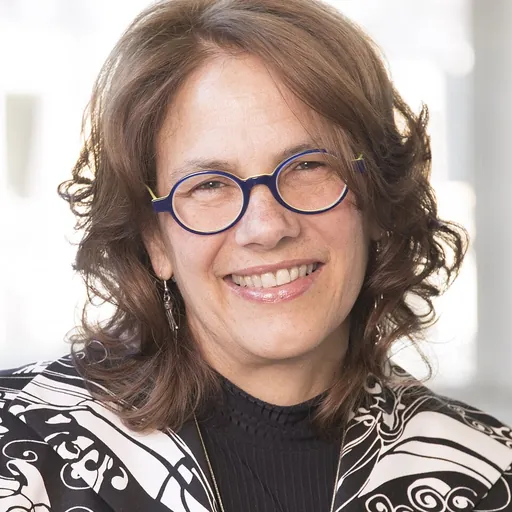
About Francoise E. Baylis
Born 1961. Francoise E. Baylis is a Canadian ethicist and philosopher.
Françoise Elvina Baylis (born 1961) is a Canadian bioethicist whose work is at the intersection of applied ethics, health policy, and practice. The focus of her research is on issues of women's health and assisted reproductive technologies, but her research and publication record also extend to such topics as research involving humans (including human embryo research), gene editing, novel genetic technologies, public health, the role of bioethics consultants, and neuroethics. Baylis' interest in the impact of bioethics on health and public policy as well as her commitment to citizen engagement and participatory democracy sees her engage with print, radio, television, and other online publications.
Education Baylis' education includes a Certificate of Bilingualism from Laurentian University (1981), political science degree (BA, First Class Honours) from McGill University (1983), followed by an MA (philosophy, 1984) and PhD (philosophy, specialization bioethics, 1989) from the University of Western Ontario. The title of her PhD thesis is "The ethics of ex utero research on spare IVF human embryos" and was completed under the supervision of Benjamin Freedman. In the thesis as acceptable objects for research is still referenced today.
Career In 1996 Baylis was appointed at Dalhousie University as an associate professor in the Office of Bioethics Education and Research (later the Department of Bioethics), and in 2004 became Professor and Canada Research Chair in Bioethics and Philosophy. In 2007, she became an elected Fellow of the Royal Society of Canada She previously served as an assistant professor of philosophy at the University of Tennessee, Knoxville as well as a Lecturer with the Departments of Paediatrics, Obstetrics & Gynaecology, and Rehabilitation Medicine with the University of Toronto (1991-1993) and Department of Obstetrics & Gynaecology with the University of Western Ontario (1989-1991). Her early employment also included working as an ethics consultant to the Royal Commission on New Reproductive Technologies and as a clinical ethics consultant at hospitals in London, Toronto, Knoxville and Halifax. She was the founder and leader (since 2003) of Novel Tech Ethics, renamed NTE Impact Ethics (ca.2013), an interdisciplinary research team based at Dalhousie University (with some international collaborators), doing research at the intersection of health, bioethics, and public policy until the time of Baylis' retirement.
Notable achievements during her career include: being named to the "Who's Who in Black Canada" (2002–present) and to "Canadian Who's Who" (2004–present); member of Governing Council, Canadian Institutes of Health Research (2001-2004) Canadian Institutes of Health Research (CIHR) grants (totaling more than $2.4 million), including a New Emerging Team grant, States of Mind: Emerging Issues in Neuroethics. In total, since 1990 she has secured greater than $2.8 million in research funding as a Principal Investigator, > $1.8 million as a Co-Principal- or Co-Investigator, and >$2 million as a Collaborator, Project Advisor or Team Member.
Fields of research Baylis has made numerous contributions to the development of public policy on various assisted human reproduction topics Baylis led one of the two Canadian Institutes of Health Research-funded neuroethics teams from 2006 to 2011. Through that six-year program, she helped to head the development of a new field for Canada. She also co-chaired one of the first international neuroethics conferences, "Brain Matters I" in Halifax in 2009. Beyond her research contributions in the realm of assisted reproductive technologies (including contemporary family-making ) and women's health in general, Baylis is counted as making contributions to several additional, specific areas of scholarly inquiry: Research on bioethics consultants – her early scholarly work with The Health Care Ethics Consultant "represents a critical assessment of both theoretical and practical issues facing practitioners in ethics consultation". This work informed the original standards for ethics consultation prepared by the Society for Health and Human Values – Society for Bioethics Consultation Task Force on Standards for Bioethics Consultation. This was published under the title Core Competencies for Health Care Ethics Consultation, The Report of the American Society for Bioethics and Humanities (1st edition). It is now available in its second edition. Research involving children, research involving women, – her research in these three areas looks past the immediate threats of vulnerability, which would presume the non-involvement of these research populations, in order: (i) to: ask why it is important to do research for children, women, and pregnant women; and, (ii) to make sure that this research proceeds on an ethical basis; Research surrounding questions of intergenerational justice – her scholarly focus on questions of intergenerational justice has sought to ensure that societal and policy choices about whether and how to pursue new technologies, such as stem cell research, animal-human hybrids and chimeras, or, most recently, embryonic gene editing techniques, give consideration to the potential consequences of those choices, not only consequences in the near term, but also for future generations; and, Research about conscientious objection in the practice of medicine – her work in this area (for example, as to whether appeals to conscience can justify refusals to provide medical services on the part of a healthcare practitioners) has relevance both for access to abortion and medical assistance in dying. Her research, with colleagues Carolyn McLeod, Jocelyn Downie, and Daniel Weinstock, has been to find ways to govern medical practice so that it is both fair ("right") and morally effective ("good"). (FAB) – an international network of feminist bioethics researchers. In this regard, Baylis’ work has helped to ensure a venue for publication of feminist bioethics authors with the International Journal of FAB. Moreover, her efforts on behalf of Feminist Approaches to Bioethics (FAB) have fostered community-building among feminist bioethics academics and practitioners as exemplified through FAB's bi-annual World Congress (held in association with International Association of Bioethics meetings). Baylis has also played a role in fostering and helping to direct the health science research community in Canada. She served on the governing councils of the Canadian Biotechnology Advisory Committee (1999-2001), Canadian Institutes of Health Research (2001-2004), and Assisted Human Reproduction Canada (2006-2010). within these agencies and the protection of human research participants. She is also known as an opponent of institutional choices and practices that abet "structural conflict of interest regarding the funding of research and the governance of research ethics."
Informing public policy and debate As a contributor to feminist ethics, Baylis' orientation stresses the political dimensions of doing bioethics, using one's expertise to impact public policy in the hopes of furthering moral and social progress—in the hopes "to make the world a better place." including ethics in the context of clinical trials and governance of assisted human reproduction.
As Baylis' academic career has progressed, the public character of her work, beyond its immediate relevance to public policy, has increased. She is a proclaimed advocate against social injustice, or by virtue of the exclusion of pregnant women from clinical research. For more than a decade she has sought to engage directly with various publics through public education initiatives, media interviews, and social media (@ImpactEthics). Speaking as the leader of the NTE Impact Ethics research group she has said: "Our big-picture goal is to support democracy by helping people to understand what the issues are and what is at stake and how they can then think about and position themselves vis-à-vis the science." Her research projects on "impact ethics" include an emphasis on knowledge translation and mobilization which aim to implement in policy and practice a bioethics that is "responsible", "accountable" and "innovative" Other awards and honours include: Canada Council for the Arts Molson Prize Winner, 2023. Killam Prize winner. Category: Humanities, 2022. Queen Elizabeth II, Platinum Jubilee Medal, 2022. Association of American Publishers Prose Award Winner. Category: Clinical Medicine, 2020. Lifetime Achievement Award, Canadian Bioethics Society/Société canadienne de bioéthique, 2017. McNeil Medal, Royal Society of Canada, 2016. Order of Nova Scotia, 2016. Distinguished Academic Award, Canadian Association of University Teachers (CAUT), 2016. Tier I, Canada Research Chair in Bioethics and Philosophy, 2004–2018. Fellow, Canadian Academy of Health Sciences, 2007–2023. Canadian Who's Who, University of Toronto Press; Third Sector Publishing, 2004–present. Who's Who in Black Canada, 2002–present.
Don’t just read it —
keep it.
Full-length biographies made to live with: read them, listen on the way to work, watch them tonight.
- E-book
- Audio
- Video
Instant download · yours to keep · every purchase keeps this site free
Important facts
more
Françoise Elvina Baylis, Françoise E Baylis, F. E. Baylis, F E Baylis, Baylis F. E., Baylis FE, Francoise BaylisPeople in Francoise E. Baylis's life
Named in this biography and alive at the same time



Related people
Same field, nearest in time




Contemporaries
People whose lives overlapped Francoise E. Baylis's




Frequently asked questions
Who is Francoise E. Baylis?
Canadian bioethicist
When was Francoise E. Baylis born?
Francoise E. Baylis was born in 1961 in Montreal.
What is Francoise E. Baylis's occupation?
Francoise E. Baylis is an ethicist and philosopher.
What nationality is Francoise E. Baylis?
Francoise E. Baylis is Canadian.
Sources & further reading
· Wikipedia: Francoise E. Baylis
Cite this page
APA: Biography.guide. (2026). Francoise E. Baylis. https://biography.guide/francoise-e-baylis/
MLA: "Francoise E. Baylis." Biography.guide, https://biography.guide/francoise-e-baylis/.
Chicago: "Francoise E. Baylis." Biography.guide. https://biography.guide/francoise-e-baylis/.
Data last updated: 2026-09-22 · Spot an error? Report a correction.
Portrait: Wikimedia Commons · author & licence
Page generated 2026-09-27 05:04 UTC