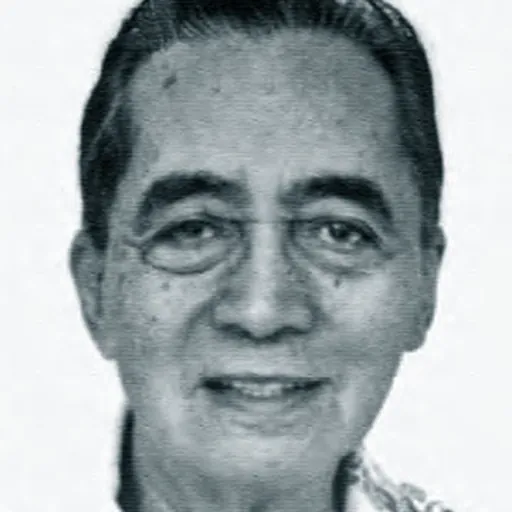
About Francisco Soc Rodrigo
Lived 1914 – 1998 (aged 83). Francisco Soc Rodrigo was a Filipino journalist, lawyer and politician.
Francisco "Soc" Aldana Rodrigo (January 29, 1914 – January 4, 1998) was a Filipino playwright, lawyer, broadcaster, and a Senator of the Philippines from 1955 to 1967.
In honor of in the struggle against the dictatorship of Ferdinand Marcos, his name was inscribed on the Wall of Remembrance at the Bantayog ng mga Bayani in 1998 - the year in which he died.
In 1937, Rodrigo married his childhood sweetheart Remedios Enriquez. Prior to this, he took Law at the University of the Philippines, which he finished in 1938.
Education Rodrigo received his elementary education from the Bulacan Elementary School, and moved on to secondary school at the University of the Philippines High School. He earned his Bachelor of Arts and Bachelor of Science in Education degrees from Ateneo de Manila and University of Santo Tomas, graduating magna cum laude and valedictorian, respectively. He was captain of the debate team at university. He then earned His Bachelor of Laws degree from the University of the Philippines Diliman.
Career Literary works Rodrigo was a playwright in English and Tagalog, with works described as those that distilled within the Filipino soul. His most celebrated play was Sa Pula, Sa Puti while his most popular Kuro – Kuro sa likod ng mga Balita had also won legions of admirers throughout the country. Some other famous works include Tagalog translations of works of Martyr of Golgotha and Cyrano de Bergerac.
Awarded as one of the Ten Outstanding Senators of his time, he was a much-invited guest of foreign governments such as the United States, Britain and West Germany, among others. Rodrigo was also awarded a U.S. Government grant under the terms of Public Law 402 (Smith - Mundt) for observation and travel under the auspices of the Governmental Affairs Institute (Nov. 20, 1959 - Jan. 20, 1960).
For the 1959 midterm elections, Rodrigo ran an unsuccessful campaign for the “Grand Alliance” counting as candidates Emmanuel Pelaez, Raul Manglapus and Jesus Vargas, among others. Then in 1961, Rodrigo got the third-most votes to win a second senatorial term as a Liberal Party candidate with Diosdado Macapagal. He sought a third term in 1967 but lost. From 1970 to 1972, Rodrigo hosted the ABS-CBN program Mga Kuro-kuro ni Soc Rodrigo.
Martial Law activism For his dissent against President Marcos, Rodrigo, along with Ninoy Aquino and many others, was incarcerated during upon the declaration of Martial Law in 1972. During this time in jail, Rodrigo kept the faith of fellow detainees alive as he led nightly prayers of the rosary. Aquino would treasure the crucifixes that Rodrigo gave him during this time. Rodrigo was released after three months but was detained two more times: in 1978, for writing Tagalog poems attacking the Marcos dictatorship, and in 1982, for his anti-Marcos poems in the newspapers, WE Forum and Philippine Star.
In August 21, 1983, Rodrigo was one of the first people allowed to look at the remains of the assassinated Ninoy Aquino. Rodrigo felt distraught over this incident since he was one of those who advised Aquino to return to the Philippines from exile in the United States.
End of the Marcos dictatorship and service in the 1986 Constitutional Commission
After the People Power Revolution that sent Marcos to exile, Rodrigo was chosen by President Cory Aquino to be a Commissioner of the 1986 Constitutional Commission. Many of Rodrigo's children were against his being a member, preferring instead to see him in the Senate one more time. Instead, he joined the commission as he turned his back on politics forever. The new Constitution was ratified by the people in February 1987.
Retirement After his service in the Constitutional Commission, Rodrigo largely retired from public life, preferring to spend time with his family. Until just before his death, though, he wrote columns for the newspapers Malaya (1980–1989) and The Philippine Star (1992–1997).
Death On January 4, 1998, Rodrigo died at the age of 83 due to complications from cancer.
Electoral history
Legacy
In November 1998, a few months after his death, Soc Rodrigo's name was inscribed in the Wall of Remembrance at the Bantayog ng mga Bayani in Quezon City, to honor his role in the struggle against Ferdinand Marcos.
The Gawad Soc Rodrigo is an award named after him given by the Komisyon sa Wikang Filipino (KWF) and the National Commission for Culture and the Arts (NCCA).
Don’t just read it —
keep it.
Full-length biographies made to live with: read them, listen on the way to work, watch them tonight.
- E-book
- Audio
- Video
Instant download · yours to keep · every purchase keeps this site free
Important facts
People in Francisco Soc Rodrigo's life
Named in this biography and alive at the same time

Related people
Same field, nearest in time



Contemporaries
People whose lives overlapped Francisco Soc Rodrigo's



Frequently asked questions
Who was Francisco Soc Rodrigo?
Filipino journalist and politician (1914–1998)
When was Francisco Soc Rodrigo born?
Francisco Soc Rodrigo was born on 29 January 1914 in Bulakan.
When did Francisco Soc Rodrigo die?
Francisco Soc Rodrigo died on 4 January 1998 in Quezon City.
What was Francisco Soc Rodrigo's occupation?
Francisco Soc Rodrigo was a journalist, lawyer and politician.
What nationality was Francisco Soc Rodrigo?
Francisco Soc Rodrigo was Filipino.
Sources & further reading
· Wikipedia: Francisco Soc Rodrigo
Cite this page
APA: Biography.guide. (2026). Francisco Soc Rodrigo. https://biography.guide/francisco-soc-rodrigo/
MLA: "Francisco Soc Rodrigo." Biography.guide, https://biography.guide/francisco-soc-rodrigo/.
Chicago: "Francisco Soc Rodrigo." Biography.guide. https://biography.guide/francisco-soc-rodrigo/.
Data last updated: 2026-09-23 · Spot an error? Report a correction.
Portrait: Wikimedia Commons · author & licence
Page generated 2026-09-27 05:06 UTC