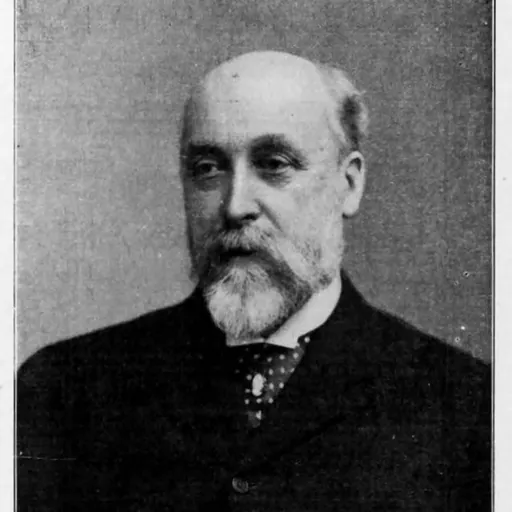
About Francis Webb
Lived 1836 – 1906 (aged 70). Francis Webb was a British engineer, railway engineer and design engineer.
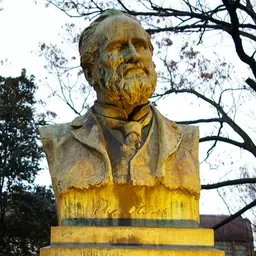
Francis William Webb (21 May 1836 – 4 June 1906) was an English railway engineer responsible for the design and manufacture of locomotives for the London and North Western Railway (LNWR). As the LNWR's chief mechanical engineer, he also exercised great influence in political and public life in the Cheshire town of Crewe, once being described as the 'King of Crewe'.
Early life Webb was born on 21 May 1836 in Tixall Rectory, near Stafford, the second son of William Webb (1806–1883), Rector of Tixall.
Career Crewe Works Showing early interest in mechanical engineering, Webb was articled as a pupil of Francis Trevithick at Crewe Works on 11 August 1851 at the age of fifteen. He joined the drawing office at the end of his training in 1856. He became Chief Mechanical Engineer when the post of Locomotive Superintendent was renamed. It appears that this happened soon after Webb took up his duties. At the same time, he also became President of the Crewe Mechanics' Institute, where he had for some time taught engineering drawing during his first stay at Crewe. Webb remained Chief Mechanical Engineer of the LNWR until 1 July 1903, having tendered his resignation in November 1902 but grown ill and been forced to leave earlier than expected. Successor George Whale was appointed in April 1903 but took over somewhat earlier than planned.
Locomotive classes No. 1881 Class B locomotive of the London & North Western Railway, a Webb 0-8-0 four cylinder compound. Webb was responsible throughout his career for some highly successful standard locomotive classes, all built at Crewe in considerable numbers. Notable among these were the Precedent class of 2-4-0 (known as Jumbos), an 0-6-0 general purpose freight design, ("Coal Engine") and its 0-6-2 ("Coal Tank") variant, a celebrated 0-6-0 mixed traffic design ("Cauliflowers"), and an 0-8-0 freight locomotive with two compound variants and a simple expansion version produced in parallel, The last-mentioned was continuously developed and built until London, Midland, and Scottish Railway days, most earlier locomotives being rebuilt to conform.
Controversy There remains some controversy over Webb's two distinct compound systems applied to a number of locomotive designs, which are reputed to have given considerable trouble in service. The Webb Experiment and Improved Precedent classed were withdrawn by his successor George Whale soon after he succeeded Webb in 1903.
An obituary in The Engineer from 8 June 1906 criticised Webb's express compound design, which used un-coupled high and low pressure cylinders, a design promoted by Webb alone. The article caused open debate in the pages of the journal, mostly based on the perceived flaw of not utilising coupling rods. In the 20 June edition, the editor of the journal continued the attack on the deceased engineer, stating: It was stated that "it was during the 'reign' of F. W. Webb, between 1872 and 1903, that the power of this office was its height. Described just before his retirement as 'the King of Crewe', Webb came to exercise control over the working lives of over 18,000 men - one third of the total LNWR workforce. Over half these lived in Crewe, around 8,000 being employed at the locomotive works. Several recreational and sporting organisations were a direct result of Webb's influence and others received benefit from his support."
Webb's influence in Crewe allegedly extended to intimidation of Liberal Party sympathisers during the 1880s. In September 1885, the editor of the Crewe Chronicle published charges against Webb, saying "that through the action, direct and indirect, of Tory railway officialism, the political life of Crewe is cramped and hindered beyond recognition". In November 1889, Crewe Town Council debated a motion which accused the works managers of working with Tories "to crush Liberalism altogether out of the town", with a member arguing that "by intimidation and persecution of your Liberal workmen, and by making the chances of promotion depend upon subserviency to the Tory political demands of the Management, they have created a state of political serfdom in the works."
Retirement and death Webb retired in 1903 to Bournemouth, where he died in 1906, aged 70. He had never married.
Locomotive designs LNWR 1201 0-4-0ST LNWR 17in Coal Engine 0-6-0 LNWR Webb Precursor Class 2-4-0 LNWR Precedent Class 2-4-0 LNWR Chopper Tank Class 2-4-2T LNWR 4ft 6in Tank Class 2-4-2T LNWR 18in Goods Class 0-6-0 LNWR Webb Coal Tank 0-6-2 LNWR Special DX Class 2-4-0 LNWR Webb Experiment Class 2-2-2-0 LNWR Dreadnought Class 2-2-2-0 LNWR Improved Precedent Class 2-4-0 LNWR Teutonic Class 2-2-2-0 LNWR Waterloo Class 2-4-0 LNWR 5ft 6in Tank Class 2-4-2T LNWR Greater Britain Class 2-2-2-2 LNWR Class A 0-8-0 LNWR John Hick Class 2-2-2-2 LNWR Dock Tank 0-4-2ST LNWR 18in Tank Class 0-6-2T LNWR Jubilee Class 4-4-0 LNWR Alfred the Great Class 4-4-0 LNWR Class B 0-8-0 LNWR 1400 Class 4-6-0
Don’t just read it —
keep it.
Full-length biographies made to live with: read them, listen on the way to work, watch them tonight.
- E-book
- Audio
- Video
Instant download · yours to keep · every purchase keeps this site free
Important facts
People in Francis Webb's life
Named in this biography and alive at the same time




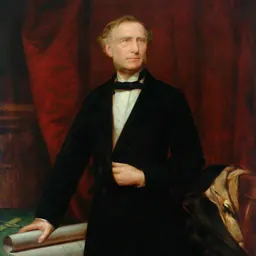
Related people
Same field, nearest in time
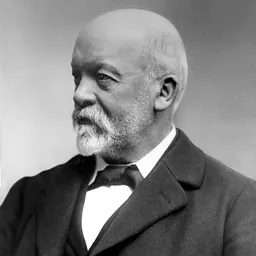

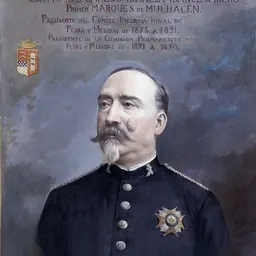
Contemporaries
People whose lives overlapped Francis Webb's



Frequently asked questions
Who was Francis Webb?
British engineer (1836–1906)
When was Francis Webb born?
Francis Webb was born on 21 May 1836 in Tixall.
When did Francis Webb die?
Francis Webb died on 4 June 1906 in Bournemouth.
What was Francis Webb's occupation?
Francis Webb was an engineer, railway engineer and design engineer.
What nationality was Francis Webb?
Francis Webb was British.
Sources & further reading
· DBpedia: Francis Webb (engineer)
Cite this page
APA: Biography.guide. (2026). Francis Webb. https://biography.guide/francis-webb-engineer/
MLA: "Francis Webb." Biography.guide, https://biography.guide/francis-webb-engineer/.
Chicago: "Francis Webb." Biography.guide. https://biography.guide/francis-webb-engineer/.
Data last updated: 2026-09-20 · Spot an error? Report a correction.
Portrait: Wikimedia Commons · author & licence
Page generated 2026-09-27 04:57 UTC