
About Francis Bromley
Lived 1550 – 1591 (aged 40–41). Francis Bromley was an English politician.
Francis Bromley (ca. 1556–1591) was an English politician. A member of an important legal and landowning dynasty of the Shropshire landed gentry, his career was cut short by an early death. He was a Member (MP) of the Parliament of England for Shropshire in 1584.
Background
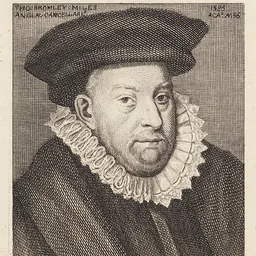
Sir Thomas Bromley, the famous uncle who became Lord Chancellor. Francis Bromley was the eldest son and heir to the estates of Sir George Bromley of Hallon, near Worfield, in Shropshire. Sir George was an important lawyer, who exercise great power and influence through his posts at with the Duchy of Lancaster and the Council in the Marches of Wales and as chief justice of Chester. Joan Waverton, the daughter and heiress of John Waverton or Wannerton of Worfield. George Bromley acquired Hallon (also rendered "Hawne") through a strategic marriage and made it his seat his stated age of 19 helps determine his date of birth as around 1556.
Bromley was admitted to the Inner Temple by special dispensation of its parliament on 28 April 1577. His father, George, and his uncle Thomas were both among the presiding benchers at the parliament and, although the terms are not stated, it is likely he was admitted gratis or at a reduced fee in deference to his father's distinction. His brother Edward was also the subject of a special admission in 1580. While Edward went on to some eminence in the profession, Francis is not mentioned again by name in the records, so it is likely his studies were intended to give him the legal foundation useful to his future position as a significant landowner in Shropshire. He was appointed a Justice of the Peace in 1583.
Member of Parliament Francis Bromley was elected knight of the shire for Shropshire in November 1584. The county seats were never contested and almost always taken by members of the local landed gentry, many of them members of or associated with the Council in the Marches, an arm of central government which dominated the West Midlands. As Sir George Bromley was very influential in the council, and his family were among the foremost gentry families in a gentry-dominated county, he would have had little difficulty inserting his son into a county seat. Francis took the second seat, deferring in order of precedence to Walter Leveson of Lilleshall Abbey.
The parliament assembled on 23 November and lasted for about ten months. Bromley played only a small part. He was appointed to the subsidy committee, reviewing the queen's main channel of taxation, in February 1585. However, in March he was given leave to return to Shropshire for the assizes.
Landowner
Sir George Bromley died on 2 March 1589 and elsewhere, although this is a misunderstanding of the name. Joyce Leighton was the daughter of: Edward Leighton of Wattlesborough. Anne Darrell, daughter of Paul Darrell of Lillingstone Dayrell, Buckinghamshire. This was a marriage of equals, with both partners coming from the dominant group of county gentry families. Edward Leighton was a powerful force politically in Shropshire during the 1580s. He was a member of the Council in the Marches and became custos rotulorum of his county in 1587.
Effigies of Edward Bromley and Margaret Lowe, his wife, in Worfield parish church. Edward, Francis's younger brother, inherited the Bromley properties in 1610 on the death, sine prole, of Francis's son, Thomas. Francis Bromley and Joyce Leighton had two children: Jane Bromley, who married William Davenport. Hallon became the focus of a bitter legal wrangle, lasting over several decades, the origin of which is recounted by Randall, the historian of Worfield, with some apologies for straying into the "region of tradition, but tradition fortified by facts." Joyce Leighton remarried after the death of Francis Bromley, becoming the second wife of Walter Wrottesley of Wrottesley Park, near Tettenhall: a remarriage mentioned by the Visitation of Shropshire William Davenport and Jane Bromley allegedly eloped after a secret and forbidden courtship in the grounds of Wrottesley. Subsequently, they put forward a claim to Hallon, which Edward Bromley had assumed was his. The family dispute was ultimately to be resolved in the Davenports' favour, with Hallon becoming Davenport House.
Family tree
Don’t just read it —
keep it.
Full-length biographies made to live with: read them, listen on the way to work, watch them tonight.
- E-book
- Audio
- Video
Instant download · yours to keep · every purchase keeps this site free
Important facts
People in Francis Bromley's life
Named in this biography and alive at the same time



Related people
Same field, nearest in time


Contemporaries
People whose lives overlapped Francis Bromley's



Frequently asked questions
Who was Francis Bromley?
English politician
When was Francis Bromley born?
Francis Bromley was born in 1550.
When did Francis Bromley die?
Francis Bromley died in 1591.
What was Francis Bromley's occupation?
Francis Bromley was a politician.
What nationality was Francis Bromley?
Francis Bromley was English.
Sources & further reading
Cite this page
APA: Biography.guide. (2026). Francis Bromley. https://biography.guide/francis-bromley/
MLA: "Francis Bromley." Biography.guide, https://biography.guide/francis-bromley/.
Chicago: "Francis Bromley." Biography.guide. https://biography.guide/francis-bromley/.
Data last updated: 2026-09-20 · Spot an error? Report a correction.
Page generated 2026-09-27 05:15 UTC