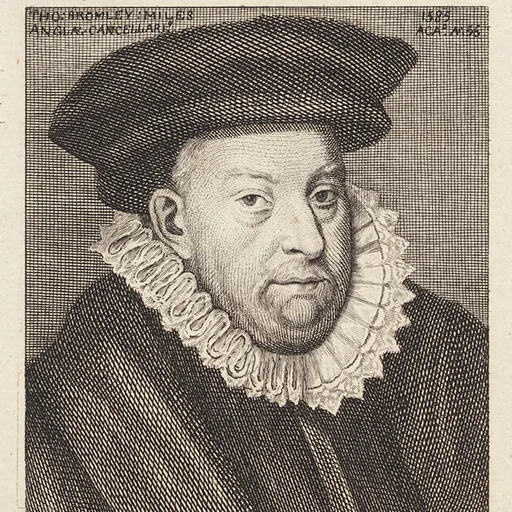
About Thomas Bromley
Lived 1530 – 1587 (aged 56–57). Thomas Bromley was a judge and politician.
Sir Thomas Bromley (153011 April 1587) was a 16th-century lawyer, judge and politician who established himself in the mid-Tudor period and rose to prominence during the reign of Elizabeth I. He was successively Solicitor General and Lord Chancellor of England. He presided over the trial of Mary, Queen of Scots and died three months after her execution.
Background Thomas Bromley was born around 1530. He was the second son of George Bromley of Hodnet, close to Market Drayton in Shropshire, the son of William Bromley of Mitley and Beatrix Hill. Jane Lacon, daughter of Sir Thomas Lacon of Willey, Shropshire.
The Bromleys originated in Staffordshire, but had acquired estates in neighbouring counties. They were of the middling landed gentry, like their allies and neighbours the Hills: the two families were to prosper together by seeking new sources of income, the Hills from commerce and the Bromleys through the law. George Bromley was a prominent member of the Inner Temple, serving as Autumn Reader for 1508 and Lent Reader for 1509, although he refused the honour for Lent 1515. Another Thomas Bromley, George's younger cousin,
Family tree: the Bromley dynasty
The family tree illustrates Thomas Bromley's relationship to the rest of the Bromley dynasty and to their main allies, the Hill, Corbet and Newport families.
Based primarily on the Heraldic Visitations of Shropshire and Cheshire, with assistance from the History of Parliament Online.
Legal education and academic career Both Thomas Bromley and his elder brother, George, were trained in law and called to the bar at the Inner Temple. By 1555, Thomas had gained some trust and prestige at his Inn of Court and was appointed as one of the auditors of the steward. In that year his namesake, the chief justice, died, bequeathing the young Thomas an allowance of 40 shillings a year for ten years, on condition he continue his legal studies. This he clearly did, as he received the degree of Bachelor of Civil Law from Oxford University in 1560 He also rose at his Inn: by February 1563 he was a member of the parliament of the Inner Temple, like his brother George. In 1565 he was appointed attendant on the Reader for the first time, accompanying Richard Onslow, a contemporary from Shropshire who often officiated with him.
Bromley is variously stated to have been Reader at the Inner temple in 1566 for Lent, ODNB states that he served in the autumn and lectured on the Statutes of Attaints. He is listed as a double reader, along with his brother George, in a state paper, probably from about 1579. In 1567 the parliament of the Inn had to rectify a number of anomalies relating to chambers held by Onslow, Bromley and Gawdy, making clear that Bromley had been admitting trainee lawyers of his own for some years, even before he became a bencher. On 25 October 1573 Bromley was chosen to be Lent Reader for the following year but the honour was deferred until 1575 because of the pressure of parliamentary business, with Edmund Anderson standing in for him.
A week later Bromley was elected Treasurer of the Inner Temple, with power to choose his own assistants. He seems to have taken his post very seriously, and apparently found the Inn's finances in crisis. On 19 November a levy was imposed on all members clear immediate debts, graded according to status, with Bromley and his fellow-benchers paying 13s. 4d. While junior barristers paid 6s. 8d. It was not enough, and in January 1574 the parliament noted that the House at this present is greatly indebted and far behindhand, by reason whereof it is the worse served both of bread, drink, meat, and divers other things, for that the creditors are not in any reasonable and convenient time paid such sums of money as are due unto them for their wares. A butler was deputed to persecute members for their outstanding fees, on pain of physical exclusion from the premises, and a few months later, pleading inflation of food prices, the members were made chargeable for their actual consumption. Bromley continued in office the following year, listed as appearing at the parliament as treasurer. Financial reform continued, with the cook made chargeable for future losses of pewter dishes – a major expense in the past. Bromley's appointment for a third term was noted in November 1575.
Member of Parliament Bromley sat as a member of the Parliament of England three times, all fairly early in his career, before he achieved major promotion as a judge. His mother's family had numerous links in the Bridgnorth area. The High Sheriff of Shropshire had a considerable say in elections, and in that year was Richard Newport, son-in-law of the chief justice Thomas Bromley and another Inner Templar. The town's elector's, a council of 14 aldermen and bailiffs, had a predilection for lawyers. Their other choice was John Broke, a young Middle Templar and the son of the Shropshire jurist Robert Broke. However, the election seems to have been delayed, perhaps for want of nominations, until 18 January, only two days before the opening of parliament.
In 1559 Bromley was returned to parliament by Wigan. This was dominated by the Duchy of Lancaster and the Earl of Derby. Although it is not known precisely how Bromley obtained the seat, the duchy too had a preference for lawyers. It generally secured the return of a member of the Gerard family, another gentry-lawyer dynasty, and Bromley's colleague on this occasion was William Gerard.
It is much clearer how Bromley came to be MP for Guildford in the parliament which assembled in January 1563. The seat was in the gift of Henry FitzAlan, 19th Earl of Arundel, a Shropshire landowner and the high steward of the borough, who was a friend and patron of Bromley. Richard Onslow had been recorder since 1563, succeeding Ralph Cholmley, who had died in office. Thus Bromley was now put forward as MP by two constituencies. However, parliament resolved the contradiction by deciding he should continue to represent Guildford. The London aldermen were forced to hold a by-election and chose Sir John White, a successful merchant in the trade with Spain. Bromley served in 1566 on a committee concerned with legal issues and another on the succession to the throne.
Legal and judicial career
Legal practice Through family influence as well as the patronage of Sir Nicholas Bacon, the lord keeper, he quickly made progress in his profession. Alongside public appointments, Bromley built up a substantial practice in both the Queen's Bench, the senior common law court, and Chancery, the principal court of equity. Bertie, acting also on behalf of his wife, sued Herenden for breach of trust. While common law viewed the estates as clearly transferred to Herenden in fee simple, Nicholas Bacon and the Court of Chancery decreed otherwise, cancelling the lease and ordering Herenden to hand over the property. However, Bertie still had to get an act passed by parliament in 1563 to get the lands actually restored to him and his wife. It was generally believed that Bromley only took on cases when he was personally convinced of their justice, and this may account for his remarkable record of never losing in five years.
Recorder of London In 1566 Bromley was appointed recorder of the City of London in succession to Richard Onslow, who had become Solicitor General. Broke and Onslow, like other London recorders, had represented the city as MPs, but Parliament ordered Bromley to continue as MP for Guilford, as noted above.
Solicitor General On 14 March 1569 After evidence had been given about the proposed marriage between Norfolk and Mary, Queen of Scots, Bromley's focus was on the communications between Ridolfi and Norfolk. As Norfolk himself argued, there was no evidence that he had ever received the letter, much less that he approved its contents. Bromley was forced to resort to hearsay evidence: that a foreign ambassador in Flanders had heard about the plot and one of his servants had mentioned it to an unnamed English government minister. None of the links in this chain of intelligence gathering was available to give evidence or face questioning but Bromley's allegations were accepted as having explicit royal warrant.
The following year Bromley was one of those sent to Sheffield to lay charges before Mary, Queen of Scots, Bromley rehearsed the history of the recent plots and her alleged part in them, but to no avail. In 1574 he was one of the arbitrators appointed to resolve a dispute between the city of Oxford and the university. Bacon had been Lord Keeper of the Great Seal and, on investiture, had been given all the powers of a Lord Chancellor, but never the office itself, probably because of his relatively humble origins. He was senior to Bromley in every way: a distinguished and highly respected lawyer of great experience. However, Campbell states that he was "awkward and ungainly in his speech and manner, and not considered fit for such a place of representation and dignity." Although very reliable, Gerard was known to be on good terms with recusants in his native Lancashire and his wife and daughters were Catholics. Bromley seems to have been entirely untroubled by ideological and theological concerns and was certainly happy to ally himself with the more radically Protestant grouping around Leicester. who had the ear of the queen. Bernardino de Mendoza, the Spanish ambassador reported home that Leicester and Hatton had recommended Bromley, hoping to use him as a supporter of the proposed marriage of the queen to Francis, Duke of Anjou, When he murdered a retainer of Edward de Vere, 17th Earl of Oxford,
Political and constitutional issues Francis, Duke of Anjou, the principal French suitor of Elizabeth I. Bromley and the Leicester faction at first supported him as tolerant of Huguenots and later opposed him as a potential Catholic king of England. Bromley was called upon to settle a number of important parliamentary matters. In 1581, Richard Broughton, one of the members for Stafford, informed Parliament that his colleague, probably Thomas Purslow, had been indicted for a felony. Bromley wrote to the Commons, claiming that he had been pressured to issue a writ for a by-election. Bromley Informed the House of Lords and it was decided to send a deputation from the two Houses to see the queen. Bromley was then instructed to tell the Commons to elect a new Speaker for themselves, with the admonition that they were not to "intermeddle with any matter touching her Majesty's person or estate, or Church government." They elected Sir John Popham, but did not entirely heed Bromley's warning. In his closing speech Bromley excluded from the queen's thanks those MPs who "had dealt more rashly in some things than was fit for them to do so."
In 1582 the queen consulted Bromley about her proposed marriage to the Duke of Anjou, However, the Victoria County History asserts that his was a former monastic property, originally belonging to Great Malvern Priory, that the reversion had been held by John Lumley, 1st Baron Lumley and the transfer was to the Lord Chancellor's son, Sir Henry Bromley, although the date is given as 1586, within Thomas's lifetime. Though the details are hazy, it seems that the manor was intended by the queen as a reward for Thomas Bromley's loyal and competent service. The manor of Wick Episcopi, formerly an estate of the Bishop of Worcester, as the name suggests, certainly was granted to Thomas Bromley by the queen in 1586 and subsequently had a similar history. Holt, in the Malvern Hills, had a chequered history and the estate was divided. Bromley acquired part of it as a marriage settlement from Thomas Fortescue, his wife's brother, and part by direct purchase from Anthony Bourne, the son of John Bourne. A landowner in considerable hardship because of his violence, marital escapades and political unreliability, Bourne was compelled to sell several properties to Bromley. Sir Henry Bromley, the Lord Chancellor's son, completed the acquisition of Holt and it became the family seat. There were legal difficulties inherent in trying Mary before the House of Lords, as she was not an English peeress, and an ordinary criminal trial would lead to political difficulties abroad. Bromley announced at the opening a bill to provide for the trial of Mary, using a special court of at least 24 peers and privy counsellors. This soon passed into law.
In September 1586 Bromley was actively involved in the examination and trial of Anthony Babington and his associates, whose conspiracy had aimed to assassinate Elizabeth and to enthrone Mary, with her knowledge. The following month, after the execution of the plotters, Bromley moved to convene a court to try Mary herself.
Trial of Mary, Queen of Scots Contemporary drawing of the trial. Queen Elizabeth was represented by an empty throne. As Lord Chancellor, it was Bromley who presided over the court which tried Mary, Queen of Scots. It consisted of 36 of the 45 privy counsellors, judges and peers, who had been appointed to the commission and assembled on 11 November 1586 at Fotheringhay Castle, where Mary was imprisoned. She was brought before the court on 14 October but protested immunity from a foreign jurisdiction. Bromley read a passage from a letter of the queen, stating baldly that "as she lived under the protection of the Queen of England, she was bound to respect the law of England. Bromley maintained personal respect towards Mary throughout the trial Bromley's old associate from the Inner Temple and now Queen's Serjeant. Mary did not openly contest her knowledge of Babington's plot to set her free and even admitted countenancing a French invasion. However, she flatly denied any involvement in the plan to assassinate Elizabeth. After two days, the trial was adjourned to 25 October at the Star Chamber, where the guilty verdicts were delivered.
It was then Bromley's task to announce at the opening of Parliament That the present parliament was summoned for no usual causes; not for making new laws, whereof her Majesty thought there were more made than executed; nor for subsidies with which, although there was some occasion for them, her Majesty would not burden her faithful subjects at this time, but the cause was rare and extraordinary; of great weight, great peril, and dangerous consequence. He next declared what plots had been contrived of late, and how miraculously the merciful providence of God, by the discovery thereof, beyond all human policy, had preserved her Majesty, the destruction of whose sacred person was most traitorously imagined, and designed to be compassed. He then outlined the case to the House of Lords and both houses resolved to petition the queen for immediate execution. The address was delivered by Bromley and Elizabeth assented, although she did not actually sign the death warrant until 1 February 1587, after much hesitation. Bromley appended the Great Seal and the warrant was entrusted to William Davison. Even then it took a small secret Privy Council meeting under Burleigh to make the decision for action and Davison was held responsible by the queen.
Death Mary, queen of Scots, was executed at Fotheringhay on 7 February 1587. When Parliament assembled eight days later, Bromley was too ill to attend and his place was taken by Edmund Anderson. Foss gave no explanation of Bromley's death In the 17th century Sir Adrian was to be venerated as a Catholic martyr and he was beatified in 1895. However, the real reasons for his execution remain mysterious and it is not at all clear that he was a religious conservative: in fact, his earlier period in favour had been because of his kinship to Anne Boleyn but he seems to have been on poor terms with Thomas Cromwell. So he may have been attached to the attainder as an act of political or personal spite among Protestants.
Elizabeth Fortescue was one of the offspring of Sir Adrian's second marriage, to Anne Rede. One of her brothers was John Fortescue of Salden, who had been in Princess Elizabeth's service during the reign of her Catholic sister, Mary I, and proved a pillar of the Elizabethan regime and a persistent parliamentarian, later becoming Chancellor of the Exchequer. Her brother Anthony Fortescue, on the other hand, actually was a Catholic conspirator, closely involved with the Pole family. Another brother, Thomas, seems to have negotiated Elizabeth's marriage with Bromley, purchasing part of the manor of Holt from Anthony Bourne to settle on her in 1578. with assistance from the History of Parliament Online and Cokayne's Complete Baronetage.
Legacy His rule in Shelley's Case is a landmark in the history of English real property law.
Don’t just read it —
keep it.
Full-length biographies made to live with: read them, listen on the way to work, watch them tonight.
- E-book
- Audio
- Video
Instant download · yours to keep · every purchase keeps this site free
Important facts
People in Thomas Bromley's life
Named in this biography and alive at the same time





Related people
Same field, nearest in time

Contemporaries
People whose lives overlapped Thomas Bromley's
Frequently asked questions
Who was Thomas Bromley?
English lawyer and politician
When was Thomas Bromley born?
Thomas Bromley was born in 1530.
When did Thomas Bromley die?
Thomas Bromley died on 11 April 1587.
What was Thomas Bromley's occupation?
Thomas Bromley was a judge and politician.
Sources & further reading
Cite this page
APA: Biography.guide. (2026). Thomas Bromley. https://biography.guide/thomas-bromley-judge/
MLA: "Thomas Bromley." Biography.guide, https://biography.guide/thomas-bromley-judge/.
Chicago: "Thomas Bromley." Biography.guide. https://biography.guide/thomas-bromley-judge/.
Data last updated: 2026-09-22 · Spot an error? Report a correction.
Portrait: Wikimedia Commons · author & licence
Page generated 2026-09-27 05:02 UTC