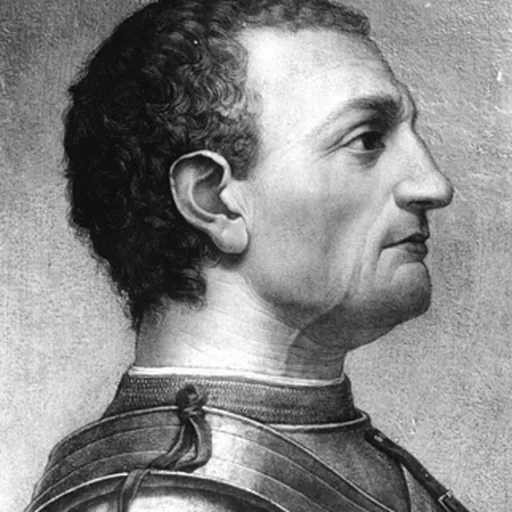
About Francesco Bonsignori
Lived 1460 – 1519 (aged 58–59). Francesco Bonsignori was an Italian painter.
Francesco Bonsignori (c. 1455 – July 2, 1519), also known as Francesco Monsignori, was an Italian painter and draughtsman, characterized by his excellence in religious subjects, portraits, architectural perspective and animals. He was born in Verona and died in Caldiero, a city near Verona. Bonsignori's style in early period was under the influence of his teacher Liberale da Verona. After becoming the portraitist and court artist to the Gonzaga family of Mantua in 1487, his style was influenced by Andrea Mantegna, who also worked for Francesco Gonzaga from the 1480s. They collaborated to execute several religious paintings, mainly with the theme of Madonna and Child. In childhood, Francesco was the most artistically talented of the Bonsignori children. His brothers, Bernardino (c.1476–1529) and Girolamo (c.1479 – unknown) also became painters. His younger brother Girolamo was highly appraised for his fine copy of Leonardo da Vinci’s Last Supper.
Apprenticeships and early career
Apprenticeship under Liberale da Verona Bonsignori was the pupil and apprentice of Liberale da Verona (1451–1536). Liberale da Verona was at first a miniaturist, who developed a larger style based on a following of Mantegna's work. There are Venetian influences observed in the coloring and background of his paintings. His appreciation of Francesco Squarcione, founder of the Paduan school and teacher of Andrea Mantegna, subsequently influenced Bonsignori’s early style and taste. Liberale da Verona was well-known for painting frescoes and altarpieces. Although he was renowned for his inventiveness and verve, his later works expose a shortage of consistent innovation and originality compared to his earlier period.
Early career Bonsignori’s early career is the most fully documented period of his life. Account of his early life is found in Giorgio Vasari’s book Lives of the Painters, Sculptors and Architects. Vasari includes the painter in a group of minor virtuosi from Verona. His pseudonym has appeared in several documentations from the Renaissance period, while he signed all his committed artwork with “Bonsignori”. Fewer than a dozen drawings attributed to Bonsginori during his early career have survived. Most paintings mentioned in Vasari's account have perished.
He often integrated subtle elements observed in nature and daily life into religious paintings. In 1483, he produced his first signed work, Virgin and Child (Castelvecchio, Verona). The style of this work is similar to that of Madonna with Saints (Gemäldegalerie, Berlin), produced by his teacher Liberale de Verona. Influenced by his teacher, Bonsignori produced several altarpieces from 1484 to 1492. He completed the Virgin and Child Enthroned with Saints (Castelvecchio, Verona) in 1484.
During Bonsignori's early career, he was inspired and influenced by different artists, including his early models Giovanni Bellini, Alvise Vivari, Antonello da Messina, and Andrea Mantegna. Integration of styles from different contemporary masters is notable in Bonsignori's early pieces, which were characterized by his concentration on human figures in devotional picture and portraits. Landscape and architectural settings in the background are often less significant in his paintings. Although derivative, Bonsignori's early style was recognizably his own.
Mantua period Bonsignori's middle career period began after he moved to Mantua in 1487. The Portrait of a Venetian Senator (National Gallery, London) was signed and dated in 1487. Successively, he produced several altarpieces depicting The Virgin and Child Enthroned with Music-making Angels and SS George and Jerome (Banda Chapel, S Bernardino, Verona) in 1488. The Virgin and Child Enthroned with SS Anthony of Egypt and Onofrio, signed and dated in 1488, is known only through a 19th-century copy preserved in Florence.
Bonsignori and the Gonzaga family
Francesco Bonsignori and his two brothers moved from Verona to Mantua in 1487. Francesco Bonsignori was employed by the Gonzaga family as a portrait painter and was in charge of decorations of their palace at Marmirolo and Gonzaga.
Bonsignori was already a master with a modest reputation when he came to Mantua and joined Mantegna's workshop in 1490. Between 1491 and 1492, Bonsignori worked as Mantegna's assistant at Marmirolo, Mantua. They collaborated on several works during this period. In 1491, The Napoleon Madonna – Madonna and Child (Philbrook Museum of Art) was painted by Mantegna with Bonsignori's assistance. The provenance of this painting can be traced to the collection of the Palais Royal in Paris. It was sold by Prince Jerome Napoleon is 1872, and was exhibited in Burlington House in 1880 and 1894. One of his pictures representing Saint Louis is preserved in the Brera at Milan. There are some perspective views in the refectory of the church of the Franciscans at Mantua, demonstrating that he was a master of that branch of art. thumb
Portrait of an Elderly Man Because Mantegna's Mantuan portraits significantly influenced Bonsignori's style, the attribution of the Portrait of an Elderly Man (National Gallery, London), produced by Bonsignori during his middle period, confused modern art historians until the 19th century. In the mid-19th century, the portrait was purchased by the Venetian collector Cesare Bernasconi. The Madonna and Child (Kaiser Friedrich Museum, Berlin) concentrates on human figures before a dark, neutral background featuring a garland of fruit. Contrarily, Napoleon Madonna gives an impression of freedom as there are abundant spaces on all four sides of the painting and landscape in the background. This sense of freedom and elegance of this composition is typical of Bonsignori's style, and also signifies Mantegna's change of style in his late career.
The Virgin and Child with Four Saints (The National Gallery, London) is the best-known of his works featuring Madonna and Child. It was painted between 1490 and 1510, during his undocumented period in Mantua. The saint on the left who is holding a book is Franciscan, while other three saints are not identifiable. According to Vasari, the appearance and position of the group of saints and child are derived from an engraving by Mantegna in reverse, except for the hand gestures of Madonna which is originally created by Bonsignori. The chalk drawing is a preparatory drawing used for the resultant painted piece. The identical details of pose and costume in both drawings prove that they were created by the same artist. The painting depicts her as a younger and prettier woman, with no trace of double-chin as in the chalk drawing. She holds herself upright, showing her elegance and pride as a noble woman. The spontaneity, fluency of lines and the presence of pentimento in her neck and face substantiate that the altarpiece is Bonsignori's original study. The art is beyond that of a venerated local saint, but an illustrative document of intricate female relationships organized around a body of that saint. The altarpiece can be described as a "city of women". In it are lifelong friends bounded by mutual devotion, private worries and popular piety, a mother and daughter, and a daughter with her monastic sisters. Today, the civic museum that occupies the former Gonzaga palace of San Sebastiano houses the painting, yet it was once found in the female Dominican monastery of San Vincenzo. Like so many monasteries of the early period, the monastery was suppressed and later fell into disrepair during the Napoleonic era. Mantua, not unlike most Italian cities, has a modern fabric that is constructed on top of the armature of the medieval and Renaissance city. Some of the female monasteries that made up the city at the time the altarpiece was produced are still surviving until this date as more practical venues like schools or cultural centers. Yet, many others did not withstand the test of time.
Major works Bonsignori: The Lamentation with a Benedictine Donor. The Ashmolean Museum of Art and Archaeology. (Circa 1490) Profile of warrior - Walters Art Gallery, Baltimore
Christ bearing Cross, and Saint Veronica - Bargello Carrand Collection, Florence
Furniture panel: Apollo and Daphne - Berenson Collection, Florence
The lamentation with a Benedictine Donor - The Ashmolean Museum of Art and Archaeology, Oxford
Portrait of an elderly man - 1487, The National Gallery, London
Way to Golgotha.L. Visions of Blessed Osanna Andeasi, with Isabella d’Este - Palazzo Ducale, Mantua
Bust of elderly man - J.G. Johnson Collection, Philadelphia
Bust of youthful Savior - J.G. Johnson Collection, Philadelphia
Madonna and sleeping Child - 1483, Verona
Madonna and Child enthroned with SS. Onophrius, Jerome, Christopher, Bishop Saint and Altobella Avigadro, widow of Donato Dal Bovo - 1484, Museo di Castelvecchio, Verona
Two Angels holding curtain - S. Anastasia, over sacristy door, Verona
Madonna and Child enthroned with SS. Jerome and George - 1488, S. Bernardino, Cappella Dei Banda, Verona
Madonna and Child in Glory and SS. Blaise, Sebastian and Juliana - 1514–19, SS. Nazaro E Celso, Verona
Madonna and Child with SS. Anthony Abbot and Mary Magdalen - S. Paolo, First chapel R, Verona
Crucifixion - S. Lorenzo, fourth altar, R. transept, Vicenza
Predella: Two captive kings before a judge – York
Bust of Petrus Leonius – Homeless
Madonna and Child - 1491, The Samuel H. Kress Collection, Philbrook Museum of Art, Tulsa, OK
Head of female saint - Poldi-Pezzoli museum, Milan
Don’t just read it —
keep it.
Full-length biographies made to live with: read them, listen on the way to work, watch them tonight.
- E-book
- Audio
- Video
Instant download · yours to keep · every purchase keeps this site free
Important facts
People in Francesco Bonsignori's life
Named in this biography and alive at the same time

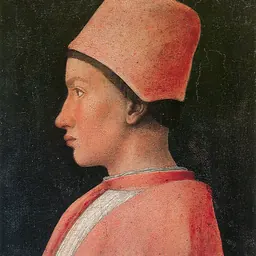
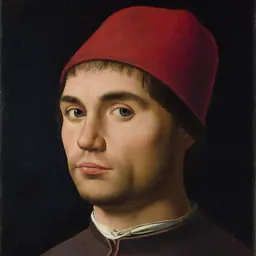
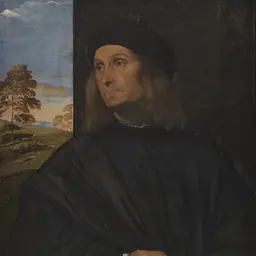

Related people
Same field, nearest in time
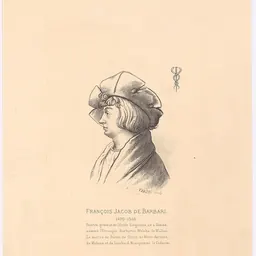


Contemporaries
People whose lives overlapped Francesco Bonsignori's

Frequently asked questions
Who was Francesco Bonsignori?
Italian painter (1460-1519)
When was Francesco Bonsignori born?
Francesco Bonsignori was born in 1460 in Verona.
When did Francesco Bonsignori die?
Francesco Bonsignori died on 2 July 1519 in Caldiero.
What was Francesco Bonsignori's occupation?
Francesco Bonsignori was a painter.
What nationality was Francesco Bonsignori?
Francesco Bonsignori was Italian.
Sources & further reading
· Wikipedia: Francesco Bonsignori
· DBpedia: Francesco Bonsignori
Cite this page
APA: Biography.guide. (2026). Francesco Bonsignori. https://biography.guide/francesco-bonsignori/
MLA: "Francesco Bonsignori." Biography.guide, https://biography.guide/francesco-bonsignori/.
Chicago: "Francesco Bonsignori." Biography.guide. https://biography.guide/francesco-bonsignori/.
Data last updated: 2026-09-20 · Spot an error? Report a correction.
Page generated 2026-09-27 05:10 UTC