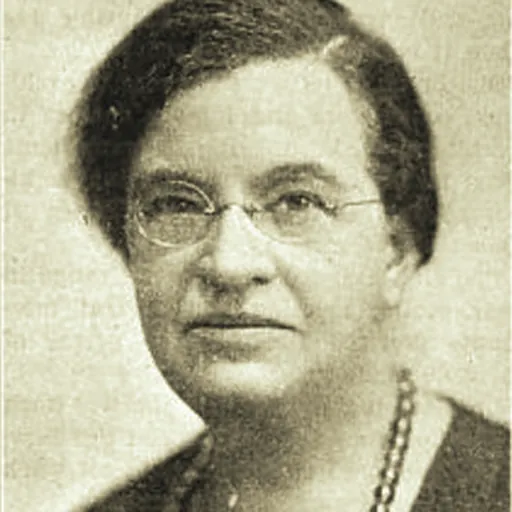
About Florence R. Sabin
Lived 1871 – 1953 (aged 81). Florence R. Sabin was an American physician, university teacher, scientist and anatomist, known for Sabin Health Laws and Women in science.
Florence Rena Sabin (November 9, 1871 – October 3, 1953) was an American physician and medical scientist known for pioneering work on the development of the lymphatic system and for later transforming public health in Colorado. She was the first woman to hold a full professorship at the Johns Hopkins School of Medicine, the first woman elected to the National Academy of Sciences, and the first woman to head a department at the Rockefeller Institute for Medical Research. During retirement she led a public-health reform campaign in Colorado that produced the “Sabin Health Laws”; in 1951 she received the Albert Lasker Public Service Award for her public-health work.
Early life On November 9, 1871, Serena Sabin gave birth to her youngest daughter, Florence Rena Sabin, in Central City, Colorado. Florence's mother was a schoolteacher who later died from puerperal fever (sepsis) in 1878. Her father, George K. Sabin, was a mining engineer living and working on site with his family. Shortly after her mother's death, Florence and her sister (Mary) moved in with their Uncle Albert in Chicago before relocating to Vermont with their paternal grandparents.
Uncle Albert was a tremendous influence on Florence, and from her relationship with him, she developed a love of nature and a keen interest in books and music. The Sabin girls soon moved with their uncle to an old family farm in Vermont.
Florence became very interested in the life story of Levi Sabin, an ancestor who had graduated from medical school in 1798. Florence's father had always wanted to be a doctor, but the obligations of mining overwhelmed him, and his thoughts of a medical career slowly disappeared. But Florence began to secretly harbor her father's dream. In 1885 Florence enrolled at Vermont Academy (and graduated in 1889), where her scientific interests were finally allowed to develop.
Throughout her childhood Sabin had intentions of becoming a pianist. However, she was never notably talented musically, which led her to shift her focus during her time at Vermont Academy, Saxtons River, Vermont, to a future in science.
In 1896, Sabin enrolled at Johns Hopkins University School of Medicine as one of fourteen women in her class. The school opened in 1893 and was co-ed from the beginning because of an early donor's contingency which required the admittance of female students.
While at Hopkins, Sabin's observational skills and perseverance in the laboratory caught anatomist Franklin P. Mall's attention. Mall inspired Sabin by helping narrow her focus onto two projects well regarded by scientists and foundational to her future research and consequent legacy. The first project was to produce a three-dimensional model of a newborn baby's brain stem, which became the focus of the textbook An Atlas of the Medulla and Midbrain (1901). The second project involved the embryological development of the lymphatic system which asserted that the lymphatic system is formed from the embryo's blood vessels and not other tissues. Shortly thereafter, a Fellowship in the Department of Anatomy at Johns Hopkins was created for her.
Rockefeller Institute for Medical Research (1925-1938) In September 1925 she became head of the department of cellular studies at Rockefeller Institute for Medical Research in New York City. Her research focused on the lymphatic system, blood vessels and cells, and tuberculosis.
In 1925, she was voted into the National Academy of Sciences. She was the first woman to gain membership in this prestigious body and would remain the lone female member for the next 20 years.
In 1926, she joined the research committee of the National Tuberculosis Association. The committee's purpose was to consolidate all of the tuberculosis research taking place with the hope of controlling the disease proactively. While here, Sabin devoted her research to immune cells, monocytes in particular, which developed into other cells. Sabin spent her final years at the institute determining the effects imposed by foreign substances and their consequent formation of antibodies. In 1948 she became manager of health and charities for Denver, donating her salary over the next three years to medical research.
In 1951 Sabin retired for a second and final time, continuing to advocate for public health issues. Sabin's lifetime of service resulted in the building housing University of Colorado’s department of medicine being named the Florence R. Sabin Building for Research in Cellular Biology. In 1985, Sabin was inducted into the Colorado Women's Hall of Fame. In 2005, Johns Hopkins University honored Sabin's legacy by naming one of the four colleges of its medical school after her.
Research projects and papers In the Johns Hopkins Medical Institutes Archives, Sabin's collection of papers and medical records from 1903 - 1941 are stored; some are even released upon request. The Sophia Smith Collection at Smith College holds many of Dr. Sabin's papers. Other collections are located in the American Philosophical Society Library in Philadelphia, the medical school of the University of Colorado, Colorado State Historical Society's Division of Museums, Rockefeller Institute, and in the Alan Mason Chesney Papers at Johns Hopkins University.
Don’t just read it —
keep it.
Full-length biographies made to live with: read them, listen on the way to work, watch them tonight.
- E-book
- Audio
- Video
Instant download · yours to keep · every purchase keeps this site free
Important facts
People in Florence R. Sabin's life
Named in this biography and alive at the same time


Related people
Same field, nearest in time



Contemporaries
People whose lives overlapped Florence R. Sabin's



Frequently asked questions
Who was Florence R. Sabin?
American medical scientist (1871–1953)
When was Florence R. Sabin born?
Florence R. Sabin was born on 9 November 1871 in Central City.
When did Florence R. Sabin die?
Florence R. Sabin died on 3 October 1953 in Denver.
What was Florence R. Sabin's occupation?
Florence R. Sabin was a physician, university teacher, scientist and anatomist.
What was Florence R. Sabin known for?
Florence R. Sabin was known for Sabin Health Laws and Women in science.
What nationality was Florence R. Sabin?
Florence R. Sabin was American.
Sources & further reading
· Wikipedia: Florence R. Sabin
Cite this page
APA: Biography.guide. (2026). Florence R. Sabin. https://biography.guide/florence-r-sabin/
MLA: "Florence R. Sabin." Biography.guide, https://biography.guide/florence-r-sabin/.
Chicago: "Florence R. Sabin." Biography.guide. https://biography.guide/florence-r-sabin/.
Data last updated: 2026-09-22 · Spot an error? Report a correction.
Portrait: Wikimedia Commons · author & licence
Page generated 2026-09-27 05:03 UTC