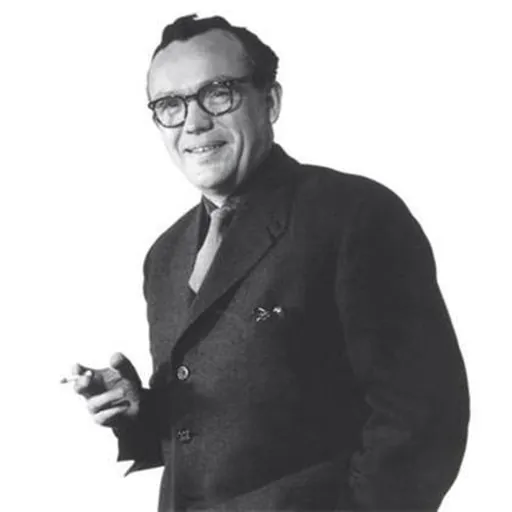
About Finn Juhl
Lived 1912 – 1989 (aged 77). Finn Juhl was a Danish designer, architect, furniture designer and university teacher.
Finn Juhl (30 January 1912 – 17 May 1989) was a Danish architect, interior and industrial designer, most known for his furniture design. He was one of the leading figures in the creation of Danish design in the 1940s and he was the designer who introduced Danish modern to America.
Biography Early life and education Finn Juhl was born on 30 January 1912 to an authoritarian father who was a textile wholesaler representing several English, Scottish and Swiss textile manufacturers in Denmark, and a mother who died shortly after he was born. From an early age he wanted to become an art historian, already as a teenager spending much time at the Statens Museum for Kunst and in spite of his young age receiving permission to borrow books at the Ny Carlsberg Glyptotek, but his father convinced him instead to pursue a career in architecture. He was admitted to the Architecture School at the Royal Danish Academy of Fine Arts where from 1930 to 1934 he studied under Kay Fisker, a leading architect of his day and noted lecturer.
Early career After graduating, Juhl worked for ten years at Vilhelm Lauritzen's architectural firm, where he had also apprenticed as a student. In close collaboration with Viggo Boesen, Juhl was responsible for much of the interior design of the national broadcaster Danmarks Radio's Radiohuset, one of the firm's most high-profile assignments during those years.
Juhl made his debut in 1937 when he commenced a collaboration with cabinetmaker Niels Vodder which would continue until 1959 and exhibited at the eleventh Copenhagen Cabinetmakers' Guild Exhibition. Therefore, his early chairs were originally produced in small numbers, eighty at most, because the Guild shows emphasized the work of the artisan over the burgeoning industry of mass production. However, they were almost all reissued later in his career.
He married Inge-Marie Skaarup on 15 July 1937 but they later divorced.
The Guild Exhibitions were an important venue for the young designers who sought to renew Danish design, turning their backs on the traditional historicist styles, heavy and with ornaments and plush, instead creating modern furniture which fitted the new trends in architecture. The projects was highly controversial and Juhl's first work met much criticism. His Pelican chair, designed in 1939 and first produced in 1940, was described as a "tired walrus" and "aesthetics in the worst possible sense of the word". In spite of the initial criticism, Juhl's work began to influence the style of homes abroad throughout the 1940s. In Denmark, however, his popularity did not reach that of his peers, Børge Mogensen and Hans Wegner, who were less radical in their designs and relied more on Kaare Klint, leader of the furniture school at the academy and the Nestor of modern Danish furniture design.
In 1951–52, he designed the Trusteeship Council Chamber in the Headquarters of the United Nations in New York City. The Government of Denmark contributed approximately $20,000 towards its construction.
At the Milan Triennial in the 1950s, he won a total of five gold medals, further adding to his international reputation. During this decade he continued to design more specifically for the mass market than had been the case in the 1940s.
From 1961, he lived in a common-law marriage with Hanne Wilhelm Hansen, a member of the family behind the Edition Wilhelm Hansen music-publishing house.
In his career, Juhl also designed refrigerators for General Electric, glassware, and ceramics.
In 1965, he was a visiting professor at the Institute of Design in Chicago. Onecollection has changed its brand name to 'House of Finn Juhl' and the company has a collection of more than 40 relaunched pieces of Juhl's designs. Hanne Wilhelm Hansen established the Finn Juhl Prize in 2003 to honor her partner's legacy. The prize is annually awarded to recipients who have made significant contributions in the field of furniture design. After Hansen's death in May 2003, their home, which she had left unchanged after his death, was made into a historic house museum, operated as part of the Ordrupgaard Art Museum whose premises it adjoins.
Style
Juhl gave a soft edge to the lines of wooden modernist chairs, favouring organic shapes which often took the wood to the limits of what was possible. He generally used teak and other dark woods, unlike many of the other proponents of the Danish Modern movement who often used oak in their designs.
He was influenced by the abstract sculptor Jean Arp, an influence which is seen already in his early Pelican chair but it remained a motif throughout his career. Also influenced by tribal art, Juhl exhibited the Chieftain chair with photos of weapons from anthropological studies.
One of his hallmarks was the floating back and seat which is seen in most of his chair designs, usually upholstered, in contrast to the hard wood of the bearing elements. The full back and seat, seeming to hover on their supports, start to emerge in the chairs from 1945 and 1948.
Selected works
Furniture
Interior designs His work also included numerous assignments within the field of interior design. Shortly after opening his own office, he received several commissions to do interior design at some of the premier addresses in Copenhagen, Bing & Grøndahl's shop on Amagertorv (1946), now housing Royal Copenhagen, and Svend Schaumann's florist's shop on Kongens Nytorv (1948). He also collaborated regularly with companies such as Georg Jensen and Scandinavian Airlines, his work for the latter including both ticket offices and aircraft interiors. He also had many assignments as an exhibition designer.
Buildings Finn Juhl's House, Klampenborg, Denmark (1942) Mrs Anthon Petersen's summer house in Asserbo, Halsnæs Municipality, Denmark, (1950) Single-family house for M. Aubertin, Nakskov, Denmark, (1952) Georg Jensen shop, Toronto, Ontario, Canada (1956) Summer house for Anders Hostrup-Pedersen (managing director of Georg Jensen), Rågeleje, Denmark (1962)
Awards and distinctions 1943 C. F. Hansen prize for young architects 1947 Eckersberg Medal, Denmark 1954 Honorary Diploma, Milan Triennial X, Italy 1957 three gold medals at the Milan Triennial XI 1960 Kaufmann International Design Award 1964 A.I.D. prize for design, Chicago 1978 Honorary Royal Designer for Industry, London Knight of the Order of Dannebrog, Copenhagen Best reisue/sofa design, 2010 Wallpaper Design Award
Don’t just read it —
keep it.
Full-length biographies made to live with: read them, listen on the way to work, watch them tonight.
- E-book
- Audio
- Video
Instant download · yours to keep · every purchase keeps this site free
Important facts
People in Finn Juhl's life
Named in this biography and alive at the same time





Related people
Same field, nearest in time


Contemporaries
People whose lives overlapped Finn Juhl's





Frequently asked questions
Who was Finn Juhl?
Danish architect and industrial designer (1912-1989)
When was Finn Juhl born?
Finn Juhl was born on 30 January 1912 in Copenhagen, Frederiksberg.
When did Finn Juhl die?
Finn Juhl died on 17 May 1989 in Copenhagen.
What was Finn Juhl's occupation?
Finn Juhl was a designer, architect, furniture designer and university teacher.
What nationality was Finn Juhl?
Finn Juhl was Danish.
Sources & further reading
Cite this page
APA: Biography.guide. (2026). Finn Juhl. https://biography.guide/finn-juhl/
MLA: "Finn Juhl." Biography.guide, https://biography.guide/finn-juhl/.
Chicago: "Finn Juhl." Biography.guide. https://biography.guide/finn-juhl/.
Data last updated: 2026-09-21 · Spot an error? Report a correction.
Portrait: Wikimedia Commons · author & licence
Page generated 2026-09-27 05:00 UTC