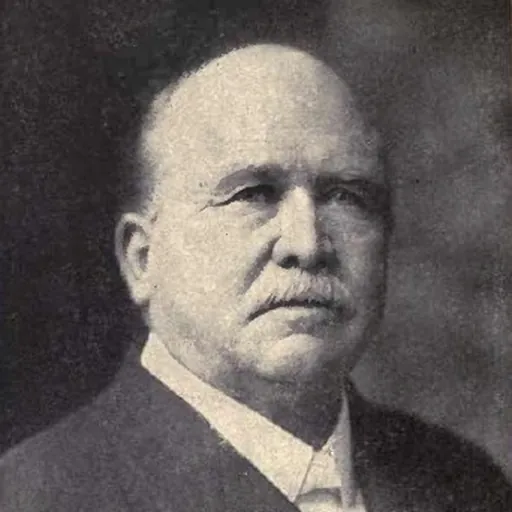
About Finis L. Bates
Lived 1848 – 1923 (aged 75). Finis L. Bates was an American lawyer.
Finis Langdon Bates (August 22, 1848 – November 29, 1923) was an American lawyer and author of The Escape and Suicide of John Wilkes Booth. In this 309-page book, Bates claimed that John Wilkes Booth, the assassin of U.S. president Abraham Lincoln, was not killed by Union Army Soldiers on April 26, 1865, but successfully eluded capture altogether, and lived for many years thereafter under a series of assumed names, notably John St. Helen and David E. George.
Personal life Bates was born on a plantation in Itawamba County, Mississippi, in 1848. He was the ninth of twelve children of planter Henderson Wesley Bates (1807–1869) and Eliza Elvira Jarratt Bourland (1815–1900). Finis Bates studied law in Carrollton, Mississippi, and in the 1870s he and his family moved to Texas, where he met John St. Helen. Bates returned to Mississippi, then moved to Memphis, Tennessee, after the death of his first wife and his subsequent marriage.
Family In 1869, Bates married Bertie Lee Money (born 1851). They had two daughters, Emma and Olga Bates, and a son, Bertram Money Bates Sr. (1870–1934), who married Anne H. "Annie" Koen. Following Bertie's death, in 1890 Finis married Madge Young Doyle (1869–1944), daughter of Washington Jackson Phepoe Doyle (1838–1907) and Minerva Hasbrook Selden (born 1851). Finis' youngest son by his second wife was Langdon Doyle Bates (1900–1989). Langdon D. Bates married Adrienne Marguerite Boutall in 1928 and they had a daughter named Beverly Anne Bates. The marriage ended in divorce and Langdon married Bertye Kathleen Talbert (1907–1997). They had a daughter named Kathleen Doyle "Kathy" Bates.
"Booth escaped" theory
John St. Helen According to The Escape and Suicide of John Wilkes Booth, in 1873, Bates met John St. Helen, a liquor and tobacco merchant in Granbury, Texas.
St. Helen later recovered and explained in greater detail:
The leader of the conspiracy to assassinate Lincoln was Vice-President Andrew Johnson. The identity of the man mortally wounded in the Garrett tobacco barn by Thomas H. "Boston" Corbett was a plantation overseer by the name of Ruddy. St. Helen/ Booth had asked Ruddy to fetch his papers, which had fallen out of his pocket while crossing the Rappahannock River. Ruddy was able to retrieve Booth's papers, and while still in possession of them, Ruddy was mortally wounded in the Garrett barn, thus leading his captors to believe that he was Booth.
Shortly thereafter, St. Helen moved on to Leadville, Colorado, to pursue mining, and Bates moved to Memphis, losing track of St. Helen.
Bates claimed not to have believed St. Helen's story at the time, calling it an "unpleasant side of St. Helen's character". Bates described him as "modest, unobtrusive and congenial, ever pleasant in association with me. He was a social favorite with all with whom he came in contact." Despite his claims of disbelief, in 1900, Bates wrote the War Department in an unsuccessful attempt to claim the $100,000 reward advertised following Lincoln's assassination.
David E. George
David E. Georgepossibly David Elihu George a house painter with an appetite for drink and a knack for quoting Shakespeare, committed suicide by ingesting poison on January 13, 1903, while staying at room number 4 in the Grand Avenue Hotel in Enid, Oklahoma. Shortly thereafter, store owner Eugene Watrous, unaware that his clerk had just sold George strychnine, provided additional strychnine to George "to poison a cat". By 10:30 a.m. that morning, other tenants complained of hearing groans and moans in George's locked room. They managed their way into George's room and found him writhing in pain. Despite the efforts of Dr. Champion, the local doctor, the poison had claimed him by 11a.m. that morning. came to view the body, and relayed a story to William H. Ryan, who was embalming the body. that he was John Wilkes Booth. Mrs. Kuhn had then dismissed the confessions as the product of drug-induced delirium. who hesitated to have him buried until the body could be claimed. On December 31, 1902, George had drawn up a will with local lawyer Niles Houston, and it was filed with Judge Milton C. Garber on January 16, 1903.
Other papers found on George requested Finis Bates to be summoned. On January 23, 1903, Bates identified the body as that of his old acquaintance John St. Helen. The body was shown at the 1904 St. Louis World's Fair, but was rejected by the 1933 Chicago World's Fair. In 1920, Bates tried to interest the automaker Henry Ford in buying it for $1,000, but Ford refused. In 1920, while traveling to San Diego, the mummy came out unscathed from a trainwreck, where eight of Evans' employees and many of his circus animals died. James Newton Wilkerson (May 11, 1866December 13, 1944)a Kansas City lawyer and expert on John Wilkes Boothexamined the mummy in 1928, comparing its scars to those of John Wilkes Booth, and began touring the Southwest with it, incorporating as the American Historical Research Society.
In 1932, Joseph "Barney" Harkin (18831943) of the Hagenbeck–Wallace Circus bought the mummy, then named "John" for $5,000.
The Escape and Suicide of John Wilkes Booth (1907)
In 1907, Finis L. Bates published The Escape and Suicide of John Wilkes Booth to support his claim that the mummy of George was, in fact, the corpse of Booth. The book was published as The Escape and Suicide of John Wilkes Booth with several variations of the following subtitle, The First True Account of Lincoln's Assassination, Containing a Complete Confession by Booth Many Years After the Crime, Giving in Full Detail the Plans, Plot and Intrigue of the Conspirators, and the Treachery of Andrew Johnson, then Vice-President of the United States. Written for the Correction of History.
Memphis publishers Pilcher Printing Company, Bates Publishing Company and Historical Publishing Company; J. L. Nichols & Company of Naperville, Illinois, Atlanta, Georgia; etc.; the Retail Druggist Journal of Detroit; and G. M. Smith of Boston all published various editions of Bates' book in 1907.
Bates, Henry Ford and Fred L. Black In order to understand how and why Henry Ford became involved with Finis L. Bates and the controversy over the alleged escape of John Wilkes Booth, it will be necessary to set forth here a little background information on some of Ford's activities in the 19161925 time period.
Ford v. The Chicago Daily Tribune
In May 1916, the Chicago Daily Tribune published an interview between journalist Charles Newton Wheeler and Henry Ford which contained Ford's now-famous statement:
History is more or less bunk. It's tradition. We don't want tradition. We want to live in the present and the only history that is worth a tinker's dam is the history we make today...
About a month later the Chicago Daily Tribune printed an editorial by Clifford Samuel Raymond who wrote:Inquiry at the Henry Ford offices in Detroit discloses the fact that employees of Ford who are members of or recruits in the National Guard will lose their places. No provision will be made for any one dependent upon them. Their wages will stop, their families may get along in any fashion possible; their positions will be filled, and if they come back safely and apply for their jobs again they will be on the same footing as any other applicants. This is the rule for Ford employees everywhere...
If Ford allows this rule of his shops to stand he will reveal himself not merely as an ignorant idealist but as an anarchistic enemy of the nation which protects him in his wealth... Originally this case was pending before U. S. District Judge Kenesaw Mountain Landis of Chicago, but Ford's legal counsel withdrew it from Landis' jurisdiction and filed a new libel suit against the Chicago Daily Tribune on July 14, 1917, in the State Court of Michigan at Detroit. However, the Chicago Daily Tribune applied for a change of venue on the grounds that too many people in Detroit worked for Ford, and it was agreed among all the parties concerned that Circuit Judge James G. Tucker of the Circuit Court of Macomb County at Mt. Clemens, Michigan, would hear the case instead. Jury selection for the trial began on May 12, 1919. The case dragged on for about three months, and the jury finally delivered its verdict on August 14, 1919, finding in favor of Ford and awarding him nominal damages of six cents.
During Ford's eight days on the witness stand he was asked to clarify the meaning of the statement he had made to Charles N. Wheeler that "History is more or less bunk." Ford's explanation to the court of what he had meant by this statement provoked extreme ridicule, not only from representatives of the Chicago Daily Tribune but from many observers of the trial proceedings worldwide. Ford became so annoyed over the public response to his explanation of his now-famous statement, that in September 1919 after his libel suit was finally over, he vowed to prove to the world it really is true that "History is more or less bunk."
Fred L. Black Bates' 1907 book on Booth had come to Ford's attention and in September 1919, Ford decided to vigorously explore the idea that if Bates' claims about John Wilkes Booth could be proven to be true by groundbreaking and exhaustive research, it would lend great credibility to his statement that "History is more or less bunk."
Ford instructed Frederick Lee Black (January 26, 1891November 7, 1971), business manager of The Dearborn Independent, to locate Finis L. Bates and to begin investigating the validity of the claims in Bates' book. Black did locate Bates and invited him to Dearborn to tell his story, whereupon Bates tried to interest Ford in buying Booth's alleged mummy from him. Between 1919 and 1923, Black, amidst his many other duties for Ford, conducted extensive research, not only into Bates' specific claims as presented in his 1907 book, but into many other controversial topics connected with the Lincoln assassination as well. However, Black at the end of his research concluded that many of Bates' claims were untrue, and advised Ford not to purchase the mummy. Black published some of his findings and conclusions in articles in The Dearborn Independent (primarily in the March, April, and May 1925 issues of the newspaper), and he also wrote a manuscript setting forth his research findings which was never published. An archive of the documents that Black collected and his manuscript are located in the Kresge Library at Oakland University in Michigan.
Death Bates died at his home at 1234 Harbert Street in Memphis, Tennessee, of "cardio-renal" failure on November 29, 1923, and is buried in Elmwood Cemetery in Memphis.
Don’t just read it —
keep it.
Full-length biographies made to live with: read them, listen on the way to work, watch them tonight.
- E-book
- Audio
- Video
Instant download · yours to keep · every purchase keeps this site free
Important facts
People in Finis L. Bates's life
Named in this biography and alive at the same time




Related people
Same field, nearest in time

Contemporaries
People whose lives overlapped Finis L. Bates's




Frequently asked questions
Who was Finis L. Bates?
American lawyer
When was Finis L. Bates born?
Finis L. Bates was born on 22 August 1848 in Itawamba County.
When did Finis L. Bates die?
Finis L. Bates died on 29 November 1923 in Memphis.
What was Finis L. Bates's occupation?
Finis L. Bates was a lawyer.
What nationality was Finis L. Bates?
Finis L. Bates was American.
Sources & further reading
Cite this page
APA: Biography.guide. (2026). Finis L. Bates. https://biography.guide/finis-l-bates/
MLA: "Finis L. Bates." Biography.guide, https://biography.guide/finis-l-bates/.
Chicago: "Finis L. Bates." Biography.guide. https://biography.guide/finis-l-bates/.
Data last updated: 2026-09-20 · Spot an error? Report a correction.
Portrait: Wikimedia Commons · author & licence
Page generated 2026-09-27 04:57 UTC