
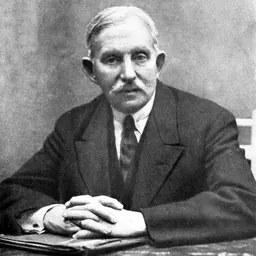
About Fernand Grenier
Lived 1901 – 1992 (aged 91). Fernand Grenier was a French politician.
Fernand Grenier (9 July 1901 – 12 August 1992) was a French communist politician.
Biography Fernand Grenier was born in to a working-class family. He spent his childhood in Tourcoing, where he obtained his school certificate. He then worked as a baker and later a municipal employee in the town of Halluin.
In the Third Republic Grenier joined the French Communist Party (PCF) shortly after the Tours Congress, in 1922, and became secretary of the Halluin section of the Jeunesse Communiste (JC). In November 1924 he trained at the “Leninist school” in Bobigny, together with Jacques Duclos, and stood out for his ability to write for union and political newspapers. Promoted to assume responsibilities in the Northern region of the PCF in 1926, he was sentenced to one year and then eight months in prison for "provoking soldiers to disobedience" following an article published in L'Avant-Garde, the newspaper of the JC.
Suspected of Trotskyism in 1930 because of his friendship with Albert Cornette, secretary of the Confédération générale du travail unitaire (CGTU), he lived a brief period of misfortune until 1932 when he resumed responsibilities in the North, then as a permanent member of the Central Committee, in Paris, where he was responsible for directing the Association of Friends of the Soviet Union (AUS), a position he held until 1939. In 1933 he spent a month in the USSR. In 1936, the association had 70,000 members and its magazine Russie d'aujourd'hui had a circulation of 130,000 copies.
In 1935, Grenier was responsible for the reconquest of the city of Saint-Denis, then in the Seine department, whose mayor, Jacques Doriot, had just been excluded from the Party. In the legislative elections of April–May 1936, Doriot was re-elected with a lead of 700 votes. After Doriot had resigned his mandate as deputy, Grenier stood in the partial legislative elections of August 1, 1937, and was elected deputy for Saint-Denis, defeating Doriot's replacement. In the Chamber of Deputies he was part of the Foreign Affairs Commission and the Final Accounts and Economy Commission.
After having had difficulties in resuming contact with the clandestine apparatus of the party, he was chosen to represent the Central Committee during the first contacts with the envoys of Free France. He then met Colonel Rémy on November 25, 1942, and with him arrived in England in January 1943 carrying a letter from the CC of the Communist Party and another from Charles Tillon, leader of the Francs-Tireurs et Partisans (FTPF). He spoke for the first time on the BBC on January 15, 1943. From then he represented the communists before the various successive bodies of Free France, but in September 1943 he could not accept a position as commissioner of the French Committee of National Liberation (CFLN) which was proposed by de Gaulle without the approval of Jacques Duclos, then the party's clandestine leader in occupied France. The Communist Party presented demands for the participation of communists in the provisional government. On April 4, 1944, a compromise was reached with the appointment of two communist commissioners, François Billoux as State Commissioner and Grenier as Air Commissioner.
Post-war and later career Grenier represented the PCF in the Provisional Consultative Assembly until October 1945, when he was re-elected deputy for the Sena in the Constituent Assembly, a deputy seat he held until 1968. He was part of the central committee of the PCF until May 1964. In September 1950, together with Denise Ginollin, he went to the Ministry of the Interior to inquire Eugène Thomas for clarification about the ban on certain books and magazines from the USSR as well as the newspaper of the Unified Socialists of Catalonia Lluita.
As a member of the National Committee Franco-USSR Association, Grenier remained pro-Soviet until the end of his life. He died in Saint-Denis and was buried at the Père-Lachaise Cemetery.
Don’t just read it —
keep it.
Full-length biographies made to live with: read them, listen on the way to work, watch them tonight.
- E-book
- Audio
- Video
Instant download · yours to keep · every purchase keeps this site free
Important facts
People in Fernand Grenier's life
Named in this biography and alive at the same time



Related people
Same field, nearest in time





Contemporaries
People whose lives overlapped Fernand Grenier's

Frequently asked questions
Who was Fernand Grenier?
French politician (1901-1992)
When was Fernand Grenier born?
Fernand Grenier was born on 9 July 1901 in Tourcoing.
When did Fernand Grenier die?
Fernand Grenier died on 12 August 1992 in Saint-Denis.
What was Fernand Grenier's occupation?
Fernand Grenier was a politician.
What nationality was Fernand Grenier?
Fernand Grenier was French.
Sources & further reading
· DBpedia: Fernand Grenier (French politician)
Cite this page
APA: Biography.guide. (2026). Fernand Grenier. https://biography.guide/fernand-grenier-politician/
MLA: "Fernand Grenier." Biography.guide, https://biography.guide/fernand-grenier-politician/.
Chicago: "Fernand Grenier." Biography.guide. https://biography.guide/fernand-grenier-politician/.
Data last updated: 2026-09-20 · Spot an error? Report a correction.
Page generated 2026-09-27 05:20 UTC