
About Ferenc Erkel
Lived 1810 – 1893 (aged 82). Ferenc Erkel was a Hungarian and Austrian conductor, composer, chess player, music educator and pianist.
Ferenc Erkel ( , ; November 7, 1810 – June 15, 1893) was a Hungarian composer, conductor and pianist. He was the father of Hungarian grand opera, written mainly on historical themes, which are still often performed in Hungary. He also composed the music of "Himnusz", the national anthem of Hungary, which was adopted in 1844. He died in Budapest.
Statue of Ferenc Erkel at the Hungarian State Opera in Budapest by Alajos Stróbl.
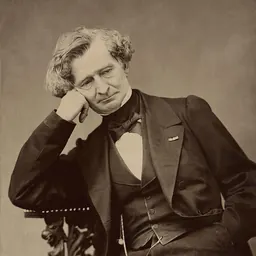
Biography Erkel was born in Gyula to an originally Danube Swabian Erkel family, a son of Joseph Erkel who was a musician. His mother was the Hungarian Klára Ruttkay. The libretti of his first three operas were written by Béni Egressy. Beside his operas, for which he is best known, he wrote pieces for piano and chorus, and a majestic Festival Overture. He acquainted Hector Berlioz with the tune of the Rákóczi March, which Berlioz used in The Damnation of Faust.
He headed the Budapest Philharmonic Orchestra (founded in 1853). He was also the director and piano teacher of the Hungarian Academy of Music until 1886. The Hungarian State Opera House in Budapest was opened in 1884, of which he was the musical director.
In 1839, he married Adél Adlers. Four of his sons participated in the composing of his later operas:Nyíregyháza (July 4, 1842, PestMarch 22, 1909, Újpest), Elek (November 2, 1843, PestJune 10, 1893, Budapest), László (April 9, 1844, PestDecember 3, 1896, Pozsony / Bratislava) and Sándor (January 2, 1846, PestOctober 14, 1900, Nyíregyháza).
In popular culture Erkel was an internationally acknowledged chess player as well, and a founder of Pesti Sakk-kör (Budapest Chess Club). A department of the Opera House was established in 1911 in Budapest which also performs operas, named Erkel Színház (Erkel Theatre) since 1953. He was commemorated on gold and silver coins issued by the Hungarian National Bank for the 200th anniversary of his birth.
Operas 200th Anniversary of birth of Ferenc Erkel, memorial coin, Hungarian National Bank, 2010, designer László Szlávics, Jr. Bátori Mária (1840, two acts; Mária Bátori is the lover of István, son of Coloman of Hungary) Hunyadi László (1844, four acts) Erzsébet (1857, three acts, only the second is by Erkel) Bánk bán (1861, three acts; Bánk bán is a palatine of Andrew II) – this opera is often thought of as the national opera of Hungary Sarolta (1862, three acts) Dózsa György (1867, five acts) Brankovics György (1874, four acts) Névtelen hősök (1880, "Nameless heroes", four acts) István király (1885, "King Stephen", four acts) Kemény Simon (remained in fragments; planned to be of three acts)
Chamber Music Duo brillant for Violin and Piano (1837) - ˙˙(Duo brillant en forme de Fantaisie sur des airs hongrois concertant pour piano et violon... par F. Erkel et H. Vieuxtemps.) IK.4. Verbunkos Fantasy for Viola and Piano (1890) IK. 47.
Don’t just read it —
keep it.
Full-length biographies made to live with: read them, listen on the way to work, watch them tonight.
- E-book
- Audio
- Video
Instant download · yours to keep · every purchase keeps this site free
Important facts
People in Ferenc Erkel's life
Named in this biography and alive at the same time

Related people
Same field, nearest in time




Contemporaries
People whose lives overlapped Ferenc Erkel's





Frequently asked questions
Who was Ferenc Erkel?
Hungarian composer, conductor and pianist (1810–1893)
When was Ferenc Erkel born?
Ferenc Erkel was born on 7 November 1810 in Gyula.
When did Ferenc Erkel die?
Ferenc Erkel died on 25 June 1893 in Budapest.
What was Ferenc Erkel's occupation?
Ferenc Erkel was a conductor, composer, chess player, music educator and pianist.
What nationality was Ferenc Erkel?
Ferenc Erkel was Hungarian and Austrian.
Sources & further reading
Cite this page
APA: Biography.guide. (2026). Ferenc Erkel. https://biography.guide/ferenc-erkel/
MLA: "Ferenc Erkel." Biography.guide, https://biography.guide/ferenc-erkel/.
Chicago: "Ferenc Erkel." Biography.guide. https://biography.guide/ferenc-erkel/.
Data last updated: 2026-09-20 · Spot an error? Report a correction.
Page generated 2026-09-27 05:20 UTC