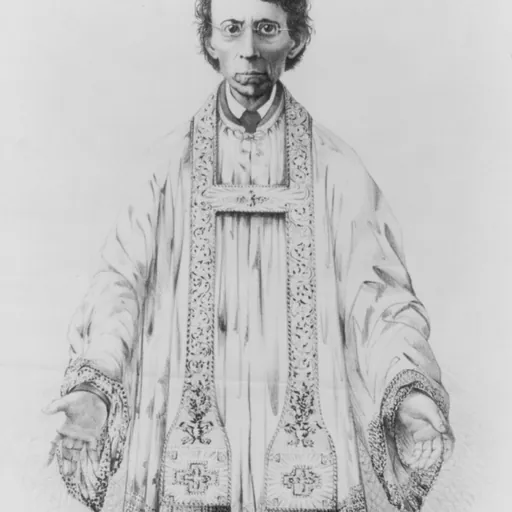
Félix Varela
Cuban Catholic priest and independence leader
About Félix Varela
Lived 1788 – 1853 (aged 64). Félix Varela was a Cuban and Spanish philosopher, politician, theologian and catholic priest.
Félix Varela y Morales (November 20, 1788 – February 18, 1853) was a Cuban Catholic priest and independence leader who is regarded as a notable figure in the Catholic Church in both his native Cuba and the United States, where he also served.
Life Varela was born in Havana, Cuba, then a captaincy of New Spain, and grew up in St. Augustine, Florida, the grandson of Lieutenant colonel Bartolomé Morales, the commander of military forces in Spanish Florida, who was stationed there and who helped to raise Felix after the death of his mother in childbirth. As a teenager, he refused his grandfather's offer to send him to a military academy in Spain, returning to Cuba, where he studied to become a priest at San Carlos and San Ambrosio Seminary in Havana, the only seminary in Cuba. He also studied at the University of Havana. At the age of 23, he was ordained in the Cathedral of Havana for the Diocese of San Cristóbal de la Habana.
Joining the seminary faculty within a year of his ordination, he taught philosophy, physics, and chemistry. In his position there, he taught many illustrious Cubans, including José Antonio Saco, Domingo del Monte, José de la Luz y Caballero, and Felipe Poey. Referring to Varela, De la Luz said: "As long as there is thought in Cuba, we will have to remember him, the one who taught us how to think." José Martí's teacher, , was also Varela's student. During this period, Varela established a literary society and published Miscelánea filosófica, a popular book on philosophy, before he was 30 years old. He published other newspapers in Spanish, including El Mensajero Semanal, and also in English The Protestant's Abridger and Annotator. He published many articles about human rights, as well as multiple essays on religious tolerance, cooperation between the English and Spanish-speaking communities, and the importance of education.
After spending some months studying English, he served as an assistant at St. Peter's Church on Barclay Street from 1825 to 1827. In 1827, Varela purchased a former Episcopalian church building on Ann Street named Christ Church, and founded a new Catholic parish bearing the same name. By 1833, the building was beginning to become unsafe to use, and Varela therefore purchased land on James Street for the construction of a new church that would be dedicated to St. James. However, some members of the congregation complained that James Street was too far from their former church, and so in 1836 Varela also purchased a former Presbyterian church on Chambers Street, which he renamed the Church of the Transfiguration, and he served as the pastor of the church on Chambers Street for his remaining time in New York. In 1853, several years after Varela had left New York for Florida, the parish moved again to a former Protestant church building on Mott Street in the Five Points neighborhood of Manhattan. The area later became known as Chinatown and the parish continues to serve a largely immigrant community as of 2017. It houses a memorial to Varela.
In 1837, Varela was named Vicar General of the Diocese of New York, which then covered all of New York State and the northern half of New Jersey. In this post, he played a significant role in how the American Church dealt with the tremendous influx of Irish refugees, which was beginning at the time. His desire to assist those in need, coupled with his gift for languages, allowed him to master the Irish language to communicate more efficiently with many recent Irish arrivals.
Varela served as a theological consultant to the committee of American bishops, which drew up the famous Baltimore Catechism, which began a standard teaching tool for Catholic children in the nation until the mid-20th century.
Cause for canonization Currently, Varela is being considered for canonization as a Catholic saint and was declared a Servant of God, recognizing his life as a devoted Catholic and a model for others in and out of the faith, and officially beginning the process.
On Easter Sunday, April 8, 2012, both the Archdiocese of New York and the Archdiocese of Miami (each having significant Catholic Cuban-American populations) announced that the Vatican's Sacred Congregation for the Causes of Saints had declared Varela "Venerable," meaning he lived a virtuous life within the Catholic faith to a heroic degree and as such is worthy of praise (veneration).
For him to be beatified, the next stage of the process since he is not a martyr, a miracle (officially deemed to be so from a neutral theological and scientific point of view) must be proved attributable to his direct intercession. The canonization will then follow if another such miracle is declared to have occurred after the first. If canonized, he would be the first Cuban-born person to be honored on the altars of the Catholic church.
On October 30, 2015, Cardinal Jaime Ortega, Archbishop of Havana, appointed Archbishop Vincenzo Paglia as Postulator in the process for Varela's beatification and canonization. Paglia is also President of the Holy See's Pontifical Council for the Family, and served as Postulator for the process of canonization of Óscar Romero, the martyred Archbishop of San Salvador, who was canonized in 2018.
Don’t just read it —
keep it.
Full-length biographies made to live with: read them, listen on the way to work, watch them tonight.
- E-book
- Audio
- Video
Instant download · yours to keep · every purchase keeps this site free
Important facts
People in Félix Varela's life
Named in this biography and alive at the same time


Related people
Same field, nearest in time




Contemporaries
People whose lives overlapped Félix Varela's


Frequently asked questions
Who was Félix Varela?
Cuban Catholic priest and independence leader
When was Félix Varela born?
Félix Varela was born on 20 November 1788 in Havana.
When did Félix Varela die?
Félix Varela died on 25 February 1853 in St. Augustine.
What was Félix Varela's occupation?
Félix Varela was a philosopher, politician, theologian and catholic priest.
What nationality was Félix Varela?
Félix Varela was Cuban and Spanish.
Sources & further reading
Cite this page
APA: Biography.guide. (2026). Félix Varela. https://biography.guide/felix-varela/
MLA: "Félix Varela." Biography.guide, https://biography.guide/felix-varela/.
Chicago: "Félix Varela." Biography.guide. https://biography.guide/felix-varela/.
Data last updated: 2026-09-23 · Spot an error? Report a correction.
Portrait: Wikimedia Commons · author & licence
Page generated 2026-09-27 05:06 UTC