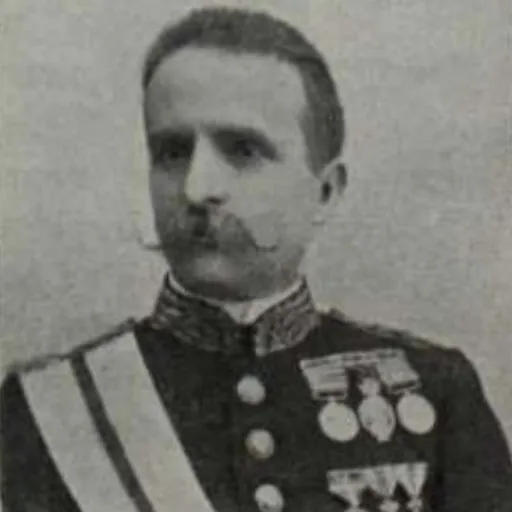
About Federico Ochando
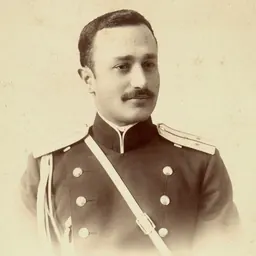
Lived 1848 – 1929 (aged 80). Federico Ochando was a Spanish military personnel and politician.
Federico Rodrigo Martín Sánchez Ochando y Chumillas (14 March 1848 – 2 February 1929) was a Spanish general and politician who served as the 110th Governor-General of the Philippines, Deputy and Senator of Albacete, and Vice President of the Senate of Spain. Ochando was an illustrious and decorated general with a prolific career in politics. As a deputy and a senator, infrastructure projects and improvement of the Spanish military were among his key programs. His brother, Andres Ochando y Chumillas, was a lawyer and would serve as Deputy of Casas-Ibáñez from 1893 to 1896. He married Maria Matilda Valera y Canada and they had a son, Roman Angel Emeterio Sanchez Ochando y Chumillas, who was born in 1867. His son would also serve as Deputy of Casas-Ibáñez from 1919 to 1920. In 1864, Ochando entered the Academia de Estado Mayor and was promoted as alférez in 1867. Two years later, he had the rank of staff lieutenant. He first saw action during the Third Carlist War, when he participated in military campaigns against Carlists in Barcelona, Sant Celoni, and Valencia. He then fought opponents of the Spanish Restoration, which placed Alfonso XII of Spain as king. His participation in the March to Cuba during the Ten Years' War earned him the rank of brigadier general in 1878.
Deputy and Governor In 1879, he was elected as Deputy of Casas-Ibáñez with 66% of the vote. In 1881, he was elected as deputy in the same district with 69% of the vote, performing better than his first election. Ochando would be one of the most notable personalities from the town of Casas-Ibáñez, who was also a leader of the Liberal Party during his political career. In 1886, he would serve as Deputy of Alcaraz, a town in the same province as Casas-Ibáñez. He was elected in the district with 100% of the vote. He was elected for the third time as Deputy of Casas-Ibáñez in 1891, but there was no record for his vote percentage. In 1893, he was elected for the second time as Deputy of Alcaraz, again with 100% of the vote. However, prior to taking his seat as deputy, he was appointed as the 110th Governor-General of the Philippines, replacing Eulogio Despujol y Dusay on 1 March 1893. The dismissal of Despujol was attributed to the new liberal government, with Práxedes Mateo Sagasta as Prime Minister of Spain. One of the notable acts of Ochando was the change of José Rizal's guard. On 16 May 1893, Ricardo Carnicero was replaced by Juan Sitges as district governor. There were rumors that Ochando gave orders to Sitges for tightening Rizal's security and to shoot the prisoner if he escaped. Soon enough, Ramón Blanco, 1st Marquess of Peña Plata assumed office as the new Governor-General of the Philippines in the same year.
Senator
After his return to Spain due to illness, he was appointed military governor of Madrid in 1894 and promoted to the rank of lieutenant general in 1895. The following year, he arrived in Cuba as Valeriano Weyler's chief of staff and participated in the Spanish campaign during the Cuban War of Independence. In 1897, he returned to Spain and was appointed Captain General of Aragon. In 1898, he was appointed Captain General of Andalusia. In the same year, he was appointed Inspector General of the Carabineros. and propose increasing the benefits for members of the armed forces. He requested the Spanish Council of State to report on the conflict between the Ministry of Justice and Ministry of War concerning the salary of a regional officer. He proposed to provide a pension for General Diego Ollero y Carmona's widow, Teresa Morales Guerrero Estrella, and General Francisco Rizzo y Ramirez's widow, Dolores Goñi y Zangroniz. He proposed the inclusion of the Bonete Road expansion in the general road plan of Spain. The Bonete Road runs from Albacete to Ayora. Ochando was known for his various infrastructure projects in his district during his service as deputy and senator. He requested the enforcement of the law concerning civilian destination of licensed members of the armed forces. Lastly, he requested financial assistance for the youth to enter military academies. During his entire career in the Senate, he served thrice as Vice President of the Senate of Spain (1901–1902, 1905–1907, 1910–1911).
Ochando's ancestry
Don’t just read it —
keep it.
Full-length biographies made to live with: read them, listen on the way to work, watch them tonight.
- E-book
- Audio
- Video
Instant download · yours to keep · every purchase keeps this site free
Important facts
People in Federico Ochando's life
Named in this biography and alive at the same time




Related people
Same field, nearest in time


Contemporaries
People whose lives overlapped Federico Ochando's





Frequently asked questions
Who was Federico Ochando?
Knowledge (1848–1929)
When was Federico Ochando born?
Federico Ochando was born on 14 March 1848 in Escairon.
When did Federico Ochando die?
Federico Ochando died on 2 February 1929 in Madrid.
What was Federico Ochando's occupation?
Federico Ochando was a military personnel and politician.
What nationality was Federico Ochando?
Federico Ochando was Spanish.
Sources & further reading
Cite this page
APA: Biography.guide. (2026). Federico Ochando. https://biography.guide/federico-ochando/
MLA: "Federico Ochando." Biography.guide, https://biography.guide/federico-ochando/.
Chicago: "Federico Ochando." Biography.guide. https://biography.guide/federico-ochando/.
Data last updated: 2026-09-23 · Spot an error? Report a correction.
Portrait: Wikimedia Commons · author & licence
Page generated 2026-09-27 05:07 UTC