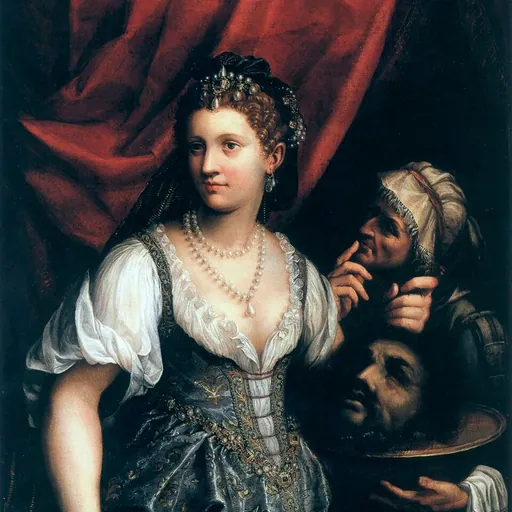
About Fede Galizia
Lived 1578 – 1630 (aged 51–52). Fede Galizia was an Italian painter and artist.
Fede Galizia ( 1578 – 1630) was an Italian painter of still-lifes, portraits, and religious pictures. She is especially noted as a painter of still-lifes of fruit, a genre in which she was one of the earliest practitioners in European art. She is perhaps not as well known as other female artists, such as Angelica Kauffman and Élisabeth Vigée Le Brun, because she did not have access to court-oriented or aristocratic social circles, nor had she sought the particular patronage of political rulers and noblemen. Her father, Nunzio Galizia, also a painter of miniatures, had moved to Milan from Trento. Fede (whose name means "faith") learned painting and likely also engraving from him. By the age of twelve, she was sufficiently accomplished as an artist to be mentioned by Gian Paolo Lomazzo, a painter and art theorist friend of her father, who wrote, "his girl dedicates herself to imitate the most extraordinary of our art." By her later teen years, she had established an international reputation as an artist.
At a young age, Galizia was already an established portrait painter handling many commissioned works. Her father may have been inspired to train his daughter by the example of Sofonisba Anguissola, who was from Cremona, around 50 miles from Milan. On June 21, 1630, she made her will, and is thought to have died of the plague in Milan shortly afterward.
Style
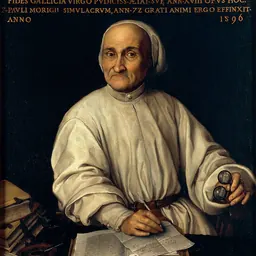
The style of her painting derived from the naturalistic traditions of the Renaissance in Italy, with a sharply realistic approach. Galizia's artistic skills are evident in her portrait of Paolo Morigia, General of the Jesuati, a scholar, writer and historian, and one of her earliest patrons and supporters. Her Portrait of Paolo Morigia (1596) depicts the subject writing a poem about the picture Galizia was painting. She received several public commissions for altarpieces in Milanese churches, including the Noli me tangere (1616; Milan, S. Stefano) made for the altar of Santa Maria Maddalena Church. However, her paintings were not given the recognition they deserved until well into the 20th century, when special attention was given to her work in studies made in 1963 and 1989.
Galizia’s paintings were deft with detail, perfectly balanced, and her attention to shadow, light, and texture was unrivalled at the time. She was particularly good at creating inviting spaces in her paintings. Her compositions are not crowded. They look as if one could reach out and touch the fruit, grasp it, and pull it from the painting without disturbing the rest of the work. Her graceful, flowing arrangements were natural and poetic.
Portrait of Paolo Morigia (1596) was painted when Galizia was only eighteen. Each detail of the figure is painted in analytic detail. Galizia employs mimesis (imitation of reality) in the depiction of Morigia’s glasses: the reflection of the lenses shows the room Morigia is sitting in, thus heightening the illusion of reality.
Galizia is recognized as a pioneer in the treatment of still-life in European painting. John and Mable Ringling Museum of Art. Judith and Holofernes, 1590s, SN684 Pinacoteca Ambrosiana, Milan. Portrait of Paolo Morigia, 1592–1595. Silvano Lodi Collection, Campione. White Ceramic Bowl with Peaches and Plum, ca. 1610. Muzeum Narodowe w Warszawie, Warsaw. Pedestal Plate with Southern Fruit, 1600-25.
Gallery
Don’t just read it —
keep it.
Full-length biographies made to live with: read them, listen on the way to work, watch them tonight.
- E-book
- Audio
- Video
Instant download · yours to keep · every purchase keeps this site free
Important facts
People in Fede Galizia's life
Named in this biography and alive at the same time

Related people
Same field, nearest in time


Contemporaries
People whose lives overlapped Fede Galizia's



Frequently asked questions
Who was Fede Galizia?
Italian painter (1574c-1630c)
When was Fede Galizia born?
Fede Galizia was born in 1578 in Milan, Trento.
When did Fede Galizia die?
Fede Galizia died in 1630 in Milan.
What was Fede Galizia's occupation?
Fede Galizia was a painter and artist.
What nationality was Fede Galizia?
Fede Galizia was Italian.
Sources & further reading
Cite this page
APA: Biography.guide. (2026). Fede Galizia. https://biography.guide/fede-galizia/
MLA: "Fede Galizia." Biography.guide, https://biography.guide/fede-galizia/.
Chicago: "Fede Galizia." Biography.guide. https://biography.guide/fede-galizia/.
Data last updated: 2026-09-22 · Spot an error? Report a correction.
Portrait: Wikimedia Commons · author & licence
Page generated 2026-09-27 05:03 UTC