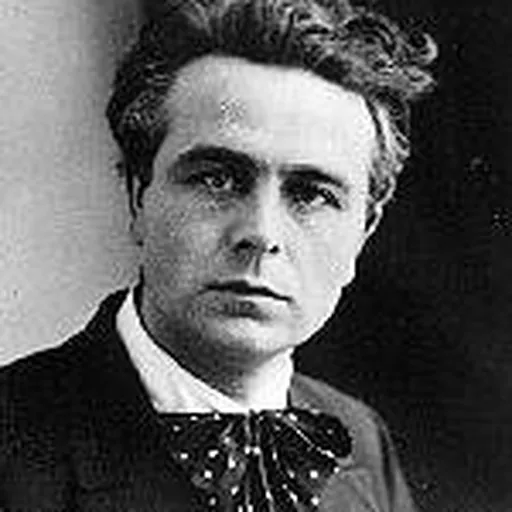
Fedde Schurer
Dutch schoolteacher, journalist, language activist, politician and poet
About Fedde Schurer
Lived 1898 – 1968 (aged 69). Fedde Schurer was a Dutch playwright, teacher, politician, translator, autobiographer and journalist.
Life and career Early life From 1904 on, Schurer grew up in the Frisian fishing village of Lemmer, and from a young age worked as a carpenter. Through self-education in the evenings he studied to become a schoolteacher, and in 1919, he was appointed in that position to the local Christian elementary school in Lemmer. Schurer and Willy were married on 1 July 1924. Schurer joined the Christian-Democratic Union (CDU), a Christian-socialist splinter party, and in 1935–1936 he served as a member of the provincial assembly of North Holland for a year.
Kneppelfreed After the war, Schurer returned to Friesland, where he lived in Heerenveen, and worked as a journalist. Like most people from Friesland, he was a native West Frisian speaker, and from a young age he had been an ardent supporter of his mother tongue. In 1950 and 1951, in several court cases in Friesland the judge denied the defendants the right to speak Frisian, Schurer wrote a sharply worded editorial rebuke in the Heerenveensche Koerier newspaper. The Honourable Sacco Richard Wolthers had said during the court session of 17 October 1951, "Officieel versta ik u niet" (Officially I can't understand you). In a follow-up piece the next day, Schurer lectured the judge on a defendant's rights, and called Mr. Wolthers' behavior childish, offensive and harassing. He was then charged with slandering the judge, and had to appear in court on Friday, 16 November 1951, in the provincial capital of Leeuwarden, together with another journalist, Tsjebbe de Jong, of the Bolswarder Nieuwsblad who used the term "nazi methods" in his column about the case.
On the Zaailand square, in front of the Leeuwarden Palace of Justice, a large crowd gathered that day. There were some supporters of Schurer (among them renowned Frisian authors like Douwe Tamminga, Anne Wadman and Eeltsje Boates Folkertsma), some Frisian nationalists, members of the Frisian-language press (who were not allowed in the court-room) and a group of students carrying placards, but it happened to be market day that day, and a lot of the people there were simply market goers who came over to see what all the fuss was about. Through inept crowd control by the police the situation got completely out of hand and turned into a riot in which the police used excessive force
Something like this was unheard of in sleepy Dutch post-war society, and the event triggered angry protest meetings throughout Friesland. The story even made headlines in the foreign press, and questions were raised in the Tweede Kamer, the Dutch lower house of parliament. Under pressure to resolve the situation, the national government in The Hague sent a committee consisting of three ministers to Friesland to confer with the Frisian leaders, which eventually led to changes in the national laws (in 1955 and 1956), making it possible for Frisians to speak their own language in the court of law and giving the Frisian language in the Province of Friesland the official status of tweede rijkstaal ("second national language"). Kneppelfreed is considered one of the most important milestones in the emancipation of the West Frisian language.
As for Schurer, he lost his case, and was sentenced to a conditional prison sentence of 14 days and a fine of ƒ150.- (€558.65 in 2018 ) Schurer appealed the sentence, but lost and was finally sentenced to 30 days conditional and a fine of ƒ150.-.
Later years Schurer served from 1956 to 1963 as a member of the Dutch national parliament for the Dutch Labour Party. Fedde Schurer died in Heerenveen, in 1968, and was survived by his wife and their adopted son Andries. In 2010, the first comprehensive biography on Schurer was published, titled Fedde Schurer (1898–1968): Biografie van een Friese Koerier, written in Dutch by Johanneke Liemburg, the mayor of Littenseradiel.
Don’t just read it —
keep it.
Full-length biographies made to live with: read them, listen on the way to work, watch them tonight.
- E-book
- Audio
- Video
Instant download · yours to keep · every purchase keeps this site free
Important facts
People in Fedde Schurer's life
Named in this biography and alive at the same time

Related people
Same field, nearest in time




Contemporaries
People whose lives overlapped Fedde Schurer's




Frequently asked questions
Who was Fedde Schurer?
Dutch schoolteacher, journalist, language activist, politician and poet (1898-1968)
When was Fedde Schurer born?
Fedde Schurer was born on 25 July 1898 in Drachten.
When did Fedde Schurer die?
Fedde Schurer died on 19 March 1968 in Heerenveen.
What was Fedde Schurer's occupation?
Fedde Schurer was a playwright, teacher, politician, translator, autobiographer and journalist.
What nationality was Fedde Schurer?
Fedde Schurer was Dutch.
Sources & further reading
Cite this page
APA: Biography.guide. (2026). Fedde Schurer. https://biography.guide/fedde-schurer/
MLA: "Fedde Schurer." Biography.guide, https://biography.guide/fedde-schurer/.
Chicago: "Fedde Schurer." Biography.guide. https://biography.guide/fedde-schurer/.
Data last updated: 2026-09-23 · Spot an error? Report a correction.
Portrait: Wikimedia Commons · author & licence
Page generated 2026-09-27 05:08 UTC