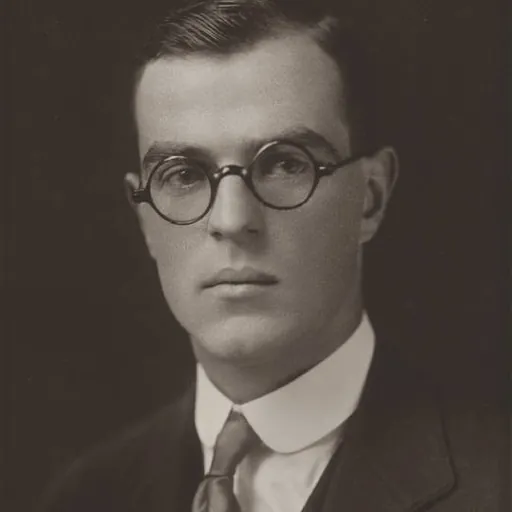
About Thornton Wilder
Lived 1897 – 1975 (aged 78). Thornton Wilder was an American playwright, novelist, screenwriter, writer and librettist.
Thornton Niven Wilder (April 17, 1897 – December 7, 1975) was an American playwright and novelist. He won three Pulitzer Prizes, for the novel The Bridge of San Luis Rey and for the plays Our Town and The Skin of Our Teeth, and a U.S. National Book Award for the novel The Eighth Day.
Early life and education
Wilder was born in Madison, Wisconsin, the son of Amos Parker Wilder, a newspaper editor and later a U.S. diplomat, and Isabella Thornton Niven.
Wilder had four siblings as well as a twin who was stillborn. All of the surviving Wilder children spent part of their childhood in China when their father was stationed in Hong Kong and Shanghai as U.S. Consul General. Thornton's older brother, Amos Niven Wilder, became Hollis Professor of Divinity at the Harvard Divinity School. He was a noted poet and was instrumental in developing the field of theopoetics. Their sister Isabel Wilder was an accomplished writer. They had two more sisters, Charlotte Wilder, a poet, and Janet Wilder Dakin, a zoologist.
Education
Wilder began writing plays while at the Thacher School in Ojai, California, where he did not fit in and was teased by classmates as overly intellectual. According to a classmate, "We left him alone, just left him alone. And he would retire at the library, his hideaway, learning to distance himself from humiliation and indifference." His family lived for a time in China, where his sister Janet was born in 1910. He attended the English China Inland Mission Chefoo School at Yantai, but returned with his mother and siblings to California in 1912 because of the unstable political conditions in China at the time. Thornton graduated from Berkeley High School in 1915.
Wilder served a three-month enlistment in the U.S. Army's Coast Artillery Corps at Fort Adams in Rhode Island during World War I, eventually rising to the rank of corporal. He attended Oberlin College before earning his Bachelor of Arts degree in 1920 at Yale University, where he refined his writing skills as a member of the Alpha Delta Phi fraternity, a literary society. He earned his Master of Arts degree in French literature from Princeton University in 1926.
Career
After graduating, Wilder went to Italy and studied archaeology and Italian (1920–21) as part of an eight-month residency at The American Academy in Rome, and then taught French at the Lawrenceville School in Lawrenceville, New Jersey, beginning in 1921. It was published by Longmans Green in 1933. In Chicago, he became famous as a lecturer and was chronicled on the celebrity pages. In 1938, he won the Pulitzer Prize for Drama for his play Our Town, and he won the prize again in 1943 for his play The Skin of Our Teeth.
World War II saw Wilder rise to the rank of lieutenant colonel in the U.S. Army Air Force Intelligence, first in Africa, then in Italy until 1945. He received several awards for his military service. He went on to be a visiting professor at Harvard University, where he served for a year as the Charles Eliot Norton professor. Though he considered himself a teacher first and a writer second, he continued to write all his life, receiving the Peace Prize of the German Book Trade in 1957 and the Presidential Medal of Freedom in 1963. In 1968 he won the National Book Award for his novel The Eighth Day. Wilder translated plays by André Obey and Jean-Paul Sartre. He wrote the libretti of two operas, The Long Christmas Dinner, composed by Paul Hindemith, and The Alcestiad, composed by Louise Talma and based on his own play. Alfred Hitchcock, whom he admired, asked him to write the screenplay of his thriller Shadow of a Doubt, and he completed a first draft for the film. Since then its popularity has grown enormously. The book is the progenitor of the modern disaster epic in literature and film-making, where a single disaster intertwines the victims, whose lives are then explored by means of flashbacks to events before the disaster.
Wilder wrote Our Town, a popular play (and later film) set in fictional Grover's Corners, New Hampshire. It was inspired in part by Dante's Purgatorio and in part by his friend Gertrude Stein's novel The Making of Americans. Wilder suffered from writer's block while writing the final act. Our Town employs a choric narrator called the Stage Manager and a minimalist set to underscore the human experience. Wilder himself played the Stage Manager on Broadway for two weeks and later in summer stock productions. Following the daily lives of the Gibbs and Webb families, as well as the other inhabitants of Grover's Corners, the play illustrates the importance of the universality of the simple, yet meaningful lives of all people in the world in order to demonstrate the value of appreciating life. The play won the 1938 Pulitzer Prize.
His play The Skin of Our Teeth opened in New York on November 18, 1942, featuring Fredric March and Tallulah Bankhead. Again, the themes are familiar – the timeless human condition; history as progressive, cyclical, or entropic; literature, philosophy, and religion as the touchstones of civilization. Three acts dramatize the travails of the Antrobus family, allegorizing the alternate history of mankind. It was claimed by Joseph Campbell and Henry Morton Robinson, authors of A Skeleton Key to Finnegans Wake, that much of the play was the result of unacknowledged borrowing from James Joyce's last work.
In his novel The Ides of March (1948), Wilder reconstructed the characters and events leading to, and culminating in, the assassination of Julius Caesar. He had met Jean-Paul Sartre on a U.S. lecture tour after the war, and was under the influence of existentialism, although rejecting its atheist implications.
In 1954, Tyrone Guthrie encouraged Wilder to rework The Merchant of Yonkers into The Matchmaker. This time the play opened in 1955 and enjoyed a healthy Broadway run of 486 performances with Ruth Gordon in the title role, winning a Tony Award for Guthrie, its director. It became the basis for the hit 1964 musical Hello, Dolly!, with a book by Michael Stewart and score by Jerry Herman.
In 1960, Wilder was awarded the first ever Edward MacDowell Medal by The MacDowell Colony for outstanding contributions to American culture.
In 1962 and 1963, Wilder lived for 20 months in the small town of Douglas, Arizona, apart from family and friends. There he started his longest novel, The Eighth Day, which went on to win the National Book Award.
His last novel, Theophilus North, was published in 1973, and made into the film Mr. North in 1988.
The Emporium is Thornton Wilder’s final, long-unfinished play, later completed by Kirk Lynn from more than 300 pages of archival drafts discovered at Yale. Premiering in 2024 at Alley Theatre in Houston and receiving an Off-Broadway run in 2026, the play follows John, an orphan who arrives in a vast, mysterious department store—the titular Emporium—that seems to contain everything yet offers no clear path to entry or belonging. Blending surreal, Kafka-esque elements with Wilder’s signature philosophical tone, the store becomes a metaphor for work, identity, longing, love, and the elusive search for meaning, with the audience often implicated as participants in this symbolic world.
The Library of America republished all of Wilder's plays in 2007, together with some of his writings on the theater and the screenplay of Shadow of a Doubt. In 2009, a second volume was released, containing his first five novels, six early stories, and four essays on fiction. Finally, the third and final volume in the Library of America series on Wilder was released in 2011, containing his last two novels The Eighth Day and Theophilus North, as well as four autobiographical sketches.
Personal life Six years after Wilder's death, Samuel Steward wrote in his autobiography that he had sexual relations with him. In 1937, Gertrude Stein had given Steward, then a college professor, a letter of introduction to Wilder. According to Steward, Alice B. Toklas told him that Wilder liked him and that Wilder had reported he was having trouble starting the third act of Our Town until he and Steward walked around Zürich all night in the rain and the next day wrote the whole act, opening with a crowd in a rainy cemetery. Penelope Niven disputes Steward's claim of a relationship with Wilder and, based on Wilder's correspondence, says Wilder worked on the third act of Our Town over the course of several months and completed it several months before he first met Steward. Robert Gottlieb, reviewing Penelope Niven's work in The New Yorker in 2013, claimed Wilder had become infatuated with a man, not identified by Gottlieb, and Wilder's feelings were not reciprocated. Gottlieb asserted that "Niven ties herself in knots in her discussion of Wilder's confusing sexuality" and that "His interest in women was unshakably nonsexual." He takes Steward's view that Wilder was a latent homosexual but never comfortable with sex.
Wilder had a wide circle of friends, including writers Ernest Hemingway, F. Scott Fitzgerald, Zelda Fitzgerald, Toklas, Jean-Paul Sartre, and Stein; actress Ruth Gordon; fighter Gene Tunney; and socialite Sibyl, Lady Colefax.
Works
Plays
The Trumpet Shall Sound (1926) The Angel That Troubled the Waters and Other Plays (1928): "Nascuntur Poetae" "Proserpina and the Devil" "Fanny Otcott" "Brother Fire" "The Penny That Beauty Spent" "The Angel on the Ship" "The Message and Jehanne" "Childe Roland to the Dark Tower Came" "Centaurs" "Leviathan" "And the Sea Shall Give Up Its Dead" "The Servant's Name Was Malchus" "Mozart and the Gray Steward" "Hast Thou Considered My Servant Job?" "The Flight Into Egypt" "The Angel That Troubled the Waters" The Long Christmas Dinner and Other Plays in One Act (1931): The Long Christmas Dinner Queens of France Pullman Car Hiawatha Love and How to Cure It Such Things Only Happen in Books The Happy Journey to Trenton and Camden Lucrece (1932) The Merchant of Yonkers (1938) The Skin of Our Teeth (1942)—won the Pulitzer Prize The Woman of Andros (1930)—based on Andria, a comedy by Terence Heaven's My Destination (1935) Ides of March (1948) The Eighth Day (1967)—won the National Book Award for Fiction Theophilus North (1973)—reprinted as Mr. North following the appearance of the film of the same name
Collections
Films Shadow of a Doubt (1943) - co-written by Wilder with Sally Benson and Alma Reville
Don’t just read it —
keep it.
Full-length biographies made to live with: read them, listen on the way to work, watch them tonight.
- E-book
- Audio
- Video
Instant download · yours to keep · every purchase keeps this site free
Important facts
People in Thornton Wilder's life
Named in this biography and alive at the same time




Related people
Same field, nearest in time




Contemporaries
People whose lives overlapped Thornton Wilder's


Frequently asked questions
Who was Thornton Wilder?
American playwright and novelist (1897–1975)
When was Thornton Wilder born?
Thornton Wilder was born on 17 April 1897 in Madison.
When did Thornton Wilder die?
Thornton Wilder died on 7 December 1975 in Hamden, New Haven.
What was Thornton Wilder's occupation?
Thornton Wilder was a playwright, novelist, screenwriter, writer and librettist.
What nationality was Thornton Wilder?
Thornton Wilder was American.
Sources & further reading
Cite this page
APA: Biography.guide. (2026). Thornton Wilder. https://biography.guide/thornton-wilder/
MLA: "Thornton Wilder." Biography.guide, https://biography.guide/thornton-wilder/.
Chicago: "Thornton Wilder." Biography.guide. https://biography.guide/thornton-wilder/.
Data last updated: 2026-09-20 · Spot an error? Report a correction.
Page generated 2026-09-27 05:10 UTC