
Fausta
Roman empress and second wife of Constantine I
About Fausta
Lived 289 – 326 (aged 36–37). Fausta was a Roman.
Flavia Maxima Fausta Augusta ( – 326 AD) was a Roman empress. She was the daughter of Maximian and second wife of Constantine the Great, who had her executed and excluded from all official accounts for unknown reasons. Historians Zosimus and Zonaras reported that she was executed for adultery with her stepson, Crispus.
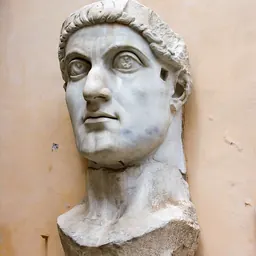
Family Fausta was the daughter of the emperor Maximian and his wife Eutropia. As her age is nowhere outright attested, scholarly estimates of her date of birth have ranged from 289/290 to the end of the 290s. To seal the alliance between them for control of the Tetrarchy, Maximian married her to Constantine I in 307.
Constantine at first tried to present Maximian's suicide as an unfortunate tragedy, but later started spreading another version where Fausta was involved in her father's downfall. Barnes observed that the story "shows clear signs of being invented during Constantine's war against Maxentius."
During her marriage, she had 5 children. Fausta held the title of nobilissima femina up until 324, when Constantine held her in high enough regard to grant her the title of augusta, which she received together with Constantine's mother Helena.
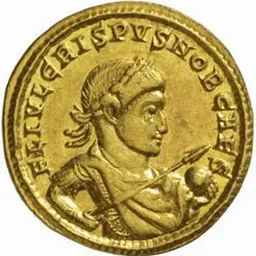
Execution In 326, Fausta was put to death by Constantine, following the execution of Crispus, his eldest son by Minervina. The circumstances surrounding the two deaths were unclear. Various explanations have been suggested; in one, Fausta is set against Crispus, as in the anonymous Epitome de Caesaribus, or conversely her adultery, perhaps with the stepson who was close to her in age, is suggested.
According to the Latin Epitome de Caesaribus and the Ecclesiastical History of Philostorgius (as epitomized by Photius), Fausta was executed by being locked in a bath which was over heated, in connection with the death of Crispus, which "people [thought]" was caused by Fausta's accusation of unclear nature. But Constantine, having obtained rule over the whole Roman Empire by remarkable success in wars, ordered his son Crispus to be put to death, at the behest (so people think) of his wife Fausta. Later he locked his wife Fausta in overheated baths and killed her, because his mother Helena blamed him out of excessive grief for her grandson.
Zosimus, on the other hand, suggests adultery as the reason: He killed Crispus, who had been deemed worthy of the rank of Caesar, as I have said before, when he incurred suspicion of having sexual relations with his stepmother Fausta, without taking any notice of the laws of nature. Constantine's mother Helena was distressed at such a grievous event and refused to tolerate the murder of the young man. As if to soothe her [feelings] Constantine tried to remedy the evil with a greater evil: having ordered baths to be heated above the normal level, he deposited Fausta in them and brought her out when she was dead.
In Zonaras' version written in the 12th century, Crispus' death was caused by Fausta's retaliatory accusation of rape following her unsuccessful sexual advances toward him. But when Constantine realized his innocence, he punished her, mirroring the myth of Phaedra and Hippolytus. Scholars have noted that if Crispus was found to be innocent, his condemnation of memory should have been lifted, but it was not.
Constantine I ordered the damnatio memoriae of Fausta and Crispus around 326 with the result that no contemporary source records details of her fate: "Eusebius, ever the sycophant, mentions neither Crispus nor Fausta in his Life of Constantine, and even wrote Crispus out of the final version of his Ecclesiastical History (HE X.9.4)", Constantine's biographer Paul Stephenson observes. Although Julian praised Fausta in his panegyric to Constantius II, there is no other evidence of her memory being rehabilitated.
In popular culture Fausta is an important antagonist in Dorothy L. Sayers' chronicle-play The Emperor Constantine (1951). In addition, Fausta was portrayed by Belinda Lee in the film Constantine and the Cross (1961).
Don’t just read it —
keep it.
Full-length biographies made to live with: read them, listen on the way to work, watch them tonight.
- E-book
- Audio
- Video
Instant download · yours to keep · every purchase keeps this site free
Important facts
People in Fausta's life
Named in this biography and alive at the same time

Contemporaries
People whose lives overlapped Fausta's


Frequently asked questions
Who was Fausta?
Roman empress and second wife of Constantine I
When was Fausta born?
Fausta was born in 289 in Rome.
When did Fausta die?
Fausta died in 326 in Rome.
What nationality was Fausta?
Fausta was Roman.
Sources & further reading
· DBpedia: Flavia Maxima Fausta
Cite this page
APA: Biography.guide. (2026). Fausta. https://biography.guide/fausta-0289/
MLA: "Fausta." Biography.guide, https://biography.guide/fausta-0289/.
Chicago: "Fausta." Biography.guide. https://biography.guide/fausta-0289/.
Data last updated: 2026-09-20 · Spot an error? Report a correction.
Page generated 2026-09-27 05:30 UTC