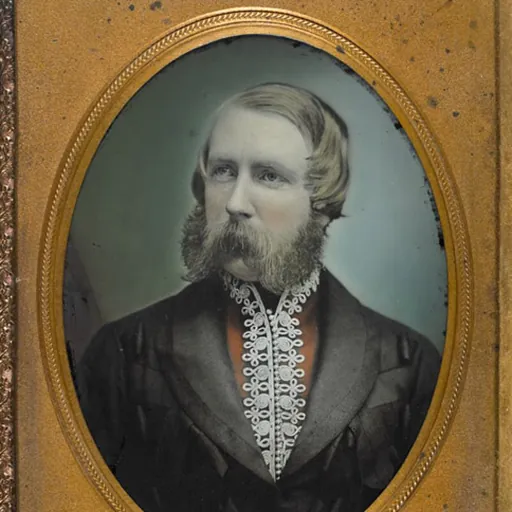
Farnham Maxwell-Lyte
English photographer and chemist
About Farnham Maxwell-Lyte
Lived 1828 – 1906 (aged 78). Farnham Maxwell-Lyte was a British photographer, engineer, mining engineer and chemist.
Farnham Maxwell Lyte FRSC (10 January 1828 – 4 March 1906), sometimes Maxwell Farnham Lyte, and after his death often called Maxwell-Lyte, was an English chemist and the pioneer of a number of techniques in photographic processing. As a photographer he is known for his views of the French Pyrenees.
Early life Lyte was born on 10 January 1828 in Brixham, Devon, the fifth and last child of Henry Francis Lyte (the author of "Abide with Me") and Anne Maxwell.
Lyte was sixteen when he first came across photography, hearing the news of William Henry Fox Talbot's invention of the calotype. In 1846, as F. M. Lyte, he entered Christ's College, Cambridge, where he graduated BA in chemical engineering in 1851, promoted to MA in 1863. On leaving Cambridge, the young Lyte became a mining engineer and was an Associate of the Society of Civil Engineers and a Fellow of the Chemical Society. and in 1856 his family joined him there. In 1854 he wrote up the results of his investigations into what became known as the "honey" process. This was "a method of improving the wet-collodion process by extending the longevity of the sensitized plate"
Lyte was one of the pioneers of inserting an imported sky into a landscape photograph to mitigate the problems of sensitivity of the collodion plates, a process that he justified in a letter of 6 November 1861 to the journal Moniteur de la photographie. In the April 1862 issue of the British Journal of Photography he published his findings on the presence of "anti-chlors" in photographic paper, a substance that jeopardised the stability of silver prints. According to Dan Younger (in notes for an exhibition of antique photographs at Kenyon College): quote|Wealthy amateur photographers in Great Britain—usually landed gentry—worked in the 1850s without a wide audience beyond their own immediate circle, and thus with little or no commercial intent (an example from this amateur period may be seen in the salted paper print by Maxwell Farnham Lyte displayed on the wall to the left of this panel). Privileged amateurs sought through small exchange clubs to communicate with each other about the technical and aesthetic challenges of early paper photography. and his Pyrenean landscapes gained him a gold medal in Bordeaux in 1859. He also regularly submitted photographs to the Photographic Society of Scotland's annual exhibition in Edinburgh, sending his entries from his home in Pau and winning silver medals at the 5th exhibition (for Pierrefith) and 7th exhibition (for Lac d'Oo). Despite the thoroughness of his instructions for the transport of his fragile prints from Pau to Scotland, the Daily Scotsman of 26 December 1859 wrote:
quote|Maxwell Lyte: Bagneres di Bigonne – An excellent specimen. Other specimens of the same artist are equally good; and we are happy to add that the injury these beautiful views sustained in their transmission to this country, by a nail being driven through them has been skillfully repaired, and does not now injure their general effect.| he attended the second meeting at Frossard's house in Bagnères-de-Bigorre. At this meeting the rules for admittance were laid down, the society was given its name, and executive positions were decided upon; Maxwell Lyte was chosen as the society's first vice-president.
Don’t just read it —
keep it.
Full-length biographies made to live with: read them, listen on the way to work, watch them tonight.
- E-book
- Audio
- Video
Instant download · yours to keep · every purchase keeps this site free
Important facts
People in Farnham Maxwell-Lyte's life
Named in this biography and alive at the same time

Related people
Same field, nearest in time


Contemporaries
People whose lives overlapped Farnham Maxwell-Lyte's





Frequently asked questions
Who was Farnham Maxwell-Lyte?
English photographer and chemist (1828-1906)
When was Farnham Maxwell-Lyte born?
Farnham Maxwell-Lyte was born on 10 January 1828 in Devon.
When did Farnham Maxwell-Lyte die?
Farnham Maxwell-Lyte died on 4 March 1906 in London.
What was Farnham Maxwell-Lyte's occupation?
Farnham Maxwell-Lyte was a photographer, engineer, mining engineer and chemist.
What nationality was Farnham Maxwell-Lyte?
Farnham Maxwell-Lyte was British.
Sources & further reading
· Wikipedia: Farnham Maxwell-Lyte
· DBpedia: Farnham Maxwell Lyte
Cite this page
APA: Biography.guide. (2026). Farnham Maxwell-Lyte. https://biography.guide/farnham-maxwell-lyte/
MLA: "Farnham Maxwell-Lyte." Biography.guide, https://biography.guide/farnham-maxwell-lyte/.
Chicago: "Farnham Maxwell-Lyte." Biography.guide. https://biography.guide/farnham-maxwell-lyte/.
Data last updated: 2026-09-21 · Spot an error? Report a correction.
Portrait: Wikimedia Commons · author & licence
Page generated 2026-09-27 05:01 UTC