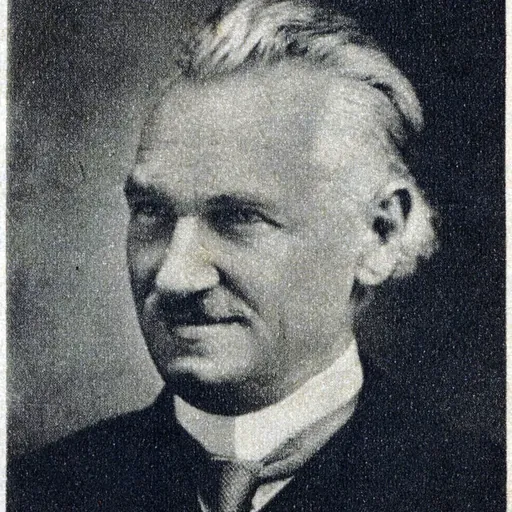
About Farkas Heller
Lived 1877 – 1955 (aged 78). Farkas Heller was a Hungarian economist and university teacher.
Heller Farkas Vocational College building on Váci utca, Budapest, Váci utca 47. in 2011 Farkas Heller (Budapest, 9 May 1877 – Budapest, 29 September 1955) was a Hungarian Economist, author and professor, member of the Hungarian Academy of Sciences. Bust of Farkas Heller by Emil Eory at the Budapest University of Technology and Economics - Lágymányos neighborhood, Budapest District XI. Hungary Biography His father, :hu:Heller Ágost (1843–1902) Hungarian physicist, historian of science, member of the Hungarian Academy of Sciences, mother knight bleybach Bolberitz Georgina (1854–1920). Her little brother dr. :hu:Heller Erik (1880–1958) lawyer, university professor whose wife was a nobleman Irén Kiss (1887–1971). His wife, Paula Klasz (1891–1971), dr. She was the daughter of Pál Klasz, Secretary of the Ministry of the Interior Career He began his career at the Budapest Chamber of Commerce and Industry, then in 1902 he joined the Ministry of Agriculture. In 1907 he was a private teacher of trade and industrial policy at the Budapest University of Technology and Economics in Budapest, and then in 1914 the same economics and finance. he became a teacher. His scholarly works have been published in series, his work entitled "Economics" has been awarded the Strókay Prize by the Hungarian Academy of Sciences, and his work has even been published in Leipzig in German. He became a corresponding member (1921), then a member (1934) of the Hungarian Academy of Sciences. In 1949 he was expelled from the Hungarian Academy of Sciences. He was rehabilitated in 1989, Posthumous promotion regained his academic membership. „Heller Farkas has been significant in three areas: processing the development of economic theory, developing theoretical and applied economics (economic policy), and finance. After the liberation, all three areas had excellent and internationally recognized cultivators, but there was no researcher alone who could cultivate all three areas comprehensively. In his research and teaching work, Heller highlighted the following theoretical areas of economics: value, price, income distribution, money, foreign trade, and economic fluctuations. In the field of economic policy, he dealt with, inter alia, organizational, credit, trade, currency, transport and social policies.
Leadership 1920–1929 Dean of the Faculty of Economics et the Budapest University of Technology and Economics 1945–1946 In the academic year he was the rector of Budapest University of Technology and Economics
Society memberships 1917–1948. He was the editor of the Economic Review 1922–1948. He is a member of the Hungarian Statistical Society 1926–1948. Member of the Board of the Hungarian Statistical Society 1934–1948. Chairman of the National Economy Committee of the Hungarian Academy of Sciences 1935–1948. Member of the National Council for Higher Education
Notable works
The theory of marginal benefit. (in Hungarian) Bp., Politzer Zs. és fia. (The project awarded the Ullmann Prize by the Hungarian Academy of Sciences) 1904. Die Grundprobleme der theoretischen Volkswirtschaftslehre (The basic problems of theoretical economics) (in German). Leipzig, 1921. Economics. Theoretical economics. I. Applied economics II. (in Hungarian) Németh J. K. Bp., 1919. (2. Edition 1921. 3. Ed. 1925. 4. Ed. 1942. 5.Ed. 1945. 6. Ed. 1988.) Monetary policy. (in Hungarian) Németh J. K., Bp., 1920. Social policy. (in Hungarian) Németh J. K., Bp., 1920. Finance. Németh J. K., Bp., 1921. (2. Edition 1943.) Die Entwicklung der Grundprobleme der volkswirtschaftlichen Theorie. (Development of the basic problems of economic theory.) (in German). Quelle und Meyer, Leipzig, 1921. (2. Edition 1924. 3. Ed. 1928. 4. Ed. 1931. Nationalökonomie. Theorie und Geschichte. Meyer’s Wörterbuch (Economic lexicon) (in German). Halberstadt, Meyer, 1925. (2. Edition 1926. 3. Ed. 1930. Ed. 1933) Business cycle theory and business cycle research. (in Hungarian) Közgazdasági Szemle 1927. Theoretische Volkswirtschaftstlehre. (Theoretical economics.) (in German). 1. Band. Quelle und Meyer, Leipzig, 1927. Economic Lexicon. (in Hungarian) Grill, Bp., 1937. Diccionario de economia politica. (Economic Lexicon) (In Spanish) Editorial Labor S. A. Barcelona, 1937. (2. Edition 1941. 3. Ed. 1946. 4. Ed. 1950. 5. Ed. 1965. 6. Ed. 1969. Introduction Fabian Estape) Business mind and public interest. (in Hungarian) A Mérnöki Továbbképző Intézet. Egyetemi Nyomda Bp., 1943. (2. Edition 1982. History of economic theory. (in Hungarian) Gergely R., Bp., 1943. (2. Edition AULA 2001.)
Don’t just read it —
keep it.
Full-length biographies made to live with: read them, listen on the way to work, watch them tonight.
- E-book
- Audio
- Video
Instant download · yours to keep · every purchase keeps this site free
Important facts
Related people
Same field, nearest in time


Contemporaries
People whose lives overlapped Farkas Heller's



Frequently asked questions
Who was Farkas Heller?
Hungarian economist (1877–1955)
When was Farkas Heller born?
Farkas Heller was born on 9 May 1877 in Budapest.
When did Farkas Heller die?
Farkas Heller died on 29 September 1955 in Budapest.
What was Farkas Heller's occupation?
Farkas Heller was an economist and university teacher.
What nationality was Farkas Heller?
Farkas Heller was Hungarian.
Sources & further reading
Cite this page
APA: Biography.guide. (2026). Farkas Heller. https://biography.guide/farkas-heller/
MLA: "Farkas Heller." Biography.guide, https://biography.guide/farkas-heller/.
Chicago: "Farkas Heller." Biography.guide. https://biography.guide/farkas-heller/.
Data last updated: 2026-09-21 · Spot an error? Report a correction.
Portrait: Wikimedia Commons · author & licence
Page generated 2026-09-27 04:58 UTC