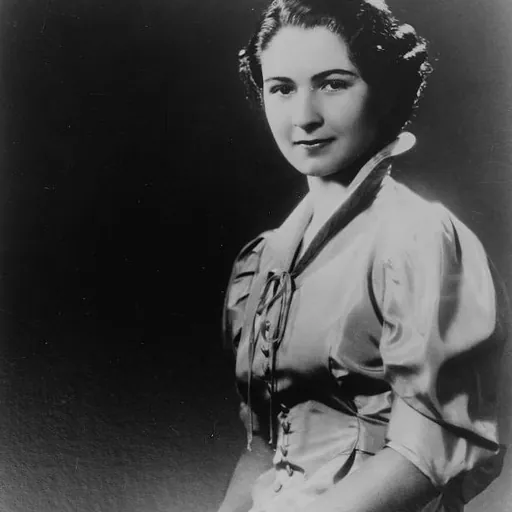
About Farida of Egypt
Lived 1921 – 1988 (aged 67). Farida of Egypt was an Egyptian painter.
Farida (born Safinaz Zulficar 5 September 1921 – 16 October 1988) was the queen of Egypt for nearly eleven years as the first wife of King Farouk. She was the first queen of Egypt since Cleopatra to have left seclusion and played a public representational role, attending public functions and acting as honorary patron of various charities and public foundations and programs in accordance with the modern image the monarchy wished to represent at the time. The marriage was dissolved by divorce in 1948.
Early life and education
Queen Farida was born Safinaz Zulficar on 5 September 1921 to an Egyptian noble family in Janaklis, Alexandria. Her father, Youssef Zulficar Pasha, was a judge of Circassian origin; he was also vice president of the Alexandria Mixed Court of Appeals. Her mother, Zeinab Zulficar, was a lady-in-waiting of Queen Nazli Sabri. On her mother's side, Farida's uncle was the artist and lawyer Mahmoud Sa'id, and her grandfather was the former prime minister of Egypt Muhammad Said Pasha, who was also of Circassian origin. Farida attended elementary and primary education at Notre Dame de Sion in Alexandria, a school run by French nuns.
Marriage and issues Farida and King Farouk first met on a royal trip to London in 1937. They were engaged in the summer of 1937. She was renamed Farida as her regnal name in accordance with the royal naming convention initiated by King Fuad I that members of the royal family should bear the same initials. She wore a wedding gown designed by The House of Worth in Paris.
She had three daughters: Princess Ferial, Princess Fawzia and Princess Fadia.
After the birth of a third daughter, Farouk divorced her, on 19 November 1948.
Queenship and public role
Queen Farida was born in a culture in which motherhood was the only priority of a woman. The birth of an heir to the throne was especially important. However, due to rising influence of the West, the role of the first lady and Queen rose to higher grounds.
A certain female emancipation at least in terms of visibility, had occurred in the Egyptian elite around the royal family, as it was regarded as a sign of modernity, suitable to use in the representation of the royal house to the Western world. In contrast to her predecessor, Queen Farida was not to live in seclusion, but to be given a public role.
The marriage in itself was used in official publicity to show the modern image the monarchy wished to give, and the royal couple was officially described as a modern domestic couple in a monogamous companionate marriage, which at that time had come to be regarded as the ideal of the Egyptian elite.
The position of first lady and Queen became an honorary position bearing with it public representational duties, such as attending charities, fundraisers, commemorations and receiving foreign dignitaries.
Queen Farida accepted the chair of the Red Crescent Society and was also honorary president of the Egyptian Feminist Union and the New Woman Alliance. She was also patron of the Egyptian Girl Guide Company which had an important role in community affairs.
During the last years of queenship, Farida progressively retired from public life during a time when her marriage deteriorated. King Farouk reportedly had numerous mistresses, did not show his queen consideration, excluded her from receptions and at one point instead attended a party of Princess Chevikar in the company of a mistress, placing her beside the Prime Minister Nuqrashi Pasha, who took offence. The absence of a male heir also contributed to the divorce.
The divorce was not popular in Egypt, since Farida was very popular, and King Farouk was publicly hissed at the Cairo Cinema because of it. Doria Shafik viewed the royal divorce, and Farida's choice to leave an unhappy marriage, as a call to the Egyptian woman to find her freedom and liberate herself: "In exchange for her liberty, Farida gave up a throne, one of the supreme gestures in the history of the Egyptian woman". Later she settled in Lebanon where she saw her children after nearly ten years. Then, she lived in Paris from 1968 to 1974 until she returned to Egypt in 1974, during the presidency of Anwar Sadat. She remained unmarried after the divorce. During the late 1960s, she began painting.
Death Farida was hospitalized in September 1988 due to several health problems, including leukemia, pneumonia and hepatitis.
Honours National honours House of Muhammad Ali: Former Grand Mistress Dame Grand Cross of the Order of the Virtues, Special Class
Foreign honours Greek Royal Family: Dame Grand Cross of the Royal Order of Beneficence Yugoslavian Royal Family: Dame Grand Cross of the Royal Order of St. Sava
Don’t just read it —
keep it.
Full-length biographies made to live with: read them, listen on the way to work, watch them tonight.
- E-book
- Audio
- Video
Instant download · yours to keep · every purchase keeps this site free
Important facts
Family & relationships
People in Farida of Egypt's life
Named in this biography and alive at the same time



Related people
Same field, nearest in time


Contemporaries
People whose lives overlapped Farida of Egypt's

Frequently asked questions
Who was Farida of Egypt?
Egyptian queen consort (1921–1988)
When was Farida of Egypt born?
Farida of Egypt was born on 5 September 1921 in Alexandria.
When did Farida of Egypt die?
Farida of Egypt died on 16 October 1988 in Cairo.
What was Farida of Egypt's occupation?
Farida of Egypt was a painter.
What nationality was Farida of Egypt?
Farida of Egypt was Egyptian.
Sources & further reading
Cite this page
APA: Biography.guide. (2026). Farida of Egypt. https://biography.guide/farida-of-egypt/
MLA: "Farida of Egypt." Biography.guide, https://biography.guide/farida-of-egypt/.
Chicago: "Farida of Egypt." Biography.guide. https://biography.guide/farida-of-egypt/.
Data last updated: 2026-09-24 · Spot an error? Report a correction.
Portrait: Wikimedia Commons · author & licence
Page generated 2026-10-03 09:36 UTC