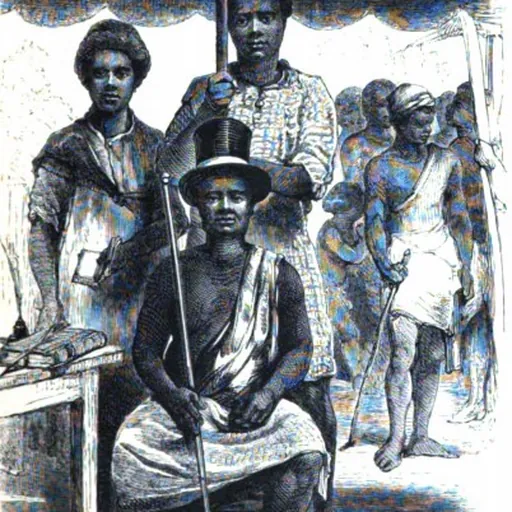
Eyo Honesty II
Obong of Creek Town
About Eyo Honesty II
Lived 1701 – 1858. Eyo Honesty II was a Nigerian.
Eyo Honesty II (; –1858) was the ruler of Creek Town from 1835 until his death on 3 December 1858. Eyo was born into the family of Eyo Nsa and Inyang Esien Ekpe. Eyo was also instrumental in the abolition of practices such as the killing of twins and human sacrifices. On his death, he was succeeded by his son Eyo Eyo Ita, who became King Eyo Honesty III. It was during this time that he learned to speak and write the English language. When young I was nobody, for I was poor; and it was long before I set up as a gentleman. I put my mind to my trade and worked; at first a little, and then more. What profit i made I put down. When ships come I trade with their money, and when they go away I trade with my own... And now pass every man (in wealth) in all Calabar. Another tradition upholds that due to the curses inflicted on the land by the Ndem during his father's reign, barrenness was rife in the town. After the death of Ekpenyong Nsa, it was decided that a new king should be installed. Although Eyo Eyo Nsa's elder brother Tom Eyo was the head of his father's ward, Tom chose to concede the position of head of Creek Town to Eyo. Eyo Eyo Nsa was crowned in around 1835 and took up the name "Eyo Honesty II". The proclamation of a new king at Creek Town is said to have displeased King Eyamba V, who did not like the idea of the presence of two kings in the region. Eyamba V sent emissaries to inform them of his displeasure. Hope Waddell records Eyo's response: ...From his residence to the town-house; he had the streets laid with hundreds of boxes of brass and copper rods, "current money of the merchants" worth each about £5 sterling. On these, he walked without putting foot to ground and told the messengers what his march had proved that he had money enough to be king and needed no leave from Eyamba. The period from 1807 to 1840 marked a turning point in the Economic history of Old Calabar. Although the slave trade was abolished in 1807, the exportation of slaves from old Calabar was still on-going until 1840. There was also an increase in other exports such as oil, barwood, due to the decreasing popularity of slave acquisition. In 1840, Commander Raymond paid a visit to King Eyo II and King Eyamba V with the anti-slave trade treaties which Nair states were willingly signed by both kings. King Eyo II and Eyamba V realising the change in the economic tides of the region sent letters to the British requesting for teachers and missionaries to Old Calabar to establish schools and teach the people, commerce and Christianity. The title of the vice-chairman of the fraternity was known as . This office was held by Eyo II's father, who inherited it on the death of Esien Ekpe Oku. Eyo II equally came to inherit the office held by his father. Eyo also appended the grade to the list of Ekpe grades. Eyo II's position within the Ekpe society made him a powerful force within Old Calabar. Through his position as Obong Ebonko, he was able to enforce laws within his territory. Thus, without Eyo's position in the Ekpe society, it would have been difficult to enforce treaties that pushed for the abolition of funeral sacrifices, twin killings, witch trials and other practices.
Eyo II sought a peaceful approach towards handling interethnic affairs except there was no other option but to go to war. An example of Eyo's handling of neighbouring affairs within the Cross River was his improvement of Old Calabar and Umon relations. Umon is an island situated in the middle of the Cross River. During the pre-colonial era, it was difficult for people to freely transport goods along the Cross River without paying fees to the ethnicities located along the Cross River. Eyamba V had attempted to bully the Umon people to obedience severally but the people were resilient and would not give in to any form of intimidation. Eyo II chose to settle matters with the Umon people amicably by first, sending out a peace mission to Umon. According to Hope Waddell, About sixty canoes followed Eyo and his Chiefs to Bosun. Most of them had each a large gun, mounted on a strong frame in the bows, and a little deck house in the middle for its owner gaily painted with ensign in the stern. Eyo led the way himself in a six oared gig rowed not by slaves but by young gentlemen of the best families in the land. Some of his canoes which followed were very large, sixty or seventy feet long and five or six broad, paddled by thirty men and carrying also bands of armed men. They had large guns both bow and stern and were ballasted with cannon balls.
When asked if the people of Umon would not feel alarmed by the presence of armed forces in the area, Eyo II pointed out that the palm fronds which surrounded the Ekpe canoe signified that they came in peace. Eyo negotiated with the chiefs of Umon and they collectively came to an agreement that Creek Town would pay an annual dash to certain chiefs at Umon to ensure trade along the area, with the people of Creek Town being undisturbed thereafter. Eyo's influence was felt in neighbouring communities within Old Calabar. Although he refrained from dabbling in the activities of other towns, he did not refuse to come to their aid when they required his wisdom. Such was the case when Duke Town was in anarchy after the death of King Archibong I. The missionaries appealed to King Eyo to come over to Duke Town and aid in the restoration of order to the town. Reverend Anderson noted that Eyo had performed the feat of restoring peace and order to Duke Town with great skill as had he not done so, the crisis would have escalated even with Eyo's presence. This event further heightened the respect the people of Duke Town and other towns had for Eyo. Another incident that is testimony to Eyo's influence across the lower Cross River was his mediating of a crisis at Mbiabo Ikot Offiong. When the community of Ikot Offiong was placed under an Ekpe ban, they sought the assistance of Eyo II to intercede on their behalf. Such houses were owned by wealthy men together with the Calabar-styled native houses. Eyo also owned a residential quarters specifically designed for his wives. The residential quarters is described by Rev. Hope Waddell as,"...nine court-yards surrounded by some low-thatched buildings each opening into the other... The walls of the buildings were tastefully painted in beautiful native patterns with native pigments, and the King's wives were the artists". He equally kept trading goods at his residential quarters. Eyo II believed in the laws of the land but was never quick to wholeheartedly accept laws which he regarded as "Fool things". On one occasion, one of Eyo's wives (the mother of his two sons) left for her father's home town in the Ibibio country and is said to have had an affair with one of the chiefs of the town. On learning of this incidence, King Eyo kept the matter secret and secretly had his wife's mate and the "go-between" brought to Creek Town where they were drowned in the river. Ima secretly left the residential quarters and into the streets to quarrel with a girl who had provoked her.
King Eyo II had many children. Some of his children included Ansa, Eyo (who later became Eyo Honesty III), Inyang, Ako, Esien, Amayo, Ekpenyong. Ansa was his eldest daughter also known as the and Eyo was his eldest son also known as the . Ansa is said to have been an ardent believer in native customs. Like Ansa, Inyang was an ardent believer of native customs. By 1850, Ako was regarded as the cleverest student of her age and in some aspects had a mind like her father. Amayo, another of Eyo's daughters was described as "Pretty lively". Ekpenyong, another of Eyo's sons is said to have been,"careless... always averse to school and was full of excuses for it".
Foreign Relations
King Eyo II's father Eyo Nsa was renowned for his honesty among foreign traders, which was why he was nicknamed "Honesty", a name which is now a family name at Creek Town. During the time of Eyo Nsa, the people of Creek town were regarded as "the best and most indefatigable traders". Eyo II was equally an honest man and was particularly known for his approach towards conflict resolution and peaceful negotiations. Eyo's methods towards conflict resolution can be seen in various accounts of his interactions with several foreigners who traded with him.
Trade with Supercargoes Foreign traders from Europe who traded at the lower Cross River were termed the "Supercargoes". These traders came from different nations such as France, the Netherlands, Portugal and England. Eyo had experience in the trade and with foreign traders since his youth. The system of trade practiced during the triangular trade era was known as the "trust system". This system involved the offering of goods by European traders to African merchants of good reputation who would then use the goods to purchase a specified quota of slaves or other items. Items exported by the Efik traders would include ivory, redwood, palm oil etc. Sometimes the Efik merchants did not make payments for the goods they received on trust which would be a termed a breach of trust. On occasions where Efik merchants had breached trust, it was not uncommon for European merchants to harass the Efik traders and visit them in their homes. On one occasion, King Eyo had chartered a whole ship known as "The Olinda" with the intention of shipping oil directly to Britain. On learning of Eyo's plans, Consul Hutchinson summoned King Eyo reminding him that he owed trust of 400 tons of oil, an equivalent of £18,000 and could not allow him to ship oil directly to Britain unless he had settled his debts.
Relations with the French The French had traded in the Bight of Biafra region for a long time. French presence in the lower Cross River region grew around the middle of the 19th century. According to Nair, in 1830, John Beecroft complained that British merchants were hopelessly outnumbered by the French slave trading vessels. In 1843, the French gun boat La Vigie had threatened to blow up Old Calabar if the Efik did not supply them with slaves. When they arrived Old Calabar, they sent word to Eyo informing him that they would be paying him a visit with the aim of signing a treaty with him for the suppression of human sacrifices. Prior to the arrival of the French in King Eyo's home, Eyo had hoisted a British flag over his home. The Sierra Leoneans arrived Old Calabar as traders in the early 1850s together with some independent European traders that arrived separately. These Sierra Leoneans were mainly ex-slaves from America who had returned to Sierra Leone as free men and later emigrated to several parts of West Africa such as Abeokuta, Lagos and Accra. While some towns such as Bonny were hostile to the idea of foreigners settling in their communities, Eyo II welcomed them saying, "Let them come, I will be glad to see them and give them land. I will look on them as white men because they have learnt white men fashion. Let them come and teach my people. Nobody will trouble them". With the assistance of the Church of Scotland Mission, several Sierra Leoneans emigrated to Old Calabar. They believed in economic liberalism and free trade. According to Nair,
The explanation given by Cuthbertson was that he could not recover an outstanding debt owed him by Creek Town if Nicoll was not held hostage. Nicoll disavowed any association he had with Creek Town's debt, stated that he was a 'British subject' and had the same rights to trade in any part of the world as any British supercargo. In appealing for redress from the acting consul, Lynslager, Nicoll pointed out that the seizure represented a breach of all the laws of commercial honour and honesty and a violation of his privileges as a British subject. Cuthbertson and the other supercargoes, who were ruthlessly determined to deal firmly with the new competitors, claimed that they had been 'perfectly unable' to obtain their trust from the Efik. They argued that in disposing of his oil to others through Nicoll, Eyo had not only delayed the supply of oil to European vessels but had also shipped it in casks lent by supercargoes to the Efik for their own oil.
The acting consul Lynslager was more sympathetic towards the supercargoes and believed the people of Creek Town were insolent, believing themselves to be safe from any hostile actions due to their town being high up the river. Lynslager visited Creek Town in H.M.S Minx, a Man-of-War possibly with the intention of intimidating the people. He assembled all the chiefs of Creek Town, accusing them of abusing the trust system and demanding an explanation. The missionaries were settled in properly at Duke Town and Creek Town. King Eyo, who realised the need for reforms, aided the missionaries in abolishing several practices which he regarded as barbaric. Upon their arrival Eyo was cited saying, "Now I am sure God will love and bless me, for I am very glad you come with this book." Eyo's respect for the missionaries ultimately resulted in law changes over his domain. Such reforms included the elimination of human sacrifice, the allowance of widows and twins to return to Creek Town, the elimination of "Ekpenyong" - the household idol of the region, and the ending of Sunday markets. Eyo maintained his agency by collaborating with the Europeans who encountered his kingdom and left a reputation that is best stated in Religion in Calabar by Rosalind I.J. Hackett, "The Efik, epitomized by King Eyo Honesty, showed the capacity to adapt internally, to 'modernize' without becoming 'westernized' or 'Christianized'".
Later years and Death By the last decade of King Eyo's reign, British involvement in several aspects of Efik socio-cultural life was evident. Although King Eyo was happy with some of the changes that had taken place within old Calabar during the stay of the British missionaries, he protested their interference in matters of the state. King Eyo died on 3 December 1858. Although he is termed as a "Christian King", King Eyo never converted to Christianity and adhered to customs which he believed were unharmful to Christian doctrine.
Legacy King Eyo is particularly known for his efforts in abolishing practices such as the killing of twins; human sacrifices; and the immolation of slaves upon the death of a dignitary. He is also credited as having invited the missionaries to Old Calabar who were responsible for several religious reforms in Old Calabar society. Within the Ekpe society of Old Calabar, King Eyo is regarded as the founder of the brass grade.
Don’t just read it —
keep it.
Full-length biographies made to live with: read them, listen on the way to work, watch them tonight.
- E-book
- Audio
- Video
Instant download · yours to keep · every purchase keeps this site free
Important facts
People in Eyo Honesty II's life
Named in this biography and alive at the same time


Contemporaries
People whose lives overlapped Eyo Honesty II's



Frequently asked questions
Who was Eyo Honesty II?
obong of Creek Town
When was Eyo Honesty II born?
Eyo Honesty II was born in 1701.
When did Eyo Honesty II die?
Eyo Honesty II died in 1858.
What nationality was Eyo Honesty II?
Eyo Honesty II was Nigerian.
Sources & further reading
Cite this page
APA: Biography.guide. (2026). Eyo Honesty II. https://biography.guide/eyo-honesty-ii/
MLA: "Eyo Honesty II." Biography.guide, https://biography.guide/eyo-honesty-ii/.
Chicago: "Eyo Honesty II." Biography.guide. https://biography.guide/eyo-honesty-ii/.
Data last updated: 2026-09-24 · Spot an error? Report a correction.
Portrait: Wikimedia Commons · author & licence
Page generated 2026-09-27 05:08 UTC