
About Ewelina Hańska
Lived 1805 – 1882 (aged 77). Ewelina Hańska was a Russian novelist.
Eveline Hańska (; 6 January – 11 April 1882) was a Polish noblewoman best known for her marriage to French novelist Honoré de Balzac. Born at the Wierzchownia estate in Volhynia (now Ukraine), Hańska married landowner Wacław Hański when she was a teenager. Hański, who was about 20 years her senior, suffered from depression. They had five children, but only a daughter, Anna, survived.
In the late 1820s, Hańska began reading Balzac's novels, and in 1832, she sent him an anonymous letter. This began a decades-long correspondence in which Hańska and Balzac expressed a deep mutual affection. In 1833, they met for the first time, in Switzerland. Soon afterward he began writing the novel Séraphîta, which includes a character based on Hańska.
After her husband died in 1841, a series of complications obstructed Hańska's marriage to Balzac. Chief of these was the estate and her daughter Anna's inheritance, both of which might be threatened if she married him. Anna married a Polish count, easing some of the pressure. About the same time, Hańska gave Balzac the idea for his 1844 novel Modeste Mignon. In 1850 they finally married, and moved to Paris, but he died six months later. Though she never remarried, she took several lovers, and died in 1882.
Biography
Family and early life Hańska was the fourth of seven children born to Count Adam Wawrzyniec Rzewuski (1760-1825) and his wife, Justyna Rdułtowska (1775-1836). The House of Rzewuski was established as Polish nobility, known for wealth and military prowess. One ancestor had imprisoned his own mother in a tower to extract his part of an inheritance. Hańska's great-grandfather, Wacław Rzewuski, was a famous writer and a Grand Crown Hetman. When the Russian Empire gained control of lands owned by the family through the Partitions of Poland at the end of the 18th century, Rzewuski swore his allegiance to Catherine II.
alt=A pencil-and-watercolor drawing of a small village. Several two-story buildings sit around a crossroad junction. One historian compares the Rzewuski estate in Pohrebysche to "a little kingdom". Her biographers and those of Balzac offer conflicting evidence of her age, taken from correspondence, family records, and testimonies from descendants. Most estimates range between 1801 and 1806. Balzac's biographer Graham Robb writes: "Balzac chose 1806 as her date of birth and he was probably right." Roger Pierrot's 1999 biography of Hańska, however, contends that she was born in 1804. Polish Biographical Dictionary gives 24 December 1805 (Julian) which converts to 5 January 1806 (Gregorian). Hańska's eldest sister, Karolina, was admired as a child for her beauty, intellect, and musical talent. Hańska's younger sisters, Alina and Paulina, married early into comfortable upper-class families.
In 1819 Ewelina married Wacław Hański, a noble who lived nearby at Verhivnya (Wierzchownia). Their marriage was a union of wealthy families, not of passion. His estate covered and owned over 3,000 serfs, including 300 domestic servants. The manor had been designed by a French architect, and its owner filled it with luxuries from around the world: paintings from galleries in Milan and London, dinnerware from China, and a library of 25,000 books in a variety of languages. Hański boasted that none of the furniture was Russian.
Hański was more than 20 years older than Ewelina, who was a teenager at the time of their wedding, and his personality clashed with her youthful vigor. He spent most of the day supervising the grounds, by some accounts with an iron fist. After dinner he was usually too fatigued to spend time with his wife, and retired early. He was generally dour, and lived with a depressed condition that Hańska referred to as "blue devils".
Becoming "The Stranger"
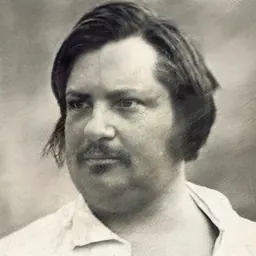
alt=A middle-aged man with wavy black hair and a small moustache wearing a dark suit. In her November 1832 letter, Hańska told Honoré de Balzac: "My heart has leapt as I read your works."
One of the writers who most enchanted Hańska was the French novelist Honoré de Balzac. After laboring in pseudonymous obscurity for 10 years, Balzac published Les Chouans (The Chouans) in 1829. A tale of star-crossed love amidst a royalist uprising in Brittany, it was the first work to which he signed his own name. Hańska was intrigued by the glowing portrayal of the female protagonist, driven by true love to protect the object of her desire. She also enjoyed Balzac's Physiologie du mariage (The Physiology of Marriage), also published in 1829, which heaps satirical scorn on husbands and celebrates the virtue of married women.
When she read his 1831 novel La Peau de chagrin (The Magic Skin), however, Hańska was appalled by the coarse depiction of Foedora, the so-called "femme sans cœur" ("woman without a heart"). She felt that Balzac had lost the reverence shown in his earlier works, and worried that he had based Foedora on a real woman from his life. Motivated partly by concern, partly by boredom, and partly by a desire to influence the life of a great writer (as her sister Karolina had done), she wrote to Balzac.
On 28 February 1832 Hańska posted a letter from Odessa with no return address. In it, she praised Balzac for his work, but scolded him for the negative portrayal of women in La Peau de chagrin. She urged a return to the glowing representations in his earlier novels, and signed enigmatically: "L'Étrangère" ("The Stranger" or "The Foreigner"). Balzac was intrigued by the letter; he took out a personal advertisement in the Gazette de France indicating his receipt of an anonymous letter and expressing regret for being unable to reply. She probably never saw this notice.
Hańska wrote to Balzac several times during 1832. On 7 November she posted a seven-page letter filled with praise and flattery:Your soul embraces centuries, Monsieur; its philosophical concepts appear to be the fruit of long study matured by time; yet I am told that you are still young. I would like to know you, but feel that I have no need to do so. I know you through my own spiritual instinct; I picture you in my own way and feel that were I to set eyes upon you I should exclaim, 'That is he!' Your outward semblance probably does not reveal your brilliant imagination; you have to be moved, the sacred fire of genius has to be lit, if you are to show yourself as you really are, and you are what I feel you to be—a man superior in his knowledge of the human heart.
In her next letter Hańska made arrangements for a trusted courier to collect letters from Balzac, and thereby allow for a direct correspondence. Before long she sent him the news that she and her husband would be traveling Europe, and visiting Vienna, Hanski's childhood home. They would also travel to the Swiss village of Neuchâtel, to visit the family of her daughter's governess. Contradicting her vow of eternal anonymity, she suggested a meeting. Balzac agreed immediately, and began to make preparations for the journey. Also, sometime in 1833, Balzac wrote his first confession of love to her, despite being at that time in another relationship. They met later that day (25 September)
Arriving in Geneva on 26 December, At this time he began working on a philosophical novel, Séraphîta, about a hermaphroditic angel united by the love of a mortal man for a compassionate and sensual woman. Balzac explained that she was his model for the latter. It was clear to all that Hański was in ill health, and Hańska began to think about her future with the French author. In the meantime, she asked Balzac to begin collecting for her autographs of the famous people he spent time with in Paris and elsewhere.
After leaving Geneva on 8 February, In the summer of 1834 they returned to Vienna, where they would stay for another year. During this time Balzac continued writing to Hańska, and by accident two especially amorous letters fell into the hands of her husband. He wrote to the French author, furious, and demanded an explanation. Balzac wrote to Hański claiming that it was nothing more than a game: "One evening, in jest, she said to me that she would like to know what a love-letter was. This was said wholly without meaning.... I wrote those two unfortunate letters to Vienna, supposing that she remembered our joke...." Hański apparently accepted the explanation, and invited Balzac to visit them in Vienna, which he did in May 1835.
Balzac's biographers agree that, despite his vows of loyalty to Hańska, he conducted affairs with several women during the 1830s, and may have fathered children with two of them. One was an Englishwoman named Sarah who had married the Count Emilio Guidoboni-Visconti. Hańska wrote to Balzac about these rumors in 1836, and he flatly denied them. Her suspicion was raised again, however, when he later dedicated his novel Béatrix to "Sarah". Balzac also corresponded with Hański; while most of their family disapproved of Balzac, Hański respected him, and the two exchanged letters on literature and agronomy. Meanwhile, Hańska was experiencing a renewal of religious interest, partly because her daughter's governess, Henriette Borel, left to join a nunnery in Paris. Hańska taught her daughter Anna from the works of Christian scholars including Jean Baptiste Massillon and St. François de Sales. Her religious interest was more towards mysticism than mainstream religions; she corresponded with Baroness Barbara von Krüdener, and read on Rosicrucianism, Martinism and Swedenborgianism.
Hański's death
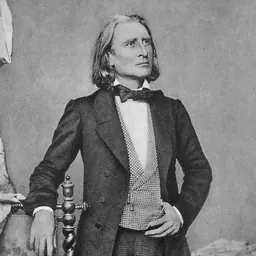
After her first husband's death, Hańska rejected advances from composer Franz Liszt.
Hańska's husband died in November 1841. She sent Balzac a letter, sealed in black, with the news. He instantly wrote back: "je n'en aurais peut-être pas voulu recevoir d'autre de vous, malgré ce que vous me dites de triste sur vous et votre santé" ("I could not perhaps wish to have received any other [news] from you, in spite of the sad things you tell me about yourself and your health"). He made plans to visit Dresden in May, and obtain a visa to visit her in Russia.
The future, however, was not as simple as Balzac wanted to believe. Hańska's family did not approve of the French author; her Aunt Rozalia was especially disdainful. To make matters worse, her late husband's uncle protested Hański's will, which left her the entire estate. Horrified that her daughter would be robbed of everything, Hańska insisted that she must end her relationship with Balzac. "You are free", she wrote to him. As she made plans to protest the uncle's interference in St. Petersburg, Balzac wrote back to offer his help. He suggested that he could become a Russian citizen and "go to the Czar myself and ask him to sanction our marriage". She asked for his patience, which he offered anew.
Soon after she arrived in the Russian capital of St. Petersburg, in order to resolve some of the litigation issues surrounding her inheritance, They saw one another on several occasions, but she ultimately rejected his advances. One biographer says that their last meeting "gives striking evidence of her loyalty to Balzac".
In late July 1843 Balzac visited her in St. Petersburg, the first time they had seen one another in eight years. He was struck by Hańska's resilient beauty, but his condition had deteriorated over the years. Biographers agree that she was much less physically attracted to him at this time. Still they renewed their vows of love and planned to marry as soon as she won her lawsuit. In early October he returned to Paris. Soon afterwards, she wrote a story based on her own experience writing to Balzac for the first time. Unhappy with it, she threw it into the fire, but the French author begged her to rewrite it so he could adapt it. He assured her that she would "know something of the joys of authorship when you see how much of your elegant and delightful writing I have preserved". Her story became Modeste Mignon, Balzac's 1844 novel about a young woman who writes to her favorite poet.
Also in 1844 Hańska won her lawsuit. The wealth of her late husband's estate would go to Anna, who had become engaged to a Polish Count, Jerzy Mniszech. They planned to marry in 1846, after which time Hańska would bestow the inheritance. Thus Hańska's marriage to Balzac would have to wait. In the meantime, two urgent problems began to complicate their plans. One was his health, which had been deteriorating for years. In October 1843 he wrote to her about "horrible suffering which has its seat nowhere; which cannot be described; which attacks both heart and brain". Balzac's other problem was financial: despite his illness, he could not afford to relax his work schedule, since he owed more than 200,000 francs to various creditors.
Second marriage and widowhood
alt=A large imposing house with solid beige walls and small windows, connected to a parallel wall, looms over an empty street. The house Balzac bought for Hańska (with her money) was built before the French Revolution by banker Nicolas Beaujon.
Hańska and Balzac were determined, however, and in 1845 she visited him in Paris with Anna and Jerzy. In April of the following year they visited Italy; Balzac joined them for a tour of Rome, and they proceeded to Geneva. Soon after he returned to Paris, she wrote with the news that she was pregnant. Balzac was overjoyed, certain that they would have a boy, and insisting on the name Victor-Honoré. The thought of having a son, he wrote, "stirs my heart and makes me write page upon page". To avoid scandal, he would have to marry Hańska in secret, to hide the fact that their child was conceived out of wedlock. In the meantime, Anna married Jerzy Mniszech on 13 October in Wiesbaden.
Hańska, living for a time in Dresden, was not soothed, either, by Balzac's disregard for financial stability. For years he had planned to buy a house for them to share, but in August 1846 she sent him a stern admonition. Until his debts were paid, she wrote, "we must postpone buying any property". One month later he purchased a house on the Rue Fortunée for 50,000 francs. Having collected finery from his many travels, he searched across Europe for items to properly complete the furnishings: carpets from Smyrna, embroidered pillowcases from Germany, and a handle for the lavatory chain crafted from Bohemian glass.
In November, Hańska suffered a miscarriage; she wrote to Balzac with the tragic news. He wanted to visit her, but Anna wrote asking him to remain in Paris. The emotion involved, she wrote, "would be fatal". Hańska made plans to return to Wierzchownia, but Balzac begged her to visit him, which she did in the spring of 1847. As soon as she was back in Ukraine, however, a new wrinkle unfolded. Hańska had long been unhappy with the presence of Balzac's housekeeper, Louise Breugniot, and he promised to break with her before marrying. He wrote with alarm to Hańska explaining that Breugninot had stolen her letters to him and blackmailed the author for 30,000 francs. Biographers disagree about truth of this story; Robb suggests it was "a convincing hysterical performance put on for the benefit of his jealous fiancée".
Both Hańska and Balzac took ill after the wedding; she suffered from a severe attack of gout, for which her doctor prescribed an unusual treatment: "Every other day she has to thrust her feet into the body of a sucking-pig which has only just been slit open, because it is necessary that the entrails should be quivering." She recovered, but he did not. They returned to Paris in late May, and his health improved slightly at the start of summer. By July, however, he was confined to his bed. Hańska nursed him constantly, as a stream of visitors – including the writers Victor Hugo and Henri Murger – came to pay their respects. But he also expressed great worry for Hańska, once telling Hugo: "My wife is more intelligent than I, but who will support her in her solitude? I have accustomed her to so much love." He died on 18 August 1850.
As most of Balzac's biographers point out, Hańska was not in the room when he died. Robb says she "must have retired for a moment", while André Maurois notes that she had been by his side for weeks with no way of knowing how long it would continue, and "there was nothing to be done". Vincent Cronin attributes her absence to the nature of their relationship: "From the first day by the lakeside at Neuchâtel theirs had been a Romantic love and Eve wanted to guard it to the end against that terrible taint of corruption."
Later years and death
Despite her obligations, Hańska was a beautiful unmarried woman of means living in Paris. The writer Jules Amédée Barbey d'Aurevilly described her this way: "Her beauty was imposing and noble, somewhat massive, a little fleshy, but even in stoutness she retained a very lively charm which was spiced with a delightful foreign accent and a striking hint of sensuality."
Hańska met the painter Jean Gigoux when she hired him in 1851 to paint Anna's portrait. They began a relationship that lasted many years, but never married. Over the next 30 years, Hańska and particularly her spend-thrift daughter spent the remainder of their fortune on fine clothing and jewelry.
Don’t just read it —
keep it.
Full-length biographies made to live with: read them, listen on the way to work, watch them tonight.
- E-book
- Audio
- Video
Instant download · yours to keep · every purchase keeps this site free
Important facts
Family & relationships
People in Ewelina Hańska's life
Named in this biography and alive at the same time



Related people
Same field, nearest in time


Contemporaries
People whose lives overlapped Ewelina Hańska's






Frequently asked questions
Who was Ewelina Hańska?
Polish noblewoman, Honoré de Balzac's wife (c. 1805 – 1882)
When was Ewelina Hańska born?
Ewelina Hańska was born on 6 January 1805 in Pohrebyshche.
When did Ewelina Hańska die?
Ewelina Hańska died on 10 April 1882 in Paris.
What was Ewelina Hańska's occupation?
Ewelina Hańska was a novelist.
What nationality was Ewelina Hańska?
Ewelina Hańska was Russian.
Sources & further reading
Cite this page
APA: Biography.guide. (2026). Ewelina Hańska. https://biography.guide/ewelina-hanska/
MLA: "Ewelina Hańska." Biography.guide, https://biography.guide/ewelina-hanska/.
Chicago: "Ewelina Hańska." Biography.guide. https://biography.guide/ewelina-hanska/.
Data last updated: 2026-09-26 · Spot an error? Report a correction.
Page generated 2026-09-27 05:15 UTC