
About Everett Ruess
Lived 1914 – 1934 (aged 19–20). Everett Ruess was an American writer, explorer, artist, poet and traveler.
Everett Ruess (March 28, 1914 – ) was an American artist, poet, and writer. He carried out solo explorations of the High Sierra, the California coast, and the deserts of the American Southwest. In 1934, he disappeared while traveling through a remote area of Utah; his fate remains unknown.
Biography Early life Yearbook Photo Winter 1931. Ruess is bottom row, second from the right. Everett Ruess was the younger of two sons of Stella and Christopher Ruess. Christopher was a Unitarian minister whose work caused the family to move every few years. Everett's older brother, Waldo, was born on September 5, 1909. A precocious child, Everett began woodcarving, modeling in clay, and sketching at an early age. At 12, he was writing essays and verse, and began a literary diary that eventually grew into volumes, with pages telling of his travels, thoughts, and works. By 1920, the Ruess family was living in Brookline, Massachusetts, and by 1930, they were living at 836 North Kingsley Drive in Los Angeles. Everett took a creative-writing class at Los Angeles High School, and later won a poetry award at Valparaiso High School in Indiana. That year, he published an original poem in the yearbook, titled "Lonesome".
Travels Starting in 1931, Ruess traveled by horse and donkey through Arizona, New Mexico, Utah, and Colorado, exploring the high desert of the Colorado Plateau. He rode broncos, branded calves, and investigated cliff dwellings. Ruess explored Sequoia and Yosemite National Parks, as well as the High Sierra in the summers of 1930 and 1933. In 1934, he worked with University of California archaeologists near Kayenta, took part in a Hopi religious ceremony, and learned to speak Navajo.
Disappearance On November 20, 1934, Ruess set out alone into the Utah desert, taking two donkeys as pack animals. He was never seen again. Allen reported the discovery of the donkeys and the inscription to Ruess' parents in a letter dated March 8, 1935. On March 15, after completing a last attempt to find Ruess in the Kaiparowits Plateau, Allen wrote a final note to the family calling an end to the search efforts.
Later searches in late May and June 1935 included an aerial survey of the land from an altitude of , covering the ground from Lee's Ferry to Escalante. On the ground, a party of nine horseback riders joined the search, but discontinued their effort a week later.
Some believe Ruess may have fallen off a cliff or drowned in a flash flood; others suspected that he had been murdered.
2009 DNA tests The discovery of a grave site on Comb Ridge, near the town of Bluff, Utah, added to the mystery. An elderly Navajo claimed that Ruess was murdered by two Ute men who wanted his donkeys. Bones and teeth found in the grave allegedly matched Ruess' race, age, size, and facial features. In April 2009, comparison of DNA from the remains and that of Ruess' nieces and nephew, and comparison of the skull to photographs, seemed to confirm that the remains were those of Ruess. Two months later, Kevin Jones, state archaeologist of Utah, advised that the remains were probably not Ruess', since dental records from the 1930s did not match those in published photographs of the body.
On October 21, 2009, the Associated Press reported that DNA tests conducted by the Armed Forces Institute of Pathology concluded that the remains were not those of Ruess. They identified them as being likely of Native American origin. A later article in National Geographic Adventure Magazine identified problems in the DNA matching software as the source of the error.
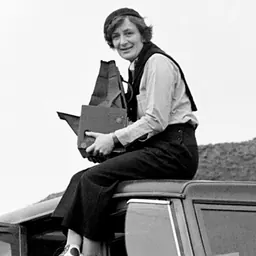
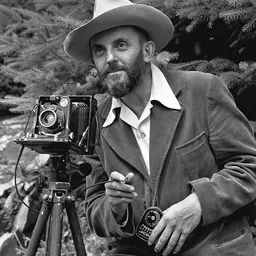
Works Ruess was known for making linoleum prints of landscapes and nature, and was associated with Ansel Adams and Dorothea Lange. His prints show scenes from the Monterey Bay coast, the northern California coast near Tomales Bay, the Sierra Nevada, Utah, and Arizona.
Ruess wrote no books during his life, but he was a lifelong diarist, and sent home hundreds of letters. His journals and poetry were posthumously published in two books, both illustrated with his own woodcuts:
Ruess's story, along with that of Christopher McCandless, was retold more briefly in Jon Krakauer's 1996 book Into the Wild. He is also mentioned in Edward Abbey's 1968 book Desert Solitaire. Wallace Stegner, in his 1942 book, Mormon Country, devotes an entire chapter, "Artist in Residence...", pages 319-350, to Ruess's travels and disappearance in southern Utah. A species of dinosaur, Seitaad ruessi, from the Lower Jurassic of Utah, was named in honor of Ruess by J.J.W. Sertich and M. Loewen, in 2010.
Don’t just read it —
keep it.
Full-length biographies made to live with: read them, listen on the way to work, watch them tonight.
- E-book
- Audio
- Video
Instant download · yours to keep · every purchase keeps this site free
Important facts
People in Everett Ruess's life
Named in this biography and alive at the same time


Related people
Same field, nearest in time


Contemporaries
People whose lives overlapped Everett Ruess's


Frequently asked questions
Who was Everett Ruess?
American artist, poet, writer, and explorer
When was Everett Ruess born?
Everett Ruess was born on 28 March 1914 in Oakland.
When did Everett Ruess die?
Everett Ruess died in 1934 in Garfield County.
What was Everett Ruess's occupation?
Everett Ruess was a writer, explorer, artist, poet and traveler.
What nationality was Everett Ruess?
Everett Ruess was American.
Sources & further reading
Cite this page
APA: Biography.guide. (2026). Everett Ruess. https://biography.guide/everett-ruess/
MLA: "Everett Ruess." Biography.guide, https://biography.guide/everett-ruess/.
Chicago: "Everett Ruess." Biography.guide. https://biography.guide/everett-ruess/.
Data last updated: 2026-09-22 · Spot an error? Report a correction.
Page generated 2026-09-27 05:28 UTC