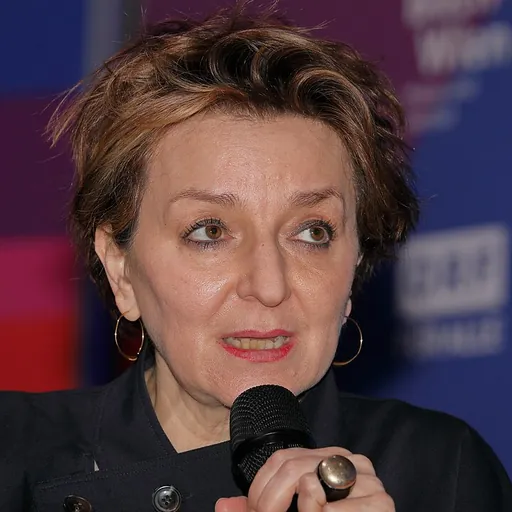
Eva Illouz
Israeli sociologist and university professor
About Eva Illouz
Born 1961. Eva Illouz is a French and Israeli sociologist, university teacher, communication scholar, director of studies and writer.
Eva Illouz (; ; born April 30, 1961) is a French-Israeli professor of sociology at the School for Advanced Studies in the Social Sciences in Paris and a Professor emerita at the Hebrew University of Jerusalem. She was the first woman president of Bezalel Academy of Art and Design.
Biography Eva Illouz was born in Fes, Morocco, and moved to France at the age of ten with her parents. She received a B.A. in sociology, communication and literature in Paris, an M.A. in literature in Paris, an M.A. in communication from the Hebrew University, and received her PhD in communications and cultural studies at the Annenberg School for Communication of the University of Pennsylvania in 1991. Her mentor was Prof. Larry Gross, currently in 2021 the head of the Annenberg School of Communications at USC.
She taught at Tel Aviv University until 2000. In 2006, she joined Hebrew University's Center for the Study of Rationality. She has held the Rose Isaac Chair in Sociology at the Hebrew University of Jerusalem. Since 2015, she is Directrice d'Etudes at the École des Hautes Études en Sciences Sociales in Paris.
In 2008 she was a fellow at the Berlin Institute for Advanced Study. Her book Oprah Winfrey and the Glamour of Misery won the Best Book Award, American Sociological Association, 2005 Culture Section. In 2004, Illouz received the Outstanding research award of the Hebrew University of Jerusalem. In the same year, Illouz delivered the Adorno lectures Cold Intimacies: The Making of Emotional Capitalism at the Institute for Social Research in Frankfurt. In 2009, the German newspaper Die Zeit chose her as one of the 12 thinkers most likely to "change the thought of tomorrow". In 2013, she received the Annaliese Meier International Award for Excellence in Research from the Alexander von Humboldt Foundation. Her book Why Love Hurts won the best book award of the Alpine Philosophy Society in France. It is also the recipient of the 2014 Outstanding Recent Contribution Award (Sociology of Emotions section) from the American Sociological Association. In 2018, Illouz received the E.M.E.T award , the highest scientific distinction in Israel. In July 2018, she was also made Chevalier de la Légion d'honneur in France. In 2021 Illouz received the Albertus Magnus award from the University of Cologne. In 2024, Illouz was awarded the Frank Schirrmacher Prize in "recognition of outstanding contributions to our understanding of current events". In 2024, Illouz was also awarded the Aby Warburg Prize for outstanding achievements in humanities and social sciences. In 2025, the Israel Prize committee selected Illouz for the 2025 Israel Prize in Sociology. However, education minister Yoav Kisch declared that he would not allow this award to be given to Illouz, citing a 2021 petition to the International Criminal Court that she had signed, which stated that Israel should not be allowed to investigate its own alleged war crimes. Following this, the Institute for Israeli Thought awarded Illouz the Democratic Israel Prize, and the Hebrew University awarded her a lifetime achievement award. In 2025, Illouz was selected to give the prestigious Schiller Lecture in Marbach (Schillerrede), and the annual Willy Brandt speech at the Bundeskanzler Willy Brandt Stiftung in Lübeck.
Research topics Illouz's research is at the junction of the sociology of emotions, of culture and of capitalism. In her latest works she has increasingly focused on the impact of capitalism on sexuality and emotions.
In her book Why Love Hurts she centers on the notion of choice. The book makes the somewhat counter-intuitive claim that one of the most fruitful ways to understand the transformation of love in modernity is through the category of choice. Illouz views choice as the defining cultural hallmark of modernity because in the economic and political arenas, choice embodies the two faculties that justify the exercise of freedom, namely rationality and autonomy. She extends this insight to the emotional realm and studies the various mechanisms through which in modernity choice of a mate have changed and have transformed the emotions active in the will of partners who meet in a market situation. In this sense, choice is one of the most powerful cultural and institutional vectors helping us understand modern individualism. Given that choice is intrinsic to modern individuality, how and why people choose – or not – to enter a relationship is crucial to understanding love as an emotion and a relationship.
Sociological critique of Psychology and self-help culture Illouz argues that psychology has been central to the constitution of modern identity and to modern emotional life: from the 1920s to the 1960s clinical psychologists became an extraordinarily dominant social group as they entered the army, the corporation, the school, the state, social services, the media, child rearing, sexuality, marriage, church pastoral care. In all of these realms, psychology established itself as the ultimate authority in matters of human distress by offering techniques to transform and overcome that distress. Psychologists of all persuasions have provided the main narrative of self-development for the 20th century. The psychological persuasion has transformed what was classified as a moral problem into a disease and may thus be understood as part and parcel of the broader phenomenon of the medicalization of social life. What is common to theme 1 and theme 2 is that both love and psychological health constitute utopias of happiness for the modern self, that both are mediated through consumption and that both constitute horizons to which the modern self aspires. In that sense, one overarching theme of her work can be called the utopia of happiness and its interaction with the utopia of consumption.
Published works Eva Illouz is the author of 16 books, some of which have been translated into 25 languages, and of numerous articles.
1997: Consuming the Romantic Utopia: Love and the Cultural Contradictions of Capitalism. Berkeley: University of California Press. (371 pp.). (Trad. esp.: El consumo de la utopía romántica, Buenos Aires/Madrid, Katz editores S.A, 2009, ) 2002: The Culture of Capitalism (in Hebrew). Israel University Broadcast (110 pp.). 2003: Oprah Winfrey and the Glamour of Misery: An Essay on Popular Culture. Columbia University Press (300 pp.) 2007: Cold Intimacies: The Making of Emotional Capitalism. Polity Press. London. (Trad. esp.: Intimidades congeladas, Buenos Aires/Madrid, Katz editores S.A, 2007, ) 2008: Saving the Modern Soul: Therapy, Emotions, and the Culture of Self-Help, The University of California Press. 2011: Who needs democracy anyway?, Haaretz. 2011: Neutrality is political, Haaretz. 2011: A collapse of trust, Haaretz. 2012: Why Love Hurts: A Sociological Explanation, Polity. (German translation by Michael Adrian: Warum Liebe weh tut, Suhrkamp Verlag, Berlin ). 2014: Hard Core Romance: Fifty Shades of Grey, Best Sellers and Society, University of Chicago Press. (in German: Die neue Liebesordnung: Frauen, Männer und Shades of Grey. Suhrkamp Verlag, Berlin 2013. ). 2015: Israel – Sociological Essays, Suhrkamp Verlag, Berlin. . 2018: Emotions as Commodities: How Commodities Became Authentic. Routledge (German translation by Michael Adrian: Wa(h)re Gefühle – Authentizität im Konsumkapitalismus, foreword by Axel Honneth, Suhrkamp Verlag, Berlin. ). 2018: Unloving: A Sociology of Negative Relations. Oxford University Press (German translation by Michael Adrian: Warum Liebe endet – Eine Soziologie negativer Beziehungen, Suhrkamp Verlag, Berlin 2020. ). 2018: Happycracy: How the Industry of Happiness controls our lives. Polity Press (French translation by Frédéric Joly: Happycratie: Comment l’Industrie du Bonheur contrôle notre vie, Premier Parallèle Editeur, Paris. ). 2023: The Emotional Life of Populism: How Fear, Disgust, Resentment, and Love Undermine Democracy. Polity Press. 2025: October 8th: a genealogy of virtuous hatred, published in French. 2025: La Civilisation des émotions, published in French. 2025: Explosive Emotions: How Modern Society Shapes What We Feel. First published in German in 2024, titled "Explosive Moderne".
Don’t just read it —
keep it.
Full-length biographies made to live with: read them, listen on the way to work, watch them tonight.
- E-book
- Audio
- Video
Instant download · yours to keep · every purchase keeps this site free
Important facts
People in Eva Illouz's life
Named in this biography and alive at the same time







Related people
Same field, nearest in time


Contemporaries
People whose lives overlapped Eva Illouz's


Frequently asked questions
Who is Eva Illouz?
Israeli sociologist and university professor
When was Eva Illouz born?
Eva Illouz was born on 30 April 1961 in Fez.
What is Eva Illouz's occupation?
Eva Illouz is a sociologist, university teacher, communication scholar, director of studies and writer.
What nationality is Eva Illouz?
Eva Illouz is French and Israeli.
Sources & further reading
Cite this page
APA: Biography.guide. (2026). Eva Illouz. https://biography.guide/eva-illouz/
MLA: "Eva Illouz." Biography.guide, https://biography.guide/eva-illouz/.
Chicago: "Eva Illouz." Biography.guide. https://biography.guide/eva-illouz/.
Data last updated: 2026-09-22 · Spot an error? Report a correction.
Portrait: Wikimedia Commons · author & licence
Page generated 2026-09-27 05:03 UTC