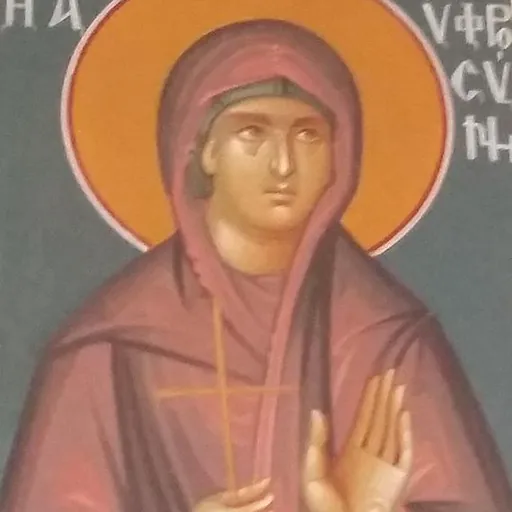
About Euphrosyne of Alexandria
Lived 414 – 470 (aged 55–56). Euphrosyne of Alexandria was an ascetic and nun.
Euphrosyne of Alexandria ( tr. "good cheer", 410–470), also called Euphrosynē, was an Egyptian saint who disguised herself as a male to enter a monastery and live, for 38 years, as an ascetic. Her feast day is celebrated on September 25 by the Greek Orthodox Church and Byzantine Rite Catholics, on September 27 by the Episcopal Church, and on January 16 by the Roman Catholic Church.
Euphrosyne was purportedly born to a wealthy family in Alexandria. When she was 18, her father wanted her to marry, so she escaped, disguised as a man, and entered a monastery. She spent most of her years as a monk in seclusion from the other monks. During the final year of her life, Euphrosyne became her father's spiritual director, comforting his grief over losing his only daughter. Eventually, she revealed her identity to him and they reconciled. After she died, he entered her monastery and became an ascetic himself, living in her cell until he died ten years later. Ecclesiastical historian Johann Peter Kirsch considered her story a legend.
Life According to Johann Peter Kirsch in the Catholic Encyclopedia, "Her story belongs to that group of legends which relate how Christian virgins, in order the more successfully to lead the life of celibacy and asceticism to which they had dedicated themselves, put on male attire and passed for men". She was baptized at the age of seven, educated in the scriptures, and was well known for her wisdom and love of learning. As writer David Clark put it, she was "unwilling to allow her gender to be a barrier to adopting this lifestyle for herself". She sent a servant to bring another monk to her, a hermit from Scete, who gave her the same advice. At her request, the monk shaved her head and invested her as a monk. eventually only seeing his spiritual director and the abbot. Clark, in his chapter about Euphrosyne in his book Between Medieval Men: Male Friendship and Desire in Early Medieval English Literature, compares her story with the story of Joseph in the Old Testament, which also includes themes of disguise and secret identities. Clark discusses "the complex and contradictory gender dynamic" in Euphrosyne's story, compares Euphrosyne with Eugenia of Rome, a 3rd-century saint who also disguised herself as a man, because they share a "similar dynamic".
Don’t just read it —
keep it.
Full-length biographies made to live with: read them, listen on the way to work, watch them tonight.
- E-book
- Audio
- Video
Instant download · yours to keep · every purchase keeps this site free
Important facts
Related people
Same field, nearest in time
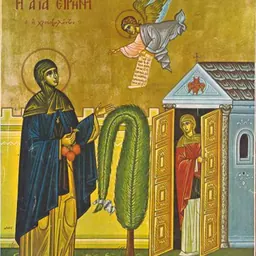

Contemporaries
People whose lives overlapped Euphrosyne of Alexandria's
Frequently asked questions
Who was Euphrosyne of Alexandria?
Egyptian monk and saint
When was Euphrosyne of Alexandria born?
Euphrosyne of Alexandria was born in 414 in Alexandria.
When did Euphrosyne of Alexandria die?
Euphrosyne of Alexandria died in 470 in Alexandria.
What was Euphrosyne of Alexandria's occupation?
Euphrosyne of Alexandria was an ascetic and nun.
Sources & further reading
· Wikipedia: Euphrosyne of Alexandria
· DBpedia: Euphrosyne of Alexandria
Cite this page
APA: Biography.guide. (2026). Euphrosyne of Alexandria. https://biography.guide/euphrosyne-of-alexandria/
MLA: "Euphrosyne of Alexandria." Biography.guide, https://biography.guide/euphrosyne-of-alexandria/.
Chicago: "Euphrosyne of Alexandria." Biography.guide. https://biography.guide/euphrosyne-of-alexandria/.
Data last updated: 2026-09-25 · Spot an error? Report a correction.
Portrait: Wikimedia Commons · author & licence
Page generated 2026-10-04 10:14 UTC