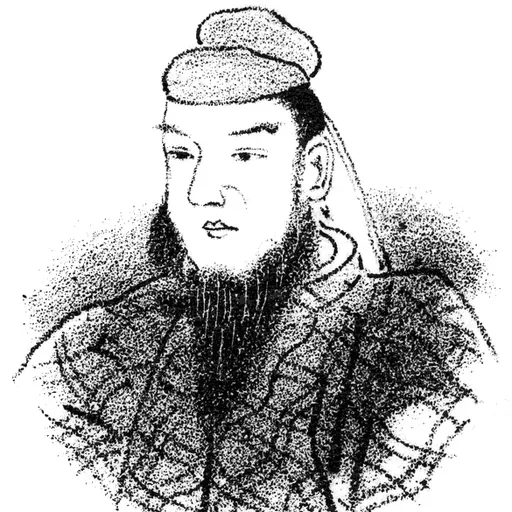
About Ingyō
Lived 376 – 453 (aged 76–77). Ingyō was a Japanese ruler.
Protohistoric narrative The Japanese have traditionally accepted this sovereign's historical existence, and a mausoleum (misasagi) for Ingyō is currently maintained. The following information available is taken from the pseudo-historical Kojiki and Nihon Shoki, which are collectively known as or Japanese chronicles. These chronicles include legends and myths, as well as potential historical facts that have since been exaggerated and/or distorted over time. It's recorded in the Kiki that Ingyō was born to somewhere between 373 and 375 AD and was given the name . ) by local men for her beauty. Ingyō couldn't punish his son due to the title he had bestowed upon him, so instead chose an indirect approach by banishing his daughter Karu no Ōiratsume to Iyo. Kinashi no Karu meanwhile faced a challenge as his younger brother Anaho was favored to be heir apparent. Scholar Francis Brinkley lists Emperor Ingyō under "Protohistoric sovereigns" whose reign was overshadowed by an affair and scandal regarding his son. Other scholars identify Ingyō with King Sai in the Book of Song. This would have been a king of Japan (referred to as Wa by contemporary Chinese scholars) who is said to have sent messengers to the Liu Song dynasty at least twice, in 443 and 451. However, there is no record in the Kiki of messengers being sent.
Titles and dating There is no evidence to suggest that the title tennō was used during the time to which Ingyō's reign has been assigned. Rather, it was presumably , meaning "the great king who rules all under heaven". An alternate title could have also been / "Great King of Yamato". The name Ingyō-tennō was more than likely assigned to him posthumously by later generations. His name might have been regularized centuries after the lifetime ascribed to Ingyō, possibly during the time in which legends about the origins of the imperial dynasty were compiled as the chronicles known today as the Kojiki.
Outside of the Kiki, the reign of Emperor Kinmei ( – 571 AD) is the first for which contemporary historiography has been able to assign verifiable dates. The conventionally accepted names and dates of the early Emperors were not confirmed as "traditional" though, until the reign of Emperor Kanmu between 737 and 806 AD. At the time, marriage between children of the same father had always been allowed as long as the mothers involved were different. Marriage of children of the same mother of whom Kinashi no Karu was guilty of was considered incest. Modern sources have since questioned the reliability of this "first earthquake", opting instead to recognize another that took place in Nara prefecture on May 28, 599 during the reign of Empress Suiko. The Imperial Household Agency designates this location as Ingyō's mausoleum/kofun-type Imperial tomb. Formally, this tomb is called , but is also given the name . Another burial candidate for Emperor Ingyō's is the , which is also located in Fujiidera. Ingyō is also enshrined at the Imperial Palace along with other emperors and members of the Imperial Family at the Three Palace Sanctuaries.
Consorts and children Spouse/Concubine
Position Name Father Issue Empress(Kōgō) Prince Comments Prince Prince Kinashi was later defeated by Prince Anaho (see below) Princess Prince Prince Sakai allegedly died sometime in 456 AD. Prince Emperor Ingyō's 3rd son later became Emperor Ankō. Princess "Princess Karu" and "Otohime" are synonymous in the Kojiki. Prince Yatsuri's lifespan was allegedly 401 to 456 AD. Prince Emperor Ingyō's 5th son later became Emperor Yūryaku. Princess Princess Princess Synonymous with aka Princess Sotoorihime
Don’t just read it —
keep it.
Full-length biographies made to live with: read them, listen on the way to work, watch them tonight.
- E-book
- Audio
- Video
Instant download · yours to keep · every purchase keeps this site free
Important facts
Family & relationships
People in Ingyō's life
Named in this biography and alive at the same time

Related people
Same field, nearest in time



Contemporaries
People whose lives overlapped Ingyō's

Frequently asked questions
Who was Ingyō?
19th Emperor of Japan
When was Ingyō born?
Ingyō was born in 376.
When did Ingyō die?
Ingyō died on 8 February 453.
What was Ingyō's occupation?
Ingyō was a ruler.
What nationality was Ingyō?
Ingyō was Japanese.
Sources & further reading
Cite this page
APA: Biography.guide. (2026). Ingyō. https://biography.guide/ingyo/
MLA: "Ingyō." Biography.guide, https://biography.guide/ingyo/.
Chicago: "Ingyō." Biography.guide. https://biography.guide/ingyo/.
Data last updated: 2026-09-23 · Spot an error? Report a correction.
Portrait: Wikimedia Commons · author & licence
Page generated 2026-09-27 05:07 UTC