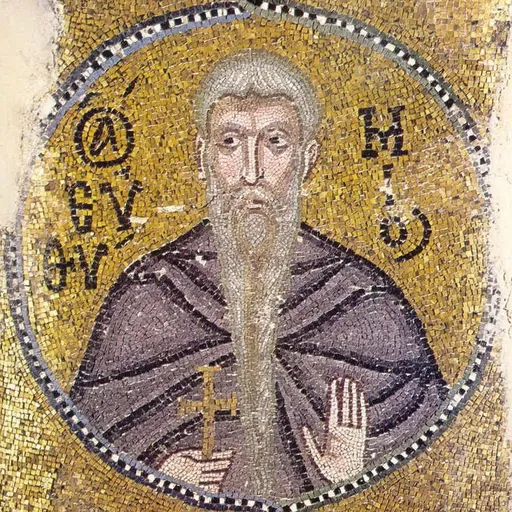
About Euthymius the Great
Lived 377 – 473 (aged 95–96). Euthymius the Great was a Byzantine priest.
Euthymius the Great (377 – 20 January 473) was an abbot in Palestine. He is venerated in both Roman Catholic and Eastern Orthodox Churches.
Euthymius' vita was written by Cyril of Skythopolis, who describes him as the founder of several monasteries in the Judaean desert, while remaining a solitary monk in the tradition of Egyptian monasticism. He nevertheless played a decisive role in helping the decisions of the Council of Chalcedon (451) prevail in Jerusalem, in spite of the majority of the monks in the region opposing it.
Melitene Euthymius was born in Melitene in Lesser Armenia in 377, in a pious family of noble birth. According to Christian tradition, his parents, Paul and Dionysia, had prayed for a son at the church of Saint Polyeuctus in Melitene. When the child was born, they named him Euthymius, meaning "good cheer".
Euthymius was educated by Bishop Otreius of Melitene, who afterwards ordained him and placed him in charge of all the monasteries in the Diocese of Melitene.
Pharan near Jerusalem In 405 or 406, at twenty-nine or thirty years of age, he secretly set out on a pilgrimage to Jerusalem and remained for five years there in an anchoritic cell he built for himself in a cave near the laura (settlement of monks) of Pharan, about six miles east of Jerusalem,
Monastery of Theoctistus In 411, Euthymius withdrew into the wilderness (Greek eremos) with a fellow hermit from Pharan, Theoctistus (see below), living in a rough cavern on the banks of a torrent.
Cyril of Skythopolis is describing how a miraculous cure effected by Euthymius for Terebon, the son of the Saracen chief called "Aspebetus" by Cyril (in fact probably the Persian title of the man, "spahbed"), led the latter and his entire tribe into adopting Christianity, with Aspebetus being baptised as Peter. The tribe of Peter settled near the monastery. Peter, the Bedouin chief Euthymius had baptised, joined him and had a number of facilities built for the two: a large cistern, three cells, a chapel and a bakery. in which capacity he went on to attend the Council of Ephesus in 431.
Laura of Euthymius Euthymius, who initially had no intention of founding a monastery around his cave, He would later become a renowned archimandrite of the hermits in the country.
Death, burial and feast day Euthymius remained in good health until the age of 94, dying on 20 January 473, and was buried in a specially built tomb inside his monastery.
The Church celebrates his feast on the day of his death, 20 January; for Orthodox Christians who still go by the Julian calendar, the feast falls on 2 February on the Gregorian calendar.
Theoctistus
Theoctistus (also spelled Theoktistos) of Palestine was an associate of Euthymius. He was an ascetic who lived in a nearby cell at the Pharan lavra. About five years after Euthymius arrived, they went into the desert for Great Lent, and found in a wadi a large cave where they remained praying in solitude for some time. Eventually shepherds from Bethany discovered them, and people from the area began to visit seeking spiritual guidance and bringing food. The monks then built a church. When other monks came seeking instruction, Euthymius and Theoctistus built a lavra over the cave church. Theoctistus became hegumen of the monastery.
Theoctistus died at an advanced age in 451 and is commemorated on 3 September.
Don’t just read it —
keep it.
Full-length biographies made to live with: read them, listen on the way to work, watch them tonight.
- E-book
- Audio
- Video
Instant download · yours to keep · every purchase keeps this site free
Important facts
Related people
Same field, nearest in time



Contemporaries
People whose lives overlapped Euthymius the Great's
Frequently asked questions
Who was Euthymius the Great?
Armenian Christian abbot and hermit (377-473)
When was Euthymius the Great born?
Euthymius the Great was born in 377 in Malatya.
When did Euthymius the Great die?
Euthymius the Great died on 20 January 473 in Jerusalem.
What was Euthymius the Great's occupation?
Euthymius the Great was a priest.
What nationality was Euthymius the Great?
Euthymius the Great was Byzantine.
Sources & further reading
· Wikipedia: Euthymius the Great
· DBpedia: Euthymius the Great
Cite this page
APA: Biography.guide. (2026). Euthymius the Great. https://biography.guide/euthymius-the-great/
MLA: "Euthymius the Great." Biography.guide, https://biography.guide/euthymius-the-great/.
Chicago: "Euthymius the Great." Biography.guide. https://biography.guide/euthymius-the-great/.
Data last updated: 2026-09-23 · Spot an error? Report a correction.
Portrait: Wikimedia Commons · author & licence
Page generated 2026-09-27 05:05 UTC