
Eugene Oberst
American football player and coach, track and field athlete and coach, basketball coach, college athletics administrator
About Eugene Oberst
Lived 1901 – 1991 (aged 89). Eugene Oberst was an American basketball coach, athletics competitor, american football player and javelin thrower.
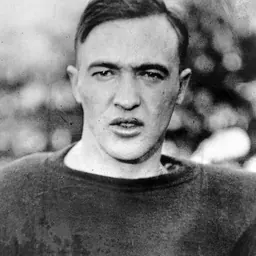
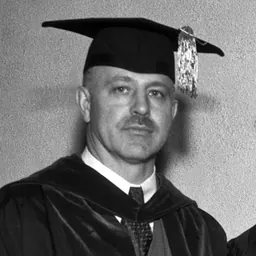
Eugene G. Oberst (July 23, 1901 – May 30, 1991) was an American football player, track and field athlete, coach of football and basketball, and college athletics administrator. Oberst was born the youngest of eleven children. Oberst served as the head football coach at Washington and Lee University (1929–1930), Canisius College (1931–1932), and John Carroll University. was a right tackle for the Notre Dame Fighting Irish in 1920, 1922, and 1923, wearing uniform No. 30, while missing the 1921 season due to injury. In 1922 and 1923, he was one of Notre Dame's "Seven Mules," the offensive linemen who blocked for the team's legendary Four Horsemen, before those terms were coined during Notre Dame's 1924 national championship season. Oberst's teammates also included halfback George Gipp.
Javelin throw As the possibly apocryphal story goes, Oberst was walking by a Notre Dame track and field practice one day when a javelin landed nearby. He picked it up and threw it far beyond the original thrower. Rockne, who coached track and field as well as football, saw the toss, and drafted Oberst on the spot. Oberst was the 1921 NCAA javelin champion, with a throw of . At the 1924 Penn Relays, Oberst's throw of beat the meet record by more than 8 feet. Oberst had a disappointing performance at the U.S. Olympic Trials in Cambridge, Massachusetts, finishing in 5th place with a throw of . The U.S. Olympic Committee added Oberst to the Olympic team, anyway, because of his better results at previous meets. The Olympic Trials winner, William Neufeld of UC Berkeley went on to finish 5th at the Olympics.
Bronze Olympic medal In Paris, Oberst's throw of 58.35 m won him the bronze medal, behind the defending Olympic champion, Jonni Myyrä of Finland (62.96 m) and Gunnar Lindström of Sweden (60.92 m). Oberst was the first American to win an Olympic medal in the javelin throw, and only seven Americans have medaled since, most notably Babe Didrikson at the 1932 Olympics in Los Angeles. Oberst was somewhat disappointed with his reception after returning with the medal and his niece noted few ever remarked on the accomplishment. She later told a reporter, "I don't think he was ever given the honor for winning an Olympic medal".
Oberst's Notre Dame football teammate Tom Lieb also made the 1924 U.S. Olympic team, in the discus throw, and won the bronze medal.
Coaching career After college, Oberst became a coach, teacher, and athletics administrator. In 1926 and 1927, his football teams at Roman Catholic High School won the championships of the Philadelphia Catholic League, with a combined record of 15–3–1. From 1929 to 1930, Oberst coached the Washington and Lee University Generals, compiling a 6–11–2 record. In 1931 and 1932, Oberst coached at Canisius College, where his record was 2–7–3.
Oberst later moved on to John Carroll College, now John Carroll University, where he finished his career. He was a football line coach for the Blue Streaks from 1936 to 1942. Oberst then served as director of the school's V-12 Navy training program from 1942 to 1946. He was head basketball coach during the 1945–46 season, with a 4–11 record, and head football coach in 1946, with a 1–7 record. Oberst also coached the school's track and field team from 1947 to 1948. Finally, Oberst served as John Carroll's athletic director from 1947 to 1951. During that time period, John Carroll's football halfback was future Hall of Famer Don Shula.
Later years
In 1971, Oberst was inducted into John Carroll University's Athletic Hall of Fame. In 1976, he was inducted into the Greater Cleveland Sports Hall of Fame. Oberst died in Cleveland in 1991.
Head coaching record Football
Don’t just read it —
keep it.
Full-length biographies made to live with: read them, listen on the way to work, watch them tonight.
- E-book
- Audio
- Video
Instant download · yours to keep · every purchase keeps this site free
Important facts
People in Eugene Oberst's life
Named in this biography and alive at the same time






Related people
Same field, nearest in time


Contemporaries
People whose lives overlapped Eugene Oberst's




Frequently asked questions
Who was Eugene Oberst?
American football player and coach, track and field athlete and coach, basketball coach, college athletics administrator (1901-1991)
When was Eugene Oberst born?
Eugene Oberst was born on 23 July 1901 in Owensboro.
When did Eugene Oberst die?
Eugene Oberst died on 30 May 1991 in Cleveland.
What was Eugene Oberst's occupation?
Eugene Oberst was a basketball coach, athletics competitor, american football player and javelin thrower.
What nationality was Eugene Oberst?
Eugene Oberst was American.
Sources & further reading
Cite this page
APA: Biography.guide. (2026). Eugene Oberst. https://biography.guide/eugene-oberst/
MLA: "Eugene Oberst." Biography.guide, https://biography.guide/eugene-oberst/.
Chicago: "Eugene Oberst." Biography.guide. https://biography.guide/eugene-oberst/.
Data last updated: 2026-09-20 · Spot an error? Report a correction.
Page generated 2026-09-27 05:33 UTC