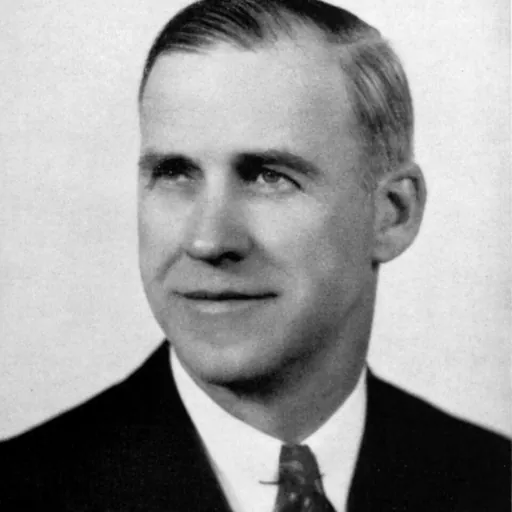
Clark Shaughnessy
American football player and coach
About Clark Shaughnessy
Lived 1892 – 1970 (aged 78). Clark Shaughnessy was an American basketball coach, american football player and american football coach.
Clark Daniel Shaughnessy (born Clark Daniel O'Shaughnessy; March 6, 1892 – May 15, 1970) was an American football coach and innovator. He is sometimes called the "father of the T formation" and the original founder of the forward pass, although that system had previously been used as early as the 1880s. Shaughnessy did, however, modernize the obsolescent T formation to make it once again relevant in the sport, particularly for the quarterback and the receiver positions. He employed his innovations most famously on offense, but on the defensive side of the ball as well, and he earned a reputation as a ceaseless experimenter.
Shaughnessy held head coaching positions at Tulane University, Loyola University New Orleans, the University of Chicago, Stanford University, the University of Maryland, the University of Pittsburgh, the University of Hawaii, and in the National Football League with the Los Angeles Rams. Shaughnessy also served in advisory capacities with the Chicago Bears and the Washington Redskins.
He reached the height of his success in 1940, in his first season at Stanford, where he led the Indians to an undefeated season that culminated with a Rose Bowl victory. That year, he also helped prepare the Chicago Bears for the 1940 NFL Championship Game, in which they routed Washington, 73–0. Shaughnessy's successes showcased the effectiveness of the T formation and encouraged its widespread adoption. He was inducted into the College Football Hall of Fame in 1968. Shaughnessy also coached college basketball at Tulane University. He played college football at the University of Minnesota.
In 2021, the Professional Football Researchers Association named Shaughnessy to the PFRA Hall of Very Good Class of 2021.
Early life and college Shaughnessy was born on March 6, 1892, in St. Cloud, Minnesota, the second son of Lucy Ann (Foster) and Edward Shaughnessy. He attended North St. Paul High School, and prior to college, had no athletic experience. When he attended the University of Minnesota, however, he played college football under head coach Henry L. Williams and alongside halfback Bernie Bierman. and Williams considered him to be the best passer from the Midwest. Shaughnessy handled both the passing and kicking duties for the team. Of the three, Shaughnessy said he preferred the tackle position.
Shaughnessy played basketball as a guard and ran track in the 440- and 880-yard events. Shaughnessy also competed as a rower with the St. Paul Boat Club. The school offered Shaughnessy $1,875 ($ adjusted for inflation) to be its football, basketball, and track coach, and athletic director. By 1919, Shaughnessy had transformed Tulane into a competitor amongst Southern collegiate teams. That season, he guided them to a then school record of seven consecutive wins. In 1920, Germany Schulz was hired to take over duties as athletic director, and he also aided Shaughnessy as the line coach from 1923 to 1925.
In 1923, Shaughnessy hired his former teammate Bernie Bierman as an assistant coach. because they believed the Tulane players were too small. Indiana University attempted to hire Shaughnessy after his undefeated season, but he instead chose to sign a ten-year extension with Tulane.
In a 1926 article written for the NEA News Service, he responded to those who asked him how the "Shaughnessy System" worked so well. He said, "If there is a 'Shaughnessy system' at Tulane, if it has any 'secret,' two words tell the whole story—common sense. All that I have done at Tulane is take the material I found and train it in plays built around the individual abilities of each man."
Despite optimistic preseason predictions, Tulane suffered its first and only losing season of Shaughnessy's tenure in 1926. Shaughnessy later received similar offers from Louisiana State and Wisconsin. On April 8, 1927, he tendered his resignation without a publicly stated reason and was subsequently released from his contract. Tulane replaced him with former assistant Bernie Bierman. He also coached the basketball team for three seasons between 1915 and 1918 and amassed a 27–15 record.
Loyola In June 1927, nearby Loyola of the South hired Shaughnessy as its head football coach. According to The Wow Boys: A Coach, a Team, and a Turning Point in College Football, a New Orleans millionaire offered him $175,000 to coach Loyola for ten years ($ adjusted for inflation).
In 1928, Loyola traveled to South Bend, Indiana, to play Notre Dame in its season opener. The Wolves took a 6–0 halftime lead before they eventually fell, 12–6. After the game, Notre Dame head coach Knute Rockne reportedly said, "Never get me another 'warm-up game' against a team coached by that guy."
At Loyola, Shaughnessy retained his emphasis on the forward pass. In 1930, the Wolves beat larger but unprepared Iowa State and Detroit teams in consecutive weeks with the same passing play. During his tenure, he was called "the greatest one man coaching staff in football." He also brought to Loyola his modified version of the Minnesota shift, which he claimed no opponent had been able to completely counteract. Despite opportunities to coach elsewhere, Shaughnessy remained in New Orleans because he liked the city and it was his wife's hometown. Athletic director T. Nelson Metcalf hired Shaughnessy to replace Stagg as head coach in 1933. He did, however, inherit from Stagg at least one important recruit: whom many Midwest pundits considered the best back of the 1930s.
Under an academic program implemented in 1933 known as the New Plan or the Chicago Plan, annual comprehensive examinations replaced end-of-term testing.
In January 1934, Shaughnessy hired Marchmont Schwartz as an assistant coach. Schwartz had played on Shaughnessy's Loyola freshman team before he transferred to Notre Dame. In February, Shaughnessy declined interest from Ohio State to replace former head coach Sam Willaman, and said that he had already assembled his coaching staff and had no desire to leave Chicago. In 1935, offered Shaughnessy a job as its head coach, which he seriously considered. Chicago moved to retain him, possibly with a salary increase, and the Harvard job ultimately went to former coach Dick Harlow.
After breaking even in each of his first three seasons, Shaughnessy's Chicago teams suffered a losing record each year from 1936 to 1939. The Maroons were outscored by their opponents, 308–37, and failed to tally in each loss. These included routs by Michigan, 85–0; Ohio State, 61–0; Illinois, 46–0; Harvard, 61–0; and Virginia, 47–0. He said, "I did not de-emphasize football at the University of Chicago, I abolished it." Hutchins hoped the move would set an example for other universities to follow, but this did not occur. His final record at Chicago was 17–34–4.
During his coaching tenure at the University of Chicago, Shaughnessy befriended George Halas, the owner and coach of the Chicago Bears. With the Bears, Jones experimented with the old T formation, and he spread the linemen, pushed out one receiver, and used a back as a man in motion, the latter usually being Red Grange. In 1937, Shaughnessy began to work part-time as a consultant to the Bears for $2,000 per year ($ adjusted for inflation). The Bears continued to experiment with the T, The media has sometimes erroneously credited Shaughnessy for the invention of the T formation. The Associated Press wrote that "he was, however, undeniably the father of the modern T-attack." At the time, the 1939 Stanford Indians were considered the worst team to have ever represented the university. During the job search, Stanford officials were surprised to learn how well regarded Shaughnessy, a coach of only occasionally successful squads, was amongst his peers. Many considered him as a "mad scientist" of football experimentation. The move surprised even Shaughnessy, who said, "I didn't expect it." Perhaps most importantly, Shaughnessy inherited back Frankie Albert, whom he considered a prototypical T formation quarterback. In 1943, Shaughnessy wrote that he considered the 1940 Stanford backfield—quarterback Frankie Albert, fullback Norm Standlee, right halfback Hugh Gallarneau, and left halfback Pete Kmetovic—as the greatest in history. While he believed the Indians backfield was better than any such combination in the single-wing, double-wing, short punt, or box formations, he added the caveat that this held true only in the Stanford players' employment in the T-formation.
Shaughnessy assembled a competent coaching staff in line coach Phil Bengtson and backfield coach Marchmont Schwartz.
Most sportswriters, unfamiliar with the T formation, called it the "Shaughnessy Formation" or "Shaughnessy's new razzle-dazzle attacks."
At the end of the season, the Poling System named Stanford the national champions, and in later years, the Billingsley Report and Helms Athletic Foundation did likewise retroactively. Shaughnessy was voted the Scripps-Howard Coach of the Year by a wide margin, The media nicknamed the 1940 squad the "Wow Boys", a play on their impressive feats and the earlier Stanford "Vow Boys",
Stanford's and the Chicago Bears' unexpected success with the modern T formation prompted coaches around the nation to adopt it. Shaughnessy and Halas taught coaching clinics, and Bears quarterback Sid Luckman installed the formation at his alma mater. Luckman also helped implement the T on national championship teams at both Army and Notre Dame. By 1944, more than half of the country's football teams at the collegiate and professional level were using the T.
1941 season
Shaughnessy made the "pessimistic" prediction of at least two losses for his 1941 squad, which lost Gallarneau and Standlee to graduation. His forecast proved accurate, as injuries took their toll, After the Indians fell in their penultimate game, Stanford, Washington, and Oregon State were tied for first-place in the Pacific Coast Conference with two losses each. California's upset win over Stanford, 16–0, in the finale ensured that Oregon State received the Rose Bowl bid.
In February 1942, Shaughnessy traveled to Yale University, which was considering three candidates for its vacant head coaching position. A month later, he said he was not interested in Yale, but that he might move to an unnamed Eastern school with little football tradition. Shaughnessy resigned in March 1942 to move to Maryland.
First stint at Maryland At Maryland, Shaughnessy served as the head football coach, athletic director, and director of physical education, under a "lifetime contract". He installed the T formation, and mentored quarterback Tommy Mont, whom he compared favorably with Frankie Albert. He also praised Terrapins fullback Jack Wright and likened him to Norm Standlee. In 1942, the Terrapins amassed a 7–2 record under Shaughnessy, Mont finished the season as one of the top three passers in the nation. After the season, Shaughnessy left Maryland for Pittsburgh, a move he later called, "the worst thing I ever did." The University of Pittsburgh had de-emphasized football, a move with which Shaughnessy said he was in accordance. During this time, Shaughnessy had to contend with the loss of players to the wartime draft. At Pittsburgh, his teams compiled a 10–17 record from 1943 to 1945 without a winning season.
In March 1944, Washington Redskins owner George Preston Marshall hired Shaughnessy as an advisor, a position he held concurrently with his duties at Pittsburgh. He mentored new head coach Dudley DeGroot in the T formation, in which quarterback Sammy Baugh excelled. Pittsburgh, however, disapproved of his affiliation with the professional franchise. University of Maryland president Dr. H. C. Byrd, himself a former football coach, called Shaughnessy one of the top-three coaches in the nation. Shaughnessy complained that he was not given a fair chance to succeed at Pittsburgh and that controversy over his role with the Redskins was without basis.
Shaughnessy said, "The funny part of it is that I gave Maryland the roughest deal I have ever given anyone in my life, and when Dr. [Byrd] offered me a chance to come back, I accepted." Because of his repeated job changes, the Associated Press dubbed Shaugnessy "football's man in motion". At Maryland, he replaced Bear Bryant who had departed for Kentucky.
After the season, it was rumored that the Redskins were interested in promoting him to replace head coach Turk Edwards, but the franchise denied it and Shaughnessy would not comment on his plans. In January 1947, he quit as Maryland coach, stating that he did not want to remain athletic director or resign from the Washington Redskins, both of which the school wanted. Shaughnessy said he would work full-time for the Redskins for the remaining year on his contract, and might return to coach only college football at the end of his term, possibly with Maryland.
Los Angeles Rams In 1948, Shaughnessy joined the Los Angeles Rams as a "technical advisor" to head coach Bob Snyder. In the preseason, owner Dan Reeves was so impressed with Shaughnessy that Reeves promoted him to head coach and fired Snyder. At Los Angeles, Shaughnessy developed the pro set that used a three wide receiver set. Stydahar, however, led the Rams to the National Conference Championship that season, and the team set numerous NFL passing and scoring records. From 1951 to 1962, Shaughnessy served on the staff of the Chicago Bears as a technical advisor, and defensive specialist.
In 1954, Shaughnessy attended the Blue–Gray Game in Montgomery, Alabama, scouting specifically for flankers. assistant Ray Wedgeworth told him the best receiver in the state was not playing in the game: Harlon Hill of Florence State Teachers' College. Shaughnessy requested game film from Hill's coach, and eventually, the Bears selected him with their 15th round pick in the 1954 NFL draft. That season, Hill was named NFL Rookie of the Year, and in his second season he was named the NEA NFL MVP.
In October 1961, the Bears—utilizing Shaughnessy's complex, shifting defensive alignments—stifled San Francisco 49ers coach Red Hickey's new shotgun formation, 31–0. Chicago had learned lessons against the Baltimore Colts who had attempted to use the shotgun the previous week. Shaughnessy explained his Chicago defensive scheme in November 1961:
We can adjust to fit three things. We have defenses to fit the [offense] we face, the personnel we face and the situation in the game. Bill George calls the basic overall defense. Then Fred Williams calls the defense for the rush men. Richie Petitbon calls the defense for the backs. All of these are real bright boys, and they do a great job.
Shaughnessy mentored middle linebacker Bill George as the defensive play-caller. Bears coach Abe Gibron likened George to having Shaughnessy himself on the field. Shaughnessy worked to counter the increasing use of the forward pass. He emphasized man-to-man coverage, dropped linebackers or defensive ends into pass coverage, and utilized blitzes from multiple directions—which had previously consisted mostly of just a middle linebacker. Anderson also claimed Shaughnessy plagiarized plays from other coaches, renamed them, and claimed them as his own.
Hawaii Shaughnessy briefly returned to coaching in 1965 when he took over at , where the football program was "in a moribund state" and "close to extinction". Hawaii amassed a 1–8–1 record during Shaughnessy's only season, he married L. Mae, with whom he had one son and two daughters: Clark Shaughnessy Jr.; Janice Shaughnessy, and Marcia Wilson. He met his wife in New Orleans while coaching at Tulane.
After he joined the Chicago Bears' staff, sportswriter Roger Treat said, "I always looked upon Clark Shaughnessy as a conscientious idealist who might better have followed the trail of Father Flanagan of Boys Town. He may never be entirely happy in the jovial thuggery of pro football, where every man has a little assassin in him." His son Clark Shaughnessy Jr. was an All-American javelin thrower for the UCLA Bruins track and field team, finishing 6th at the 1938 NCAA track and field championships.
Later life Shaughnessy retired to Santa Monica, California. On May 4, 1970, he was admitted to Santa Monica Hospital suffering from hypertension. He died there at the age of 78 on May 15.
The College Football Hall of Fame inducted Shaughnessy in 1968. Shaughnessy had been a finalist for induction in 1970, 1975, and 1976, but fell short in the voting each time. He was inducted into the University of Minnesota "M" Club Hall of Fame in 2010, the Tulane University Athletics Hall of Fame in 1977, and the Stanford University Athletic Hall of Fame.
Published works The Modern "T" Formation with Man-in-Motion, Clark Shaughnessy, Ralph Jones, and George Halas, Chicago, 1941. Football in War & Peace, Clark Shaughnessy, Clinton, SC: Jacobs Press, 1943.
Don’t just read it —
keep it.
Full-length biographies made to live with: read them, listen on the way to work, watch them tonight.
- E-book
- Audio
- Video
Instant download · yours to keep · every purchase keeps this site free
Important facts
People in Clark Shaughnessy's life
Named in this biography and alive at the same time




Related people
Same field, nearest in time


Contemporaries
People whose lives overlapped Clark Shaughnessy's

Frequently asked questions
Who was Clark Shaughnessy?
American football player and coach (1892–1970)
When was Clark Shaughnessy born?
Clark Shaughnessy was born on 6 March 1892 in St. Cloud.
When did Clark Shaughnessy die?
Clark Shaughnessy died on 15 May 1970 in Santa Monica.
What was Clark Shaughnessy's occupation?
Clark Shaughnessy was a basketball coach, american football player and american football coach.
What nationality was Clark Shaughnessy?
Clark Shaughnessy was American.
Sources & further reading
· Wikipedia: Clark Shaughnessy
Cite this page
APA: Biography.guide. (2026). Clark Shaughnessy. https://biography.guide/clark-shaughnessy/
MLA: "Clark Shaughnessy." Biography.guide, https://biography.guide/clark-shaughnessy/.
Chicago: "Clark Shaughnessy." Biography.guide. https://biography.guide/clark-shaughnessy/.
Data last updated: 2026-09-23 · Spot an error? Report a correction.
Portrait: Wikimedia Commons · author & licence
Page generated 2026-09-27 05:04 UTC