
Eugene Bullard
First African-American military pilot
About Eugene Bullard
Lived 1895 – 1961 (aged 66). Eugene Bullard was an American aircraft pilot, military personnel, boxer and french foreign legionnaire.
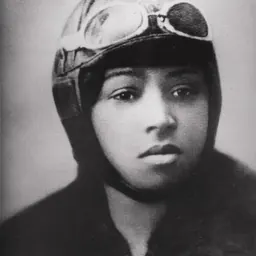
Eugene Jacques Bullard (born Eugene James Bullard; October 9, 1895 – October 12, 1961) was one of the first African-American military pilots, although Bullard flew for France, not the United States. Bullard was one of the few Black combat pilots during World War I (along with Pierre Réjon from France, William Robinson Clarke, a Jamaican who flew for the Royal Flying Corps, from Italy, and Ahmet Ali Çelikten of the Ottoman Empire). Also a boxer and a jazz musician, he was called "L'Hirondelle noire" in French (literally "Black Swallow").
All Blood Runs Red, a biography of Bullard by Phil Keith and Tom Clavin, was published in 2019 by Hanover Square Press.
Early life Bullard was born in Columbus, Georgia, the seventh of 10 children born to William (Octave) Bullard, a Black man from Stewart County, Georgia, and Josephine ("Yokalee") Thomas, a Black woman said to be of African-American and Indigenous (Muscogee Creek) heritage. His paternal ancestors had been enslaved in Georgia and Virginia according to U.S. census records, and his father was born on a property owned by Wiley Bullard, a slave-owning planter in Stewart County. Bullard attended the 28th Street School in Columbus from 1901 to 1906, completing the fifth grade. Despite this, Bullard became enamored with his father's stories of France, where slavery had been abolished and blacks were treated in the same way as whites. When Bullard reached his 11th birthday, he ran away from home with the intention of getting to France. Stopping in Atlanta, he joined a British clan of Romanis known by the surname of Stanley and traveled throughout Georgia tending their horses and learning to race. It was the Stanleys who told him how the racial barriers did not exist in Britain and reset his determination to now get to the United Kingdom. In 1912, he made his way to Norfolk, Virginia, where he stowed away on the German freighter Marta Russ, hoping to escape racial discrimination. Bullard arrived at Aberdeen, Scotland, and made his way first to Glasgow and then to London, where he boxed and performed slapstick in Belle Davis's "Freedman Pickaninnies", an African-American troupe. as foreign volunteers were allowed only to serve in the Foreign Legion.
By 1915, Bullard was a machine gunner and saw combat on the Somme front in Picardy. In May and June, he was at Artois, and in the fall of that year fought in the Second Battle of Champagne (September 25November 6, 1915) along the Meuse River. He was assigned to the 3rd Marching Regiment of the 1st Foreign Regiment. On July 13, 1915, he joined the 2nd Marching Regiment of the 1st Foreign Regiment and also served with the . The 2nd Marching Regiment of the 1st Foreign Regiment and the 2nd Marching Regiment of the 2nd Foreign Regiment were serving as part of the 1st Moroccan Division. Commanded initially by Hubert Lyautey, Resident-General of Morocco at the outbreak of World War I, the division was a mix of the Metropolitan and Colonial French troops, including Legionnaires, zouaves and tirailleurs. Towards the end of the war, the 1st Moroccan Division became one of the most decorated units in the French Army. The Foreign Legion suffered high casualties in 1915. It started the year with 21,887 soldiers, NCOs, and officers, but ended with only 10,683. Bullard opted to serve in the 170th Infantry Regiment, and the 170 military insignia is displayed on his uniform collar. At the start of 1916, the 170th Infantry along with the , to which the regiment belonged from February 1915 to December 1916, was sent to Verdun. During his convalescence, Bullard was cited for acts of valor at the orders of the regiment on July 3, 1917, and was awarded the croix de guerre.
Aviation
While serving with the 170th Infantry, Bullard was seriously wounded in action in March 1916 at the Battle of Verdun. While recuperating, he learned to fly on a bet. After recovering, he volunteered on October 2, 1916, for the French Air Service as an air gunner. He was accepted and underwent training at the Aerial Gunnery School in Cazaux, Gironde. which was a designation for all American pilots who served with the French Air Service, rather than the name of a specific unit. American volunteers flew with French pilots in different pursuit and bomber/reconnaissance aero squadrons on the Western Front. Edmund L. Gros, who facilitated the incorporation of American pilots in the French Air Service, listed in the October 1917 issue of Flying, an official publication of the Aero Club of America, Bullard's name is on the member roster of the Lafayette Flying Corps.
On June 28, 1917, Bullard was promoted to corporal. The squadron was equipped with Nieuport and Spad aircraft that displayed a flying stork/swan as the squadron insignia. Bullard's service record also includes Squadron N.85 , September 13, 1917 – November 11, 1917, which had a bull insignia. He took part in more than twenty combat missions, and he is sometimes credited with shooting down one or two German aircraft (sources differ).
When the United States entered the war, the United States Army Air Service convened a medical board to recruit Americans serving in the Lafayette Flying Corps for the Air Service of the American Expeditionary Forces. Bullard went through the medical examination, but he was not accepted, as only white pilots were chosen. Following his time at Zelli's, Bullard departed for Alexandria, Egypt, where he performed with a jazz ensemble at Hotel Claridge and fought two prize fights. They later separated, though they did not divorce because both were Catholics.
When World War II began in September 1939, Bullard, who also spoke German, agreed to a request from the French government to spy on the German citizens who still frequented his nightclub.
World War II Following the German invasion of France in May 1940, Bullard volunteered and served with the 51st Infantry Regiment in defending Orléans on June 15, 1940. Bullard was wounded, but he escaped to neutral Spain, and in July 1940 he returned to the United States.
Bullard spent some time in a New York hospital and never fully recovered from his wound. Moreover, he found the fame he enjoyed in France had not followed him to the United States. He worked as a perfume salesman, a security guard, and as an interpreter for Louis Armstrong, but a back injury severely restricted him. In 1945, he attempted to regain his nightclub in Paris, but it had been destroyed during the war. He received a financial settlement from the French government and was able to buy an apartment in Harlem, New York City.
Peekskill riots
In 1949, a concert by Black actor, singer and activist Paul Robeson in Peekskill, New York, to benefit the Civil Rights Congress ended in the Peekskill riots. These were caused in part by members of the local Veterans of Foreign Wars and American Legion posts, who considered Robeson a communist sympathizer. The concert was scheduled to take place on August 27 at Lakeland Acres, north of Peekskill. Before Robeson arrived, however, a mob attacked the concert-goers with baseball bats and stones. Thirteen people were seriously injured before police put an end to it. The concert was then postponed until September 4. The rescheduled concert took place without incident, but as concert-goers drove away, they passed through long lines of hostile locals, who threw rocks through their windshields.
Bullard was among those attacked after the concert. He was knocked to the ground and beaten by an angry mob, which included members of the state and local law enforcement. The attack was captured on film and can be seen in the 1970s documentary The Tallest Tree in Our Forest and in the Oscar-winning documentary narrated by Sidney Poitier, Paul Robeson: Tribute to an Artist. None of the assailants were prosecuted. Graphic pictures of Bullard being beaten by two policemen, a state trooper, and a concert goer were published in Susan Robeson's biography of her grandfather, The Whole World in His Hands: a Pictorial Biography of Paul Robeson. He was buried with military honors in the French War Veterans' section of Flushing Cemetery in the New York City borough of Queens. His friend Louis Armstrong is buried in the same cemetery.
Honors
Bullard received 14 decorations and medals from the government of France.
In 1989, he was posthumously inducted into the inaugural class of the Georgia Aviation Hall of Fame. On August 23, 1994 – 33 years after his death, and 77 years to the day after the physical that should have allowed him to fly for his own country – Bullard was posthumously commissioned a second lieutenant in the United States Air Force.
There is a sign in Columbus, Georgia, near the site of the house where Bullard grew up, which describes his early life.
In 2022, Bullard was inducted with the class of 2020 into The National Aviation Hall of Fame in Dayton, Ohio.
Decorations and medals
1st row : Chevalier de la Légion d'honneur (Knight of the Legion of Honor) Médaille militaire (Military Medal) 2nd row : Croix de guerre 1914–1918 avec etoile de bronze (War Cross with bronze star) Croix du combattant volontaire 1914–1918 (Volunteer Combatant Cross) Croix du combatant (Combatant's Cross) Médaille des blessés militaires (Medal for Military Wounded) 3rd row : Médaille commémorative de la guerre 1914–1918 (World War Service Medal) Médaille interalliée 1914–1918, dite de la Victoire (Interallied Victory Medal) Médaille engagé volontaire (Voluntary Enlistment Medal) Médaille commémorative de la bataille de Verdun (Battle of Verdun Medal) 4th row : Médaille commémorative de la bataille de la Somme (Battle of the Somme Medal) Médaille commémorative de la guerre 1939–1945 (World War II Service Medal) Médaille commémorative des services volontaires de la France libre (Voluntary Service to Free France) Médaille des volontaires américains avec l'Armée Française (American Volunteer with French Army Medal)
In addition to the above awards, Bullard also received the French Pilot's Badge and the fourragere unit award.
Note – Bullard was posthumously eligible for the World War I Victory Medal (United States) as he was posthumously commissioned an officer in the United States Army with a date of rank that fell during the eligibility period of the medal.
In popular culture In 1972, Bullard's exploits as a pilot were retold in a biography, The Black Swallow of Death by Patrick Carisella and James Ryan. Bullard is also the subject of the nonfiction young adult memoir Eugene Bullard: World's First Black Fighter Pilot by Larry Greenly.
The 2006 movie Flyboys loosely portrays a fictionalization of Bullard, called 'Eugene Skinner' played by British actor Abdul Salis.
In 2012–2014, the French writer Claude Ribbe wrote a book on Bullard and made a television documentary.
In the 2012 movie Red Tails, the fictional Col. A. J. Bullard (played by Terrence Howard), a thinly disguised representation of the World War II African-American Tuskegee Airmen's main commander, Lt. Col. (later Gen.) Benjamin O. Davis Jr., is given that surname in honor of Eugene Bullard.
In 2020, the progressive rock/metal project Telergy released the album Black Swallow, which portrays the life of Eugene Bullard.
In 2023, Now Let Me Fly, a biographical graphical novel of Bullard's life, was published by First Second publishing house.
Gallery
Don’t just read it —
keep it.
Full-length biographies made to live with: read them, listen on the way to work, watch them tonight.
- E-book
- Audio
- Video
Instant download · yours to keep · every purchase keeps this site free
Important facts
People in Eugene Bullard's life
Named in this biography and alive at the same time




Related people
Same field, nearest in time

Contemporaries
People whose lives overlapped Eugene Bullard's

Frequently asked questions
Who was Eugene Bullard?
first African-American military pilot
When was Eugene Bullard born?
Eugene Bullard was born on 9 October 1895 in Columbus.
When did Eugene Bullard die?
Eugene Bullard died on 12 October 1961 in New York City.
What was Eugene Bullard's occupation?
Eugene Bullard was an aircraft pilot, military personnel, boxer and french foreign legionnaire.
What nationality was Eugene Bullard?
Eugene Bullard was American.
Sources & further reading
Cite this page
APA: Biography.guide. (2026). Eugene Bullard. https://biography.guide/eugene-bullard/
MLA: "Eugene Bullard." Biography.guide, https://biography.guide/eugene-bullard/.
Chicago: "Eugene Bullard." Biography.guide. https://biography.guide/eugene-bullard/.
Data last updated: 2026-09-20 · Spot an error? Report a correction.
Page generated 2026-09-27 05:18 UTC