
Ethel H. Bailey
American mechanical engineer who began her working life in aviation and went on to develop radar and spectroscopic equipment
About Ethel H. Bailey
Lived 1896 – 1985 (aged 88). Ethel H. Bailey was an American mechanical engineer and engineer.
Ethel H. Bailey (18 August 18965 July 1985) was an American mechanical engineer who began her working life in aviation and went on to develop radar and spectroscopic equipment. She was called a 'trailblazer' by fellow engineer Margaret Ingels in a 1952 speech. Bailey was a member of the American Automotive Society (the first woman to be admitted as a full member, in 1926), the American Society of Mechanical Engineers, the Society of American Military Engineers, and the National Society of Professional Engineers. She was also a member of the British Women's Engineering Society and contributed to their journal, The Woman Engineer.
Early life Ethel H. Bailey was born on 18 August 1896 in Houlton, Maine, USA, to Walter and Anna Bailey (née Sanders). She had one sister, Margaret (b. 1889).
Education Bailey had been interested in radios and motorboats at high school, and during the First World War she became an assistant inspector of Liberty L-12 aeroplane engines for the U.S. government, at a test airfield in Indianapolis.
After the war she studied at the Michigan State Automobile School in Detroit in 1918, and George Washington University in 1920.
Career During and after the First World War, Bailey was employed by Lowe, Willard, Fowler Engineering Company in Queens, New York, working as an aeronautical material engineer on their contracts with both the US Navy and Army Air Services. Bailey oversaw testing for materials and parts for T-3 Army Transport planes and Type XII bombers built for the army, and the US Navy's Davis-Douglas torpedo planes. (Marie Luhring had been admitted as an associate member of the SAE in 1920). In June 1925 she published a paper in The Woman Engineer journal entitled A Ternary Alloy Bearing Metal (The Development of a Material of Unusual Wearing Qualities).
In September 1925 she travelled to Paris where she visited Marie Curie at her home. She spoke on 'Automotive Research' undertaken by the SAE, speaking alongside physical chemist Isabel Hadfield and electrical engineer Margaret Partridge. She was also credited as part of the Advisory Committee for the high profile conference. In 1945 she was director of the technical publications division of a printing company in Boston, Massachusetts. She went on to be research assistant at the Department of Biology at the Massachusetts Institute of Technology, developing spectroscopic equipment. She was still working at MIT in 1967.
Death Ethel H. Bailey died on 5 July 1985 in Concord, Massachusetts, at the age of 88, and was buried in Farmington, Maine.
Articles 'Automotive Research' in The Woman Engineer, 2:4 (1925) pp.72–3.
Don’t just read it —
keep it.
Full-length biographies made to live with: read them, listen on the way to work, watch them tonight.
- E-book
- Audio
- Video
Instant download · yours to keep · every purchase keeps this site free
Important facts
People in Ethel H. Bailey's life
Named in this biography and alive at the same time
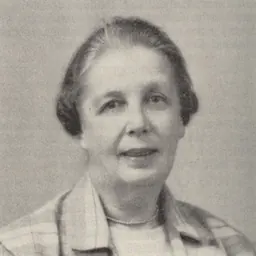



Related people
Same field, nearest in time


Contemporaries
People whose lives overlapped Ethel H. Bailey's




Frequently asked questions
Who was Ethel H. Bailey?
American mechanical engineer who began her working life in aviation and went on to develop radar and spectroscopic equipment
When was Ethel H. Bailey born?
Ethel H. Bailey was born on 18 August 1896 in Houlton.
When did Ethel H. Bailey die?
Ethel H. Bailey died on 5 July 1985 in Concord.
What was Ethel H. Bailey's occupation?
Ethel H. Bailey was a mechanical engineer and engineer.
What nationality was Ethel H. Bailey?
Ethel H. Bailey was American.
Sources & further reading
Cite this page
APA: Biography.guide. (2026). Ethel H. Bailey. https://biography.guide/ethel-h-bailey/
MLA: "Ethel H. Bailey." Biography.guide, https://biography.guide/ethel-h-bailey/.
Chicago: "Ethel H. Bailey." Biography.guide. https://biography.guide/ethel-h-bailey/.
Data last updated: 2026-09-20 · Spot an error? Report a correction.
Page generated 2026-09-27 04:57 UTC