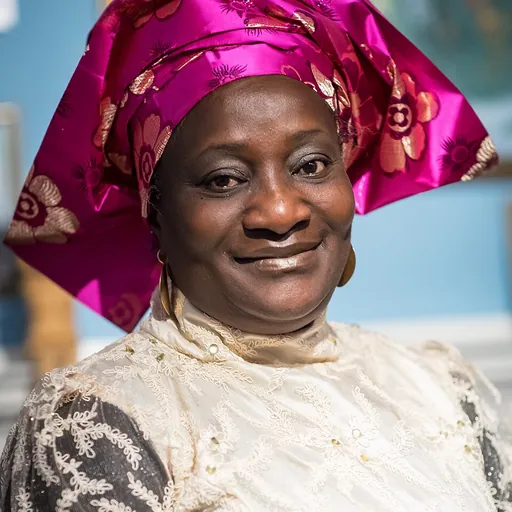
About Esther Ibanga
Born 1961. Esther Ibanga is a Nigerian pastor.
Esther Ibanga (born 31 March 1961 ) is a Nigerian pastor and founder of the "Women Without Walls Initiative". She won the 32nd Niwano Peace Prize for promoting peace among people of different ethnic groups and religions in Jos, Nigeria.
Life Esther Ibanga was born on 31 March 1961 to Abumadga Auta and Mariamu Abimiku. She was the seventh of ten children and one of eight daughters. She is from Kagbu; Nasarawa Eggon Local Government Area of Nasarawa State in Nigeria. Her father was a policeman who won awards for his bravery and honesty. She says of him, “My father was a praying man and a prophet. We were born and raised into an atmosphere of prayer. He named me Baban Meche which means great woman.” Her strict mother, Mariamu Abimiku; was a housewife who was known as “mama mission” due to her involvement with the fellowship of the church (Zumantan mata) and the mission trips she embarked on. She is married to her husband of 25 years, Ikoedem Ibanga and has two daughters, Uyai and Ifiok.
Education Ibanga started her education at St. Paul’s Primary School, Kasuwan Kaji in Jos North Local Government Area of Plateau State from 1968 to 1973. She had her secondary school education at St. Louis College in Jos from 1973. In 1978 she enrolled for an advanced level program at the School of Basic Studies, Zaria, Kaduna State where she obtained an Interim Joint Matriculation Board (IJMB) Certificate. Her passion for business led her to obtain a bachelor's degree in Business Administration at Ahmadu Bello University in Zaria, Kaduna State from 1979 to 1983. In 2001, she obtained an MBA from the University of Jos.
Work Ibanga started her work experience in Nation Plan Consortium, where she served in the compulsory one year National Youth Service Corps program as a young graduate. After her NYSC, she worked at the Jos Steel Rolling Mills as a marketing officer, and then at the Central Bank of Nigeria, where she rose to be a manager. After working there for sixteen years, she left that job in 1995 to become the first woman to lead a church in Jos. These activities include conferences (both locally and internationally), economic empowerment program for women, police-community dialogue, campaigns against electoral violence, rallies, etc. In February 2010 Ibanga led a march to protest against the Dogon Nahawa ethno-religious crisis in Plateau State. There was said to be 100,000 Christian women dressed in black taking part in the march. The march ended at the Government house in Jos where the participants, protested about the loss lives and particularly those of women and children.
Don’t just read it —
keep it.
Full-length biographies made to live with: read them, listen on the way to work, watch them tonight.
- E-book
- Audio
- Video
Instant download · yours to keep · every purchase keeps this site free
Important facts
People in Esther Ibanga's life
Named in this biography and alive at the same time

Related people
Same field, nearest in time




Contemporaries
People whose lives overlapped Esther Ibanga's


Frequently asked questions
Who is Esther Ibanga?
Nigerian pastor
When was Esther Ibanga born?
Esther Ibanga was born on 31 March 1961.
What is Esther Ibanga's occupation?
Esther Ibanga is a pastor.
What nationality is Esther Ibanga?
Esther Ibanga is Nigerian.
Sources & further reading
Cite this page
APA: Biography.guide. (2026). Esther Ibanga. https://biography.guide/esther-ibanga/
MLA: "Esther Ibanga." Biography.guide, https://biography.guide/esther-ibanga/.
Chicago: "Esther Ibanga." Biography.guide. https://biography.guide/esther-ibanga/.
Data last updated: 2026-09-20 · Spot an error? Report a correction.
Portrait: Wikimedia Commons · author & licence
Page generated 2026-09-27 04:58 UTC