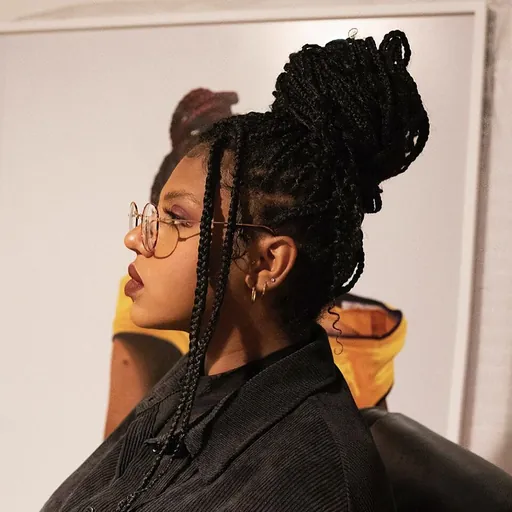
Esmaa Mohamoud
African-Canadian sculpture and installation artist
About Esmaa Mohamoud
Born 1992. Esmaa Mohamoud is a Canadian sculptor and installation artist.
Esmaa Mohamoud, also known as "E," (born 25 November 1992) is an African-Canadian sculptor and installation artist who grew up in London, Ontario, and currently practices in Toronto, Ontario. Her work has been shown at the Royal Ontario Museum, McGill University, The Art Gallery of Ontario, YYZ Artist Outlet, The Drake Devonshire Gallery, Art Lab Gallery at Western University, Georgia Scherman Projects, She graduated from Western University with a Bachelor's in fine art in 2014 and later from Ontario College of Art and Design University, in June 2016, with a master's degree in fine arts. Her art focuses on interrogating issues around black masculinity culturally in sports (in the NBA and NFL) and politically in North American society at large. She creates sculptures, photography, and drawings to bring awareness to and to expose these specific issues in today's society. Mohamoud's outstanding notable works include exhibits One of the Boys, Heavy, Heavy (Hoop Dreams), Glorious Bones, Blood and Tears Instead of Milk and Honey, A Seat Above the Table, Untitled (No Fields) Why See the World When You've Got the Beach?, Chain Gang, I Am Series, and Unholy Matrimony.
Selected works
One of the Boys (2017–2018) From 2017–2018, Mohamoud collaborated with Qendrim Hoti to create and photograph sculptures designed to be worn by black, male-presenting models. In One of the Boys, men and women wear custom-made ball gown jerseys, thus pointing to gender fluidity and race through their use of fashion. Mohamoud uses Vince Carter's Raptors jerseys for the top half of the gown and the bottom half is a beautiful puffy dress. The jersey itself is not of the usual sports mesh, but is made of velvet and contains corset lacings on both sides an allusion to basketball through the use of shoelaces and to high fashion through the use of corseted tops. Some of the models can be seen wearing jewelry such as earrings, rings, necklaces, colorful hair ties, braids, and tattoos. Amanda Parris points out that some of the models in this series face away from the camera or conversely they stare directly at it, something Mohamoud terms the "power stance."
Fashion and body language work in this piece works in tandem to create a harmonious balance between femininity and masculinity. This balance of feminine and masculine objects and poise convey the overarching theme of gender fluidity depicted on and through black, male bodies. Mohamoud's design of the jersey and the ballgown is meant to convey gender fluidity in a way in which it is difficult for viewers to categorize the subject of the photographs in a binary fashion. The Raptors jersey itself is meant to symbolize masculinity, as athleticism is usually thought to be masculine, and the ballgowns are meant to symbolize femininity. Mohamoud recalls her mother requiring that she wear a dress when she wanted to play basketball with the neighborhood boys. Mohamoud stated that she wore a dress and put a Raptors jersey on top to which her mother reprimanded, "you are not one of the boys." Mohamoud focuses on black men in sports and uses basketball specifically to explore societal problems around the construction of black masculinity. In the book Black Sexual Politics, Patricia Hills Collins explains how and why black masculinity is treated and viewed the way it is in sports, specifically in basketball. Collins shares the story about a professional black basketball player named Latrell Sprewell, playing for the Golden State Warriors at the time, who choked his coach P. J. Carlesimo. Collins says Sprewell was viewed "as the worst of basketball" and his actions gave a bad reputation to all black basketball players. Collins notes that black basketball players are thought of as irrational "bad boys" that are too sensitive and can't control their aggressive nature when provoked. Author and activist, bell hooks, has acknowledged in her book, We Real Cool: Black Men and Masculinity, the long-standing belief that black men are the embodiment of violence and aggression, stating "read any article or book on black masculinity and it will convey the message that Black men are violent." This image of violence can be dangerous for black men as they navigate their way through the world.
Through her art, Mohamoud brings awareness to a current and problematic view of black masculinity in order to shift it and reclaim it as her own through subversion of gender norms, "power stances," and the use of bell hooks' the "oppositional gaze."
Heavy, Heavy (Hoop Dreams) (2016) In 2016, Esmaa Mohamoud displayed Heavy, Heavy (Hoop Dreams) as part of her Interdisciplinary Master's in Art, Media, and Design Program. Mohamoud added the Heavy Heavy as a reference to the disappointment black boys feel when they are not scouted for the NBA. Each is made to display vivid kente cloth patterns, symbolizing both the royal Ghanaian weaving tradition and a textile that has come to represent an African diasporic identity. Kente cloth is an "iconic" visual representation of the history, philosophy, ethics, oral literature, religious belief, social values, and political thought of West Africa. and the emptiness of the helmets to include an ominous presence to express the toll that sports can have on one's body.
Black bodies are often rendered invisible within the spaces they navigate, including the professional sports industry. Mohamoud transforms these helmets, to illustrate discriminatory behaviors and attitudes based on race, class, gender and sexuality. Examining aspects of race, class, gender and sexuality to present the individual struggle each faces, Mohamoud specifically focuses on homogenizations of bodies within these high-level athletics as sites of corporate profit and discrimination.
Don’t just read it —
keep it.
Full-length biographies made to live with: read them, listen on the way to work, watch them tonight.
- E-book
- Audio
- Video
Instant download · yours to keep · every purchase keeps this site free
Important facts
People in Esmaa Mohamoud's life
Named in this biography and alive at the same time


Related people
Same field, nearest in time



Contemporaries
People whose lives overlapped Esmaa Mohamoud's
Frequently asked questions
Who is Esmaa Mohamoud?
African-Canadian sculpture and installation artist
When was Esmaa Mohamoud born?
Esmaa Mohamoud was born on 25 November 1992 in Canada.
What is Esmaa Mohamoud's occupation?
Esmaa Mohamoud is a sculptor and installation artist.
What nationality is Esmaa Mohamoud?
Esmaa Mohamoud is Canadian.
Sources & further reading
Cite this page
APA: Biography.guide. (2026). Esmaa Mohamoud. https://biography.guide/esmaa-mohamoud/
MLA: "Esmaa Mohamoud." Biography.guide, https://biography.guide/esmaa-mohamoud/.
Chicago: "Esmaa Mohamoud." Biography.guide. https://biography.guide/esmaa-mohamoud/.
Data last updated: 2026-09-22 · Spot an error? Report a correction.
Portrait: Wikimedia Commons · author & licence
Page generated 2026-09-27 05:02 UTC