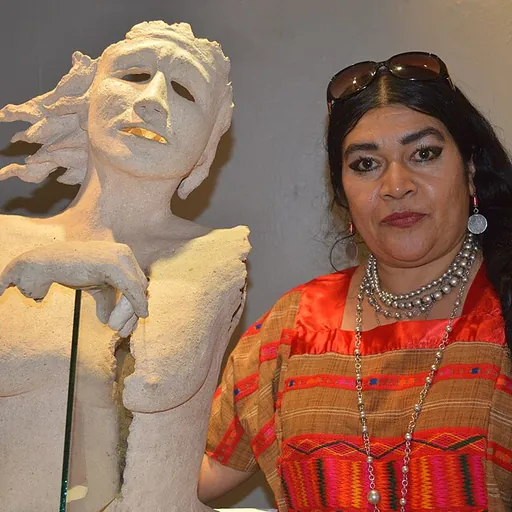
About Deyanira África Melo
Born 2000. Deyanira África Melo is a Mexican sculptor and painter.
Deyanira África González Melo is a Mexican sculptor who generally works in ceramics, depicting elements of the human form, especially the torso, generally with mutilations and other disturbing elements to dispute the otherwise traditional and sensual depictions of the human body. She has exhibited her work since studying at the Escuela Nacional de Artes Plásticas (ENAP) in Mexico as well as in Europe and the Caribbean. Her work has received recognition in Mexico and abroad, and is a member of the Salón de la Plástica Mexicana.
Life
Deyanira África González Melo prefers to go by África informally, although this name does not indicate her origins. She was born in Putla Villa de Guerrero, Oaxaca, Mexico, and is of Indigenous, African and Italian heritage.
She began her art studies in 1977 at the Academy of San Carlos, entering the Escuela Nacional de Artes Plástica in 1980. She studied sculpture under Gerda Gruber and other subjects under Luis Nishizawa, Manuel Felguérez, Javier Anzures, Gilberto Aceves Navarro, Katy Horna, Ignacio Salazar and Juan Acha. She graduated with a bachelor's degree in visual arts in 1984.
Currently lives in Colonia Balbuena en Mexico City. Important collective exhibitions include the Maestros de La Esmeralda at the Centro Nacional de Artes, "Escultura en Cerámica" at the Casa del Lago in 1983, "El Barro den al Escultura" at the Museo de Arte Moderno in 1984, Trienal de Escultura 1985 at the Gallery of the Auditorio Nacional, "Sin Motivos Aparentes II" at the Museo de Arte Carrillo Gil in 1986 and the 1985 World Ceramics Triennial in Zagreb.
She has been a member of the Salon de la Plástica Mexicana since 1998, which exhibits her work regularly. Heads and faces are generally left out. The torsos often emphasize the breasts of the woman and the genitalia of both sexes. She feels that this is the most apt for expressing her emotions and ideology. Often her themes related to the pain of women who rebel against society’s norms. She also likes the colors, textures and forms that they provide. The human forms have an overall traditional form, but with expressionist and symbolic accents meant to be disturbing, such as parts of the body mutilated or missing or the use of iron pins, staple or wire. The emphasis is usually on the reproductive organs and heart as these related to emotions, especially basic ones. She considers eroticism to be “the beginning, the end and the totality of existence.” Many of the sculptures also depict pregnancy and maternity because she feels this kind of love is the strongest and feels the strongest attachments to her mother and grandmothers. When faces do appear, they are not common ones or appear in expected places. In one sculpture, a fully adult human face emerges from a womb. Even without faces, the sculptures express sadness, resignation and suffering, which are expressed through the movement of her figures.
Don’t just read it —
keep it.
Full-length biographies made to live with: read them, listen on the way to work, watch them tonight.
- E-book
- Audio
- Video
Instant download · yours to keep · every purchase keeps this site free
Important facts
People in Deyanira África Melo's life
Named in this biography and alive at the same time




Related people
Same field, nearest in time



Contemporaries
People whose lives overlapped Deyanira África Melo's


Frequently asked questions
Who is Deyanira África Melo?
Mexican sculptor and painter
When was Deyanira África Melo born?
Deyanira África Melo was born in 2000.
What is Deyanira África Melo's occupation?
Deyanira África Melo is a sculptor and painter.
What nationality is Deyanira África Melo?
Deyanira África Melo is Mexican.
Sources & further reading
· Wikipedia: Deyanira África Melo
· DBpedia: Deyanira África Melo
Cite this page
APA: Biography.guide. (2026). Deyanira África Melo. https://biography.guide/deyanira-africa-melo/
MLA: "Deyanira África Melo." Biography.guide, https://biography.guide/deyanira-africa-melo/.
Chicago: "Deyanira África Melo." Biography.guide. https://biography.guide/deyanira-africa-melo/.
Data last updated: 2026-09-21 · Spot an error? Report a correction.
Portrait: Wikimedia Commons · author & licence
Page generated 2026-09-27 05:00 UTC