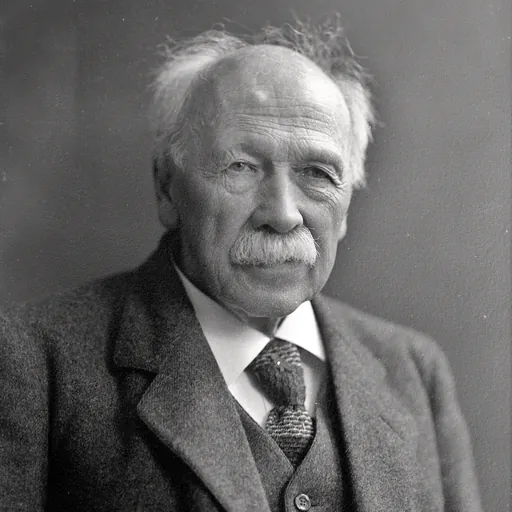
About Esaias Tegnér the Younger
Lived 1843 – 1928 (aged 85). Esaias Tegnér the Younger was a Swedish bible translator and linguist.
Esaias Henrik Wilhelm Tegnér Jr. ( ; ; 13 January 1843 – 21 November 1928) was a Swedish linguist. He was professor of eastern languages at Lund University 1879–1908, lead editor of Svenska Akademiens ordbok 1913–1919, member of the Bible Commission (writing a new translation) 1884–1917, and member of the Swedish Academy from 1882 onward. Tegnér was the grandson of the well-known poet Esaias Tegnér, also his namesake, and was brother-in-law to the poet and composer Alice Tegnér.
Biography Esaias Tegnér's parents were Kristofer Tegnér, a provost and vicar, and Emma Sofia Tegnér (née Kinberg). He began studying at Lund in 1859, graduated with a PhD in 1865, and became a Docent in Semitic languages the same year. In 1872 he became an adjunct professor in comparative linguistics. He further studied linguistics in Stockholm beginning 1873, and joined the Scientific Society of Uppsala in 1876.
In 1879 Tegnér married Märta Maria Katarina (née Ehrenborg) who was herself born in 1859 in Linde, Gotland County. The same year he joined the Royal Swedish Academy of Letters, History and Antiquities. He also became a member of the Royal Society of Sciences and Letters in Gothenburg in 1882, doctor of theology at Copenhagen in 1894, and a member of the Royal Swedish Academy of Sciences in 1896.
Tegnér is buried at Östra kyrkogården in Lund.
Indo-European languages Tegnér wrote just one journal article about the history of the Indo-European languages, De ariske språkens palataler (The palatals of the Aryan languages). It is an important work however, because he there suggests a solution to one of the most pressing questions in linguistics at the time. Between 1860 and 1880 three such problems were solved, represented by Grassmann's Law, Verner's law, and the palatalization law. Tegnér was one of several possible authors of the palatalization law, das Palatalgesetz, which describes a sound change in the Indo-Iranian languages. The discovery had important ramifications on the understanding of vowels in the Proto-Indo-European language.
Language reform
Spelling In the second half of the nineteenth century there was a spelling debate between conservative members of the Swedish Academy and the "new spellers", led by Adolf Noreen. Esaias Tegnér would take a moderate position.
The spelling debate arose following the release of the first edition of Svenska Akademiens ordlista (Dictionary of the Swedish Academy) in 1874, before Tegnér had joined the academy. In this dictionary, new consideration was given to new spelling suggestions that had been received in 1869 and collected into 15 points in Artur Hazelius's manifesto Om svensk rättstafning (On correct Swedish spelling) (1870–71). The first edition however did not include these modifications, and instead used the traditional spellings, standardized by Carl Gustaf af Leopold since 1801.
Tegnér joined the debate with an essay in 1886. In that essay he suggested the morphological principle of spelling as an alternative to the phonetic spelling proposed by the reformers. This morphological principle suggested that morphemes should as much as possible be spelled the same. The principle was seen as a compromise, and the sixth edition of Svenska Akademiens ordlista in 1889 exhibited Tegnér's influence in several new spellings.
Biblical language Esaias Tegnér was during 1884-1917 a member of the Bible Commission of 1773, created by Gustav III of Sweden, and was responsible for overseeing the linguistics of the new translation.
Family names In his 1882 paper Om Sveriges familjenamn (On Sweden's family names) Tegnér studied elements of Swedish family names. He found that several endings were not used, although they were common in names of towns and places. Nobody had yet taken names ending in -hed, -lid, -myr, -näs, -rud, -ryd, -säter, -vad, -åker, -ås or -äng. In 1939 professor Jöran Sahlgren included these in his book Svensk namnbok (Swedish book of names), which was provided by the state to aid people seeking new names. During the 20th century they have been used as name elements in several new Swedish family names.
Don’t just read it —
keep it.
Full-length biographies made to live with: read them, listen on the way to work, watch them tonight.
- E-book
- Audio
- Video
Instant download · yours to keep · every purchase keeps this site free
Important facts
People in Esaias Tegnér the Younger's life
Named in this biography and alive at the same time


Related people
Same field, nearest in time




Contemporaries
People whose lives overlapped Esaias Tegnér the Younger's

Frequently asked questions
Who was Esaias Tegnér the Younger?
Swedish linguist (1843-1928)
When was Esaias Tegnér the Younger born?
Esaias Tegnér the Younger was born on 13 January 1843.
When did Esaias Tegnér the Younger die?
Esaias Tegnér the Younger died on 21 November 1928 in Lund Cathedral parish.
What was Esaias Tegnér the Younger's occupation?
Esaias Tegnér the Younger was a bible translator and linguist.
What nationality was Esaias Tegnér the Younger?
Esaias Tegnér the Younger was Swedish.
Sources & further reading
· Wikipedia: Esaias Tegnér the Younger
Cite this page
APA: Biography.guide. (2026). Esaias Tegnér the Younger. https://biography.guide/esaias-tegner-the-younger/
MLA: "Esaias Tegnér the Younger." Biography.guide, https://biography.guide/esaias-tegner-the-younger/.
Chicago: "Esaias Tegnér the Younger." Biography.guide. https://biography.guide/esaias-tegner-the-younger/.
Data last updated: 2026-09-21 · Spot an error? Report a correction.
Portrait: Wikimedia Commons · author & licence
Page generated 2026-09-27 04:59 UTC