
About Erwin Wilhelm Müller
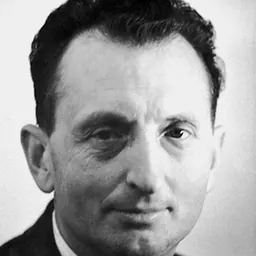
Lived 1911 – 1977 (aged 65). Erwin Wilhelm Müller was a German and American physicist and university teacher.
Erwin Wilhelm Müller (or Mueller) (June 13, 1911 – May 17, 1977) was a German physicist who invented the Field Emission Electron Microscope (FEEM), the Field Ion Microscope (FIM), and the Atom-Probe Field Ion Microscope. He and his student, Kanwar Bahadur, were the first people to experimentally observe atoms.
Life and work Müller was born in Berlin, where he studied at the Technische Hochschule in Charlottenburg (now Technische Universität Berlin) under Gustav Hertz. He received his degree in engineering in 1935 and his doctorate in 1936. Müller worked at the Siemens Research Laboratory, where he invented the field emission microscope in 1936 that allowed resolutions of 2 nanometers.
Müller married Klara Thüssing in 1939, and their only daughter Jutta was born in 1940. Due to the circumstances of war, he also worked at the Stabilovolt Company.
In 1947, he was appointed to the Kaiser Wilhelm Institute for Physical Chemistry and Electrochemistry (renamed to Fritz-Haber-Institut on the occasion of its incorporation into the Max Planck Society in 1953) by Iwan N. Stranski. Here he developed the field ion microscope which, due to its resolution of 0.25 nm, was the first instrument used to observe atoms.
In 1950, he took a teaching appointment at Technische Universität Berlin after finally having completed the required Privatdozent (habilitation). In 1951, he became professor at the Free University Berlin.
Müller joined the faculty at Pennsylvania State University in 1952, where he remained until his death in 1977. He co-invented the Atom-Probe Field Ion Microscope at Penn State in 1967. He died in Washington D.C.
Honors National Medal of Science (1977) Achievement Award of the Instrument Society of America (1960) Davisson-Germer Prize of the American Physical Society (1972) Carl Friedrich Gauß Medal (:de:Carl-Friedrich-Gauß-Medaille) (1952) John Scott Medal of the City of Philadelphia (1970) External Scientific Member, Fritz-Haber-Institut (1957) Honorary Degree, Free University of Berlin (1968) Honorary Degree, University of Lyon Medard W. Welch Award 1971 American Physical Society 1971
Selected bibliography Müller's first FIM paper. According to Melmed, "[this paper] provided the world's first view of the atomic nature of solid matter and began an entirely new field of study."
Don’t just read it —
keep it.
Full-length biographies made to live with: read them, listen on the way to work, watch them tonight.
- E-book
- Audio
- Video
Instant download · yours to keep · every purchase keeps this site free
Important facts
People in Erwin Wilhelm Müller's life
Named in this biography and alive at the same time






Related people
Same field, nearest in time




Contemporaries
People whose lives overlapped Erwin Wilhelm Müller's





Frequently asked questions
Who was Erwin Wilhelm Müller?
German American physicist and inventor (1911–1977)
When was Erwin Wilhelm Müller born?
Erwin Wilhelm Müller was born on 13 June 1911 in Berlin.
When did Erwin Wilhelm Müller die?
Erwin Wilhelm Müller died on 17 May 1977 in Washington, D.C..
What was Erwin Wilhelm Müller's occupation?
Erwin Wilhelm Müller was a physicist and university teacher.
What nationality was Erwin Wilhelm Müller?
Erwin Wilhelm Müller was German and American.
Sources & further reading
· Wikipedia: Erwin Wilhelm Müller
· DBpedia: Erwin Wilhelm Müller
Cite this page
APA: Biography.guide. (2026). Erwin Wilhelm Müller. https://biography.guide/erwin-wilhelm-muller/
MLA: "Erwin Wilhelm Müller." Biography.guide, https://biography.guide/erwin-wilhelm-muller/.
Chicago: "Erwin Wilhelm Müller." Biography.guide. https://biography.guide/erwin-wilhelm-muller/.
Data last updated: 2026-09-20 · Spot an error? Report a correction.
Page generated 2026-09-27 05:13 UTC