
Erwin N. Hiebert
Canadian-American physicist
About Erwin N. Hiebert
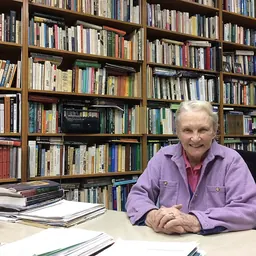
Lived 1919 – 2012 (aged 93). Erwin N. Hiebert was an American and Canadian physicist, university teacher and historian of science.
Erwin Nick Hiebert (May 27, 1919 – November 28, 2012) was a Canadian-American physical chemist and historian of science. He taught numerous students who would go on to become leading figures in the history of science, particularly women such as Carolyn Merchant and Mary Jo Nye, during academic tenures at the University of Wisconsin–Madison and Harvard University. He contributed to the Manhattan Project as a research chemist before becoming a historian.
He published four books: on atomic energy; on the history of the principle of conservation of energy; on thermodynamics in the thought of Ernst Mach and Max Planck; and on the legacy of Hermann von Helmholtz in acoustics. He was the president of the History of Science Society for a two-year term from 1973 to 1974 and was president of the Division of the History of Science of the International Union of History and Philosophy of Science from 1982 to 1985.
Early life and education Erwin N. Hiebert, whose father was a Mennonite minister, was born in Waldheim, Saskatchewan and grew up in an urban Russian Mennonite community in Winnipeg, Manitoba. He went to high school in Winnipeg and financed his own college education by working during summers and wheat harvests on Mennonite farms in Oklahoma, Kansas, Nebraska, and the Dakotas. and he was an American Scholar in Kabul of the International Education Exchange Program in summer 1961, visiting professor at the University of Tübingen in 1964–1965, and visiting professor at Harvard University in 1965.
In 1970 Hiebert was appointed to a professorship at Harvard University and the Hiebert family settled in Belmont, Massachusetts. and he and his wife continued to serve on the congregation's Social Concerns Committee for decades. He was remembered by Mary Jo Nye as notably supportive of women scholars, unusually for his time: "The proportion of his students who are women was quite high (one of his early students was Carolyn Merchant). He gave us confidence, and he treated women like he treated the men. He always supported us in what we did, and I'm talking about the Sixties and early Seventies." Erwin and Elfrieda Hiebert welcomed students into their home
He was elected in 1966 a fellow of the American Association for the Advancement of Science, in November 1971 a membre correspondant of the Académie Internationale d'Histoire des Sciences, for 1973–1974 the president of the History of Science Society, in 1975 a fellow of the American Academy of Arts and Sciences, In 1992 a festschrift was published in his honor.
Research The focus of Hiebert's research was the history and philosophy of chemistry and physical sciences in the 2nd half of 19th century and 1st half of the 20th century. During his lifetime he completed three books and his fourth book (which deals with acoustics) was nearly complete at the time of his death. His 1961 book Impact of Atomic Energy examined the Manhattan Project, the atomic bombings of Hiroshima and Nagasaki, and World War II's consequences related to atomic energy from an ethical and religious perspective. He wrote papers about the science and philosophy of Max Planck, Ernst Mach, Walther Nernst, Ludwig Boltzmann, Hermann von Helmholtz, and Wilhelm Ostwald.
Selected publications Articles
Books
Don’t just read it —
keep it.
Full-length biographies made to live with: read them, listen on the way to work, watch them tonight.
- E-book
- Audio
- Video
Instant download · yours to keep · every purchase keeps this site free
Important facts
People in Erwin N. Hiebert's life
Named in this biography and alive at the same time


Related people
Same field, nearest in time




Contemporaries
People whose lives overlapped Erwin N. Hiebert's



Frequently asked questions
Who was Erwin N. Hiebert?
Canadian-American physicist (1919–2012)
When was Erwin N. Hiebert born?
Erwin N. Hiebert was born on 27 May 1919 in Waldheim.
When did Erwin N. Hiebert die?
Erwin N. Hiebert died on 28 November 2012 in Waltham.
What was Erwin N. Hiebert's occupation?
Erwin N. Hiebert was a physicist, university teacher and historian of science.
What nationality was Erwin N. Hiebert?
Erwin N. Hiebert was American and Canadian.
Sources & further reading
Cite this page
APA: Biography.guide. (2026). Erwin N. Hiebert. https://biography.guide/erwin-n-hiebert/
MLA: "Erwin N. Hiebert." Biography.guide, https://biography.guide/erwin-n-hiebert/.
Chicago: "Erwin N. Hiebert." Biography.guide. https://biography.guide/erwin-n-hiebert/.
Data last updated: 2026-09-20 · Spot an error? Report a correction.
Page generated 2026-09-27 05:28 UTC