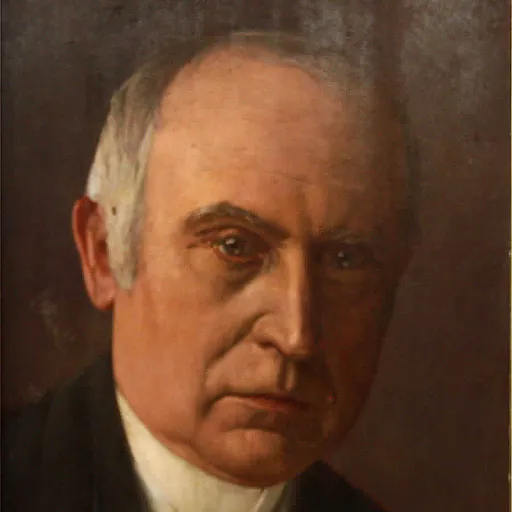
About Ernst te Peerdt
Lived 1852 – 1932 (aged 79). Ernst te Peerdt was a German painter, art historian and playwright.
Ernst Carl Friedrich te Peerdt (25 November 1852, Tecklenburg – 20 February 1932, Düsseldorf) was a German painter, associated with the Düsseldorfer Malerschule and the Münchner Schule.
Life and work
He was born to a lower court judge, and grew up in Wesel, where he attended the local Gymnasium. Beginning in 1868, he studied at the Kunstakademie Düsseldorf, with Eduard Bendemann and Andreas Müller. In 1873, he transferred to the Academy of Fine Arts, Munich, where he studied with Wilhelm von Diez. He completed his studies in 1874, with Ludwig Knaus, at the Prussian Academy of Arts.
The years from 1878 to 1881 were spent travelling throughout Italy. Upon returning to Germany, he settled in Düsseldorf, and joined Malkasten, a progressive artists' association. He moved again in 1884; this time back to Munich. There, in 1888, he married Wilhelmine Baumgartner, from Burghausen. Their daughter, Johanna, was born in 1890. Two years later, they settled permanently in Düsseldorf, where their son, Heinrich, was born in 1895.
In 1909, he joined the Sonderbund, a society devoted to Impressionist art; participating in major exhibitions at the (1909) and the (1910). In 1914, the art dealer, Alfred Flechtheim, organized and presented his first solo showing. That same year, Flechtheim was able to place some of his works at the Werkbund Exhibition. His second solo showing came at the Kölnischer Kunstverein in 1917. The following year, he was given the title "Professor" at the Kunstpalast. In 1919, he became one of the first members of the avant-garde artists' society, Young Rhineland.
In 1925, the University of Bonn awarded him an honorary doctorate. Two years later, the Kunstakademie Düsseldorf celebrated his 75th birthday by making him an honorary member. His last significant exhibition was in 1928. Shortly after his death, an obituary by the art historian, , in described him as a "Painter-Poet-Philosopher". Later that same year, a memorial exhibition was held at the Kunstpalast.
In addition to his paintings, he wrote several books on art criticism, two dramas (Berufung, 1901 and Der Dichter und der Tod, 1906) and a work on philosophy (Das Ding an sich – das Ding als Funktion, 1927). He also published translations from Hindi, which included a short criticism of the Upanishads. His estate is held by the .
Selected paintings
Don’t just read it —
keep it.
Full-length biographies made to live with: read them, listen on the way to work, watch them tonight.
- E-book
- Audio
- Video
Instant download · yours to keep · every purchase keeps this site free
Important facts
more
e. de. peerdt, Ernst K. Fr. Te Peerdt, Ernst de PeerdtPeople in Ernst te Peerdt's life
Named in this biography and alive at the same time


Related people
Same field, nearest in time
Contemporaries
People whose lives overlapped Ernst te Peerdt's


Frequently asked questions
Who was Ernst te Peerdt?
German painter (1852–1932)
When was Ernst te Peerdt born?
Ernst te Peerdt was born on 25 November 1852 in Tecklenburg.
When did Ernst te Peerdt die?
Ernst te Peerdt died on 20 February 1932 in Düsseldorf.
What was Ernst te Peerdt's occupation?
Ernst te Peerdt was a painter, art historian and playwright.
What nationality was Ernst te Peerdt?
Ernst te Peerdt was German.
Sources & further reading
Cite this page
APA: Biography.guide. (2026). Ernst te Peerdt. https://biography.guide/ernst-te-peerdt/
MLA: "Ernst te Peerdt." Biography.guide, https://biography.guide/ernst-te-peerdt/.
Chicago: "Ernst te Peerdt." Biography.guide. https://biography.guide/ernst-te-peerdt/.
Data last updated: 2026-09-22 · Spot an error? Report a correction.
Portrait: Wikimedia Commons · author & licence
Page generated 2026-09-27 05:02 UTC