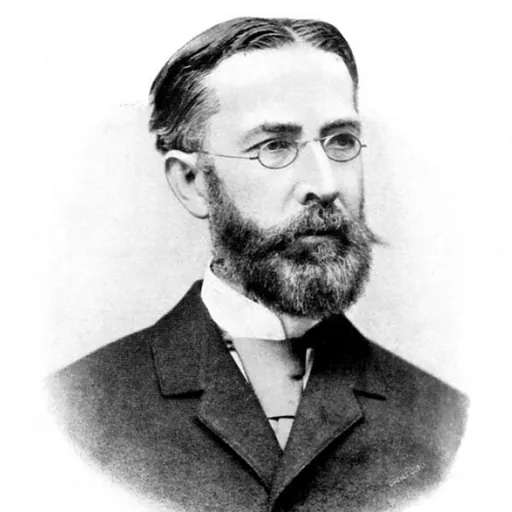
About Ernst Schulze
Lived 1840 – 1912 (aged 71). Ernst Schulze was a university teacher, chemist and biochemist.
Ernst Schulze (; 31 July 1840, Bovenden near Göttingen – 15 June 1912, Zürich) was a German chemist who discovered a number of amino acids.
Biography Schulze's grandfather was the philosopher Gottlob Ernst Schulze, and his father held public office in the town where he was born: Bovenden near Göttingen. After completing school, Schulze studied chemistry at the University of Göttingen. Among his professors were Friedrich Wöhler and Heinrich Limpricht. He completed his final semester at Heidelberg, where he completed his studies under Robert Wilhelm Bunsen. Schulze then traveled to Jena, where he completed his doctoral studies as the assistant to Karl Gotthelf Lehmann and later to his successor, Anton Geuther, receiving his doctorate in 1867. He started his scientific career in Jena, and then went on to the agricultural research station at Weende near Göttingen, working under Wilhelm Henneberg, until in 1871 he was offered a position to lead a similar research station in Darmstadt. One year later, Schulze was appointed as professor for agricultural chemistry at the new agriculture and forestry school of the Zürich polytechnic, where his future father-in-law Adolf Kraemer had already been appointed as one of the first leaders.
During his four decades at Zürich, Schulze concentrated on a variety of phytochemical studies, in the course of which he and his doctoral students discovered the amino acids Glutamine, Phenylalanine and Arginine, among many other organic compounds. Schulze also laid emphasis on researching the importance of the amino acids Asparagine and Glutamine in the protein metabolism of plants. He also pioneered the investigation of plant lecithin, cholesterol and phytosterols. At the end of his time in Zürich, Schulze researched the role of carbohydrates in plant cell membranes. This systematic research into plant chemistry made Schulze one of the pioneers of the new science of biochemistry, at the time still called "physiological chemistry".
In the middle of the 1880s, Schulze was awarded the Liebig-Medal in silver, and in 1907 he won a prize from the Royal Society of Sciences in Göttingen. In 1910, in recognition of his life's work, the University of Heidelberg awarded him an honorary medical doctorate.
Publications With Ernst Steiger: Ueber das Arginin. In: Zeitschrift für Physiologische Chemie. 11, 1887, p. 43 (online).
Don’t just read it —
keep it.
Full-length biographies made to live with: read them, listen on the way to work, watch them tonight.
- E-book
- Audio
- Video
Instant download · yours to keep · every purchase keeps this site free
Important facts
People in Ernst Schulze's life
Named in this biography and alive at the same time



Related people
Same field, nearest in time

Contemporaries
People whose lives overlapped Ernst Schulze's


Frequently asked questions
Who was Ernst Schulze?
German chemist (1840-1912)
When was Ernst Schulze born?
Ernst Schulze was born on 31 July 1840 in Bovenden.
When did Ernst Schulze die?
Ernst Schulze died on 15 June 1912 in Zurich.
What was Ernst Schulze's occupation?
Ernst Schulze was a university teacher, chemist and biochemist.
Sources & further reading
· DBpedia: Ernst Schulze (chemist)
Cite this page
APA: Biography.guide. (2026). Ernst Schulze. https://biography.guide/ernst-schulze/
MLA: "Ernst Schulze." Biography.guide, https://biography.guide/ernst-schulze/.
Chicago: "Ernst Schulze." Biography.guide. https://biography.guide/ernst-schulze/.
Data last updated: 2026-09-20 · Spot an error? Report a correction.
Portrait: Wikimedia Commons · author & licence
Page generated 2026-09-27 04:58 UTC