
About Ernst Niekisch
Lived 1889 – 1967 (aged 78). Ernst Niekisch was a German politician, writer, journalist, revolutionary, university teacher and resistance fighter.
Ernst Niekisch (23 May 1889 – 23 May 1967) was a German writer and political theorist. Initially a member of the Social Democratic Party (SPD) and of the Old Social Democratic Party of Germany (ASPD), he later became a prominent exponent of the National revolutionary branch of the Conservative Revolution and National Bolshevism.
Early life Niekisch was born on 23 May 1889 in Trebnitz (Silesia), and brought up in Nördlingen. After studying at a teaching seminar, and completing a one-year voluntary military service with the Bavarian Army, he was appointed a public school teacher in Augsburg. From 1914 to 1917, he served with the Imperial German Army during WWI.
Political career Early years and Bavarian Soviet Republic In 1917, Niekisch joined the Social Democratic Party of Germany (SPD) and was, in 1918, elected as the head of the Augsburg Workers and Soldiers Council, which gave him de facto dictatorial powers over the city and made him instrumental in setting up of a short-lived Bavarian Soviet Republic during 1919. After the end of the Soviet Republic in May 1919, Niekisch served two years in prison for his part in the abortive Bavarian coup, being released in August 1921, immediately taking a seat in the Bavarian Landtag that had been awarded to him by the USPD ticket during the 1920 state election. Niekisch soon returned to the SPD however, where he started to stress the importance of nationalism and attempted to turn the SPD in a pro-nationalist direction. He was so vehemently opposed to the Dawes Plan, the Locarno Treaties and the general pacifism of the SPD that he was expelled from the party in 1926. The attempt to combine ultranationalism and communism, two extreme ends of the political spectrum, caused Niekisch's National Bolsheviks to be a force with little support.
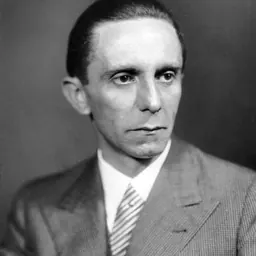
Under Nazi Germany Although anti-Jewish and in favour of a totalitarian state, Niekisch rejected Adolf Hitler, who he felt lacked any real socialism. Niekisch instead looked towards Joseph Stalin and the industrial development of the Soviet Union. He additionally claimed and criticized that Hitler, after release from prison, started to look more towards Italian Fascism for inspiration, rather than Ludendorff. Niekisch was particularly ill-disposed towards Joseph Goebbels and, at a meeting between the two facilitated by their mutual friend, Arnolt Bronnen, Niekisch and Goebbels had almost come to blows. Bronnen would break from Niekisch in 1932 after the latter published the pamphlet Hitler – ein deutsches Verhängnis, a vocal critique of Nazism and fascism as a whole, with Bronnen considering the attack on Nazism a personal insult. In the immediate aftermath of the Reichstag fire, his house was searched for evidence of any involvement, but that was not pursued.
Despite his criticisms of Nazism, he was allowed to continue editing Widerstand until the paper was banned in December 1934. Following the intervention of his former ally, Jünger, Niekisch's family could retain his property, but Jünger was not able secure his release. His works have also been cited and praised by neo-fascists, in particular the Autonomous Nationalists, and some elements of the West German far-left. Aleksandr Dugin also referenced Niekisch in his book The Fourth Political Theory in relation to Eurasianism.
Niekisch is primarily known for his National Bolshevism, having been called a leader in the movement and one of its most prominent as well as earliest supporters.
Works Der Weg der deutschen Arbeiterschaft zum Staat. Verlag der Neuen Gesellschaft, Berlin 1925. Grundfragen deutscher Außenpolitik. Verlag der Neuen Gesellschaft, Berlin 1925. Gedanken über deutsche Politik. Widerstands-Verlag, Dresden 1929. Politik und Idee. Widerstands-Verlag Anna Niekisch, Dresden 1929. Entscheidung. Widerstands-Verlag, Berlin 1930. Der politische Raum deutschen Widerstandes. Widerstands-Verlag, Berlin 1931. Hitler – ein deutsches Verhängnis. Drawings by A. Paul Weber. Widerstands-Verlag, Berlin 1932. Im Dickicht der Pakte. Widerstands-Verlag, Berlin 1935. Die dritte imperiale Figur. Widerstands-Verlag 1935. Deutsche Daseinsverfehlung. Aufbau-Verlag Berlin 1946, 3. Edition Fölbach Verlag, Koblenz 1990. Europäische Bilanz. Rütten & Loening, Potsdam 1951. Das Reich der niederen Dämonen. Rowohlt, Hamburg 1953. Gewagtes Leben. Begegnungen und Begebnisse. Kiepenheuer & Witsch, Köln und Berlin 1958. Die Freunde und der Freund. Joseph E. Drexel zum 70. Geburtstag, 6. Juni 1966., Verlag Nürnberger Presse, Nürnberg 1966. Erinnerungen eines deutschen Revolutionärs. Verlag Wissenschaft und Politik, Köln. Volume 1: Gewagtes Leben 1889–1945. 1974. Volume 2: Gegen den Strom 1945–1967. 1974.
Don’t just read it —
keep it.
Full-length biographies made to live with: read them, listen on the way to work, watch them tonight.
- E-book
- Audio
- Video
Instant download · yours to keep · every purchase keeps this site free
Important facts
People in Ernst Niekisch's life
Named in this biography and alive at the same time



Related people
Same field, nearest in time



Contemporaries
People whose lives overlapped Ernst Niekisch's




Frequently asked questions
Who was Ernst Niekisch?
German politician (1889–1967)
When was Ernst Niekisch born?
Ernst Niekisch was born on 23 May 1889 in Trzebnica.
When did Ernst Niekisch die?
Ernst Niekisch died on 23 May 1967 in West Berlin, Berlin.
What was Ernst Niekisch's occupation?
Ernst Niekisch was a politician, writer, journalist, revolutionary, university teacher and resistance fighter.
What nationality was Ernst Niekisch?
Ernst Niekisch was German.
Sources & further reading
Cite this page
APA: Biography.guide. (2026). Ernst Niekisch. https://biography.guide/ernst-niekisch/
MLA: "Ernst Niekisch." Biography.guide, https://biography.guide/ernst-niekisch/.
Chicago: "Ernst Niekisch." Biography.guide. https://biography.guide/ernst-niekisch/.
Data last updated: 2026-09-20 · Spot an error? Report a correction.
Page generated 2026-09-27 05:33 UTC