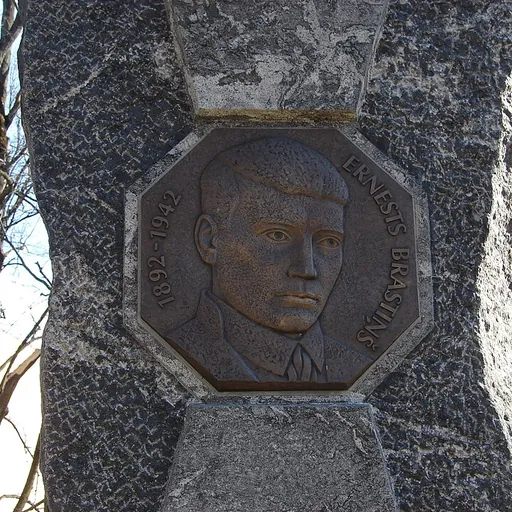
Ernests Brastiņš
Latvian opinion journalist and art historian
About Ernests Brastiņš
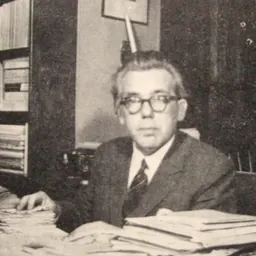
Lived 1892 – 1942 (aged 49). Ernests Brastiņš was a Latvian opinion journalist and art historian.
Ernests Brastiņš (19 March 1892 – 28 January 1942) was a Latvian artist, amateur historian, folklorist and archaeologist. He is known as the founder and driving force behind the neopagan religion Dievturība, which he started in the 1920s and which was re-established after the fall of the Soviet Union.
Biography Ernests Brastiņš was educated at the Stieglitz Art Academy in Saint Petersburg from 1911 to 1915. After military service in World War I and the Latvian War of Independence he became the director of the Latvian War Museum. During his time at the museum he studied Latvian history, Latvian ethnography, folk art and symbols, and investigated around 300 Latvian hill forts and the folklore connected to them.
In 1925, Brastiņš co-wrote a neopagan manifesto with Kārlis Marovskis-Bregžis, titled Latviešu dievturības atjaunojums . This marked the beginning of Dievturība, a Baltic neopagan religion based on pre-Christian Baltic religion, Latvian folk culture, and especially the folk songs known as dainas. The word Dievturība roughly means "the people who hold or live according to God's laws". Having attracted prominent artists and intellectuals to the movement, Brastiņš unsuccessfully tried to have Dievturība adopted as the official state religion of Latvia.
After the 1934 Latvian coup d'état the movement was forced to re-register as a secular organization. Brastiņš' research as well as his religious engagements were terminated with the Soviet occupation of Latvia in 1940. He was arrested by the Soviet security services on 6 July 1940. On 24 May 1941, he was sentenced to eight years in a correctional labour camp in Russia for having founded and led the Dievturība organization. He was put on another trial in Russia on 27 January 1942 and was sentenced to death. The execution was carried out the following day.
Legacy During the Soviet era the Dievturība religion primarily lived on abroad in Latvian émigré communities. These varied in their view of it as a religion or just as a way to preserve Latvian traditions. The movement was officially re-registered in Latvia on 18 April 1990. Its contemporary adherents recognize Brastiņš as its founder and leading ideologue.
On 26 October 2006, a monument to Brastiņš was unveiled in the Kronvald Park in central Riga, close to the Riga Congress Hall. The four and a half meter tall stone monument features an embedded bronze disc with a relief portrait of Brastiņš on its northern side, and on its southern side a sun symbol and the words "Tautai" (Folk), "Dievam" (God) and "Tēvijai" (Fatherland). It was made by the sculptor in collaboration with the stonecutter Robertu Zvagūzis and the medal artist Jānis Strupulis.
Don’t just read it —
keep it.
Full-length biographies made to live with: read them, listen on the way to work, watch them tonight.
- E-book
- Audio
- Video
Instant download · yours to keep · every purchase keeps this site free
Important facts
Related people
Same field, nearest in time


Contemporaries
People whose lives overlapped Ernests Brastiņš's






Frequently asked questions
Who was Ernests Brastiņš?
Latvian opinion journalist and art historian (1892-1942)
When was Ernests Brastiņš born?
Ernests Brastiņš was born on 19 March 1892 in Straupe.
When did Ernests Brastiņš die?
Ernests Brastiņš died on 28 January 1942 in Soviet Union.
What was Ernests Brastiņš's occupation?
Ernests Brastiņš was an opinion journalist and art historian.
What nationality was Ernests Brastiņš?
Ernests Brastiņš was Latvian.
Sources & further reading
Cite this page
APA: Biography.guide. (2026). Ernests Brastiņš. https://biography.guide/ernests-brastins/
MLA: "Ernests Brastiņš." Biography.guide, https://biography.guide/ernests-brastins/.
Chicago: "Ernests Brastiņš." Biography.guide. https://biography.guide/ernests-brastins/.
Data last updated: 2026-09-22 · Spot an error? Report a correction.
Portrait: Wikimedia Commons · author & licence
Page generated 2026-09-27 05:00 UTC