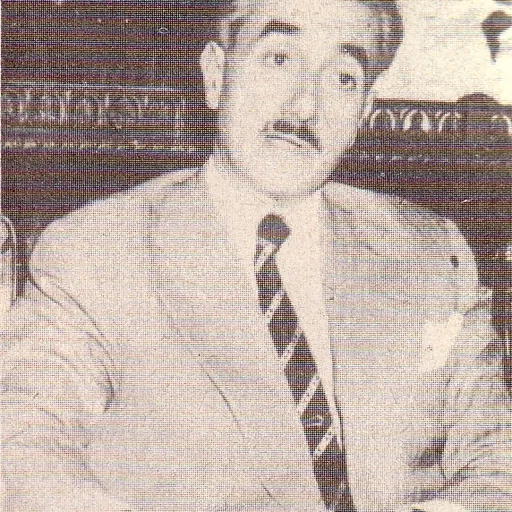
About Ernesto Sammartino
Lived 1902 – 1979 (aged 77). Ernesto Sammartino was an Argentine politician.
Ernesto Enrique Sammartino (Ramallo, — Buenos Aires, ) was an Argentine journalist, lawyer, writer, diplomat and politician belonging to the Radical Civic Union (UCR), who served several times as a national deputy and member of the National Academy of Moral and Political Sciences and who was famous for having used the term "zoological barrage" in 1947, when Juan Domingo Perón was elected as president of Argentina.
Biography After graduating in law and beginning his judicial career as a prosecutor in 1929 in the province of Entre Ríos and director of legal affairs of the Education Council of the same in 1931, he headed into the field of journalism and politics as a member of the Radical Civic Union.
In 1932, he was elected as a member of the Constituent Convention of Entre Ríos that modified the provincial constitution. For that same province he was elected national deputy for the period 1936–1940. In 1940 he was again elected national deputy for radicalism, this time for Buenos Aires.
He was part of the group led by General Arturo Rawson that participated in the military coup of June 4, 1943.
In the 1946 elections, when Juan Domingo Perón was elected president, he was again elected national deputy for the Federal Capital for the period 1946–1950, assuming a clearly anti-Peronist position. On August 8, 1946, he accused the Peronist majority of "knowing the 40 forms of theft," which is why he was suspended for three days.
In the course of a parliamentary debate he uttered the controversial and famous expression "zoological barrage." The event occurred during the session of the Chamber of Deputies on July 26, 1947, when he said: The zoological barrage of February 24 seems to have thrown some congressman to his bench, so that from there he can meow at the stars for a diet of 2,500 pesos. Let him continue meowing, it doesn't bother me.
As a result of these expressions, on August 5, 1948, he was expelled from the Chamber of Deputies by the vote of the Peronist legislators, leaving him without parliamentary immunity.
Writing career In the world of journalism he was director of El Diario de Paraná, Nueva Palabra and La Voz de Mayo of Buenos Aires and La Montaña of Entre Ríos between 1930 and 1936. As a writer he is the author of poems, plays and essays. His works include Escuchemos ahora a los poetas (1956) and Los santos no van al cielo.
Don’t just read it —
keep it.
Full-length biographies made to live with: read them, listen on the way to work, watch them tonight.
- E-book
- Audio
- Video
Instant download · yours to keep · every purchase keeps this site free
Important facts
People in Ernesto Sammartino's life
Named in this biography and alive at the same time

Related people
Same field, nearest in time





Contemporaries
People whose lives overlapped Ernesto Sammartino's


Frequently asked questions
Who was Ernesto Sammartino?
Argentinian politician
When was Ernesto Sammartino born?
Ernesto Sammartino was born on 4 January 1902 in Ramallo.
When did Ernesto Sammartino die?
Ernesto Sammartino died on 7 January 1979 in Buenos Aires.
What was Ernesto Sammartino's occupation?
Ernesto Sammartino was a politician.
What nationality was Ernesto Sammartino?
Ernesto Sammartino was Argentine.
Sources & further reading
· Wikipedia: Ernesto Sammartino
Cite this page
APA: Biography.guide. (2026). Ernesto Sammartino. https://biography.guide/ernesto-sammartino/
MLA: "Ernesto Sammartino." Biography.guide, https://biography.guide/ernesto-sammartino/.
Chicago: "Ernesto Sammartino." Biography.guide. https://biography.guide/ernesto-sammartino/.
Data last updated: 2026-09-20 · Spot an error? Report a correction.
Portrait: Wikimedia Commons · author & licence
Page generated 2026-09-27 04:58 UTC