
About Ernestine Mills
Lived 1871 – 1959 (aged 87–88). Ernestine Mills was a writer.
Ernestine Evans Mills (née Bell; 1871 – 6 February 1959) was an English metalworker and enameller who became known as an artist, writer and suffragette. She was the author of The Domestic Problem, Past, Present, and Future.
Background Mills was born in Hastings to Emily "Mynie" Ernest Bell (née Magnus; c. 1839 – 1893), an actor and classical musician,
She was educated at home with a governess, then at Notting Hill High School for Girls and taught drawing from a young age by the artist Frederic Shields, a friend of the family.
Her father died in 1887 and her mother in 1893, and she was supported for a time by guardians, William Edward and Hertha Ayrton. She attended South Kensington School of Art Finsbury Central Technical School, and was awarded a place at the Slade Art School. She acted as vice-president for the craft section of the Society of Women Artists for a period.
In 1898 Mills married the doctor Herbert Henry Mills (1868–1947), who shared her Fabian views and was physician to Richard and Emmeline Pankhurst.
In May 1915, Hertha Ayrton tested an 'anti-gas fan’ in Mill's back garden in Kensington. It was later adopted as a device to clear poisonous chemical gases from British frontline trenches during the First World War. The story was transmuted into a scene in the 1924 novel The Call later written by Ayrton's step daughter Edith Zangwill.
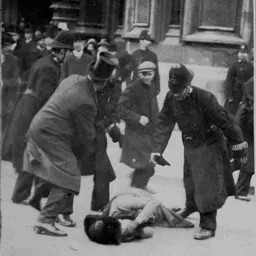
Activism alt=A woman is on the ground with her gloved hands over her face. A man in a top hat is holding back one police officer, while another is holding one of his gloves and stooping over the woman. In the background are several police officers and other men. Beyond them are the walls and doorway to the Parliament buildings.
In 1907 Mills joined Emmeline Pankhurst's Women's Social and Political Union (WSPU) and by 1909 had joined the Fabian Women's Group. The photograph was published under the headline: "Violent Scenes at Westminster Where Many Suffragettes Were Arrested While Trying to Force Their Way Into the House of Commons." Other sources have identified the woman as the suffragette Ada Wright.
Works The Museum of London holds three pieces of jewellery Mills made for the suffragettes. One is an enamel-and-silver pendant of winged Hope singing outside prison bars with semi-precious stones of purple, green and white, created to celebrate the release from prison of Louise Eates, Honorary Secretary of the Kensington branch of the WSPU. The other two are brooches, one in the WSPU colours, with the words "Votes for Women" in white on a green wreath and purple background, and the second, made for the Women's Freedom League (WFL), reads "Votes for Women" in the WFL colours: green, white and gold. and The Life and Letters of Frederic Shields (1912), a biography of her teacher.
Mills was a member of the Soroptimist Greater London club, founded in 1924, and for which she created an enamelled President's badge in 1933. The Soroptimist International of London Mayfair commissioned a painted enamel President's badge from her in 1946, paying seven guineas for it. The design included their founding date of 1942 and commemorates the Alpha Club, founded in 1928, from which they grew, with the chain ultimately listing the names of the club's presidents from 1942 to 2006, including Flora Drummond. The chain is now held at the V&A Museum.
Death Ernestine Mills died on 6 February 1959, aged 88. She was cremated at Mortlake Crematorium the ceremony attended by her daughter, Dr Hermia Mills, and members of the Society for Women Artists, and the Soroptimist Club of Greater London.
Her obituary in The Times described her as "a vivid personality, well known in Kensington, where she lived all her life. A very unconventional upbringing of late Victorian days made her an Edwardian of the modern school, a friend of Mrs Pankhurst, and a champion of women’s rights. She had a courtesy and sympathy for all and was beloved of a large circle of friends."
Don’t just read it —
keep it.
Full-length biographies made to live with: read them, listen on the way to work, watch them tonight.
- E-book
- Audio
- Video
Instant download · yours to keep · every purchase keeps this site free
Important facts
People in Ernestine Mills's life
Named in this biography and alive at the same time



Related people
Same field, nearest in time


Contemporaries
People whose lives overlapped Ernestine Mills's

Frequently asked questions
Who was Ernestine Mills?
British enameller
When was Ernestine Mills born?
Ernestine Mills was born in 1871 in Hastings.
When did Ernestine Mills die?
Ernestine Mills died in 1959.
What was Ernestine Mills's occupation?
Ernestine Mills was a writer.
Sources & further reading
Cite this page
APA: Biography.guide. (2026). Ernestine Mills. https://biography.guide/ernestine-mills/
MLA: "Ernestine Mills." Biography.guide, https://biography.guide/ernestine-mills/.
Chicago: "Ernestine Mills." Biography.guide. https://biography.guide/ernestine-mills/.
Data last updated: 2026-09-20 · Spot an error? Report a correction.
Page generated 2026-09-27 05:04 UTC