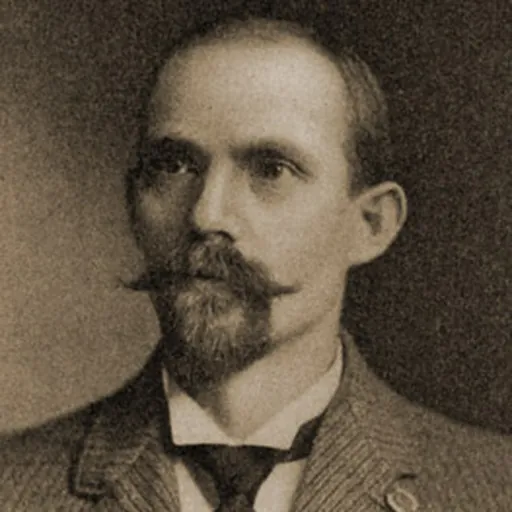
About Ernest Untermann
Lived 1864 – 1956 (aged 91–92). Ernest Untermann was a German editor, politician, journalist, geologist and paleontologist.
Gerhard Ernest Untermann, Sr. (November 6, 1864 – January 5, 1956) was a German-American seaman, socialist author, translator, and newspaper editor. In his later life he was Director of the old Washington Park Zoo in Milwaukee, a geologist, fossil hunter, and artist.
Biography
Early years Ernest was born in what was then Soldin, Brandenburg, Kingdom of Prussia on November 6, 1864. He studied geology and paleontology at the University of Berlin. He later wrote that after graduating, he was "drafted into the great army of the unemployed before I had done a stroke of useful work. Society had trained me for intellectual tasks, but had failed to provide for employment." Untermann took work as a deckhand on a German steamer sailing to New York City, thus bringing him to America for the first time. He subsequently made several trips around the world, working on German, Spanish, and American sailing vessels.
Untermann was the first American translator of Karl Marx's Das Kapital, beginning work on the massive project in the spring of 1905 while living on a chicken farm in Orlando, Florida and completing translations of volumes 2 and 3 for Kerr in 1907 and 1909, respectively. He also translated other socialist works for an American audience, including the memoirs of Wilhelm Liebknecht and August Bebel as well as The Origin of the Family, Private Property, and the State, by Frederick Engels. In addition to translations from German and Italian, Untermann wrote original works on Economics and Natural History. His books included Science and Revolution (1905), The World's Revolutions (1906), and Marxian Economics: A Popular Introduction to the Three Volumes of Marx's Capital (1907).
Untermann professed an adherence to the thinking of Karl Kautsky and Joseph Dietzgen. He held that science had a class basis and drew very radical conclusions from this premise without hesitation or pulling of punches, writing in his 1905 book, Science and Revolution, that
"I speak as a proletarian and a socialist. I make no pretense to be a scientist without class affiliation. There has never been any science which was not made possible, and which was not influenced, by the economic and class environment of the various scientists. I am, indeed, aware of the fact that there are certain general facts in all sciences which apply to all mankind regardless of classes. But I am also aware of the other fact, that the concrete application of any general scientific truth to different historical conditions and men varies considerably, because abstract truths have a general applicability only under abstract conditions, but are more or less modified in the contact with concrete environments."
Untermann further indicated that "bourgeois science" was perpetually under assault in capitalist society and that "university professors have learned to their bitter disappointment that freedom of science is little respected when it runs counter to freedom of trade." Hence: "Under these circumstances, the proletariat cannot place any reliance on bourgeois science. it must and will maintain a critical attitude toward all bourgeois science, and accept nothing that does not stand the test of proletarian standards. "So far as bourgeois science coincides with the findings of proletarian science, we shall gladly accept and foster every truth... But we shall on our part reject everything which tends to strengthen the ruling class, endanger the progress of the proletarian revolution, or interfere with the advance of human knowledge and control of natural forces in general."
Rather unsurprisingly, his Science and Revolution was translated into Russian and published in Soviet Ukraine in 1923.
Untermann was on the National Executive Committee of the Socialist Party of America from 1908 to 1910. He was the Socialist candidate for governor of Idaho in 1908 and 1910, and for U.S. senator from California in 1914. He strongly supported the affiliated unions of the AF of L and opposed the radical labor militancy of the Industrial Workers of the World. His anti-syndicalist perspective became more pronounced over time. He declared in a 1913 polemical article that a crisis approached during which "it will be impossible to avoid the expulsion of individuals who through word and deed confess that they are not in harmony with the fundamental principles of the [socialist] organization."
Untermann was a delegate to the 1910 "National Congress" and 1912 National Convention of the Socialist Party, chairing the organization's Committee on Immigration. He was a chief author, along with Joshua Wanhope (1863–1945), of a resolution on immigration which was pro-exclusionary — called "racist" by its critics — backing the AF of L in its desire to stop manufacturers from importing cheap, non-union labor from the Far East. Untermann and Wanhope were joined as a majority on this point by journalist Robert Hunter and J. Stitt Wilson of California.
John Spargo, Meyer London, and Leo Laukki (1880–1938) were the minority on this committee, opposing exclusionism. Untermann and Wanhope's majority proposal was effectively killed by the convention on motion by Charles Solomon of New York not to receive the committee's report, but rather to hold the matter open for further investigation and final decision by the next party convention, scheduled for four years hence.
Untermann later served as Foreign Editor of Victor Berger's socialist daily, the Milwaukee Leader, during World War I and from 1921 to 1929. Untermann wrote the editorials pertaining to international affairs, while John M. Work wrote the editorials on domestic affairs.
Post-radical years Untermann was also a painter of great accomplishment, specializing in landscapes and prehistoric flora and fauna. He was known as "The Artist of the Uintas". He contributed paintings, murals, and panels to the Dinosaur National Monument, the old Utah Field House of Natural History State Park Museum and has a large collection of paintings at the new Utah Field House of Natural History State Park Museum in Vernal, Utah. His interest in paleontology and Geology led to his moving to Vernal, Utah.
Untermann died in Vernal on January 5, 1956.
Untermann's papers are housed at two institutions, the Wisconsin Historical Society in Madison, Wisconsin, and the University of Utah Library, Special Collections, in Salt Lake City.
Selected works
Books and pamphlets Municipality: From Capitalism to Socialism. Girard, KS: Appeal to Reason, 1902. Religion and Politics. Girard, KS: Appeal to Reason, c. 1904. Socialism: A New World Movement. Girard, KS: Appeal to Reason, 1904. Science and Revolution. Chicago: Charles H. Kerr & Co., 1905. Socialism vs. Single Tax: A Verbatim Report of a Debate held at Twelfth Street, Turner Hall, Chicago, December 20th, 1905. With Louis F. Post. Chicago: Charles H. Kerr & Co., n.d. . The World's Revolutions. (1906) Chicago: Charles H. Kerr & Co., 1909. Marxian Economics: A Popular Introduction to the Three Volumes of Marx's Capital. Chicago: Charles H. Kerr & Co., 1907. Die Logischen Mängel des Engeren Marxismus. Georg Plechanow et alii gegen Josef Dietzgen. Berlin: Verlag der Dietzgenschen Philosophie, 1910. Popular Guide to the Geology of Dinosaur National Monument.
Articles "The American Farmer and the Socialist Party", The Socialist [Seattle], part 1: no. 143 (May 3, 1903), pg. 2; part 2: no. 144 (May 10, 1903), pg. 2; part 3: no. 145 (May 17, 1903), pp. 2, 4; part 4: no. 147 (May 31, 1903), pg. 2. part 5: no. 149 (June 14, 1903), pg. 2; part 6: no. 153, pg. 3.; part 7 (conclusion): no. 156 (August 5, 1903), pg. 2. "How I Became a Socialist", The Comrade, v. 2, no. 3 (Dec. 1902), p. 62. "Marxism and Revisionism", The Worker, vol. 14, no. 6, (May 8, 1904), pg. 8. "The Socialist Party and the Trade Unions", The Worker [New York], vol. 16, no. 5, (May 5, 1906). "The Third Volume of Marx's Capital", International Socialist Review, vol. 9, no. 6 (June 1909), pp. 946–958. "A Reply to Debs", The Social-Democratic Herald [Milwaukee], Wisconsin Edition, vol. 13, no. 16, whole no. 629 (Aug. 20, 1910), pg. 2. "The Immigration Question", The Social-Democratic Herald [Milwaukee], vol. 13, no. 32 (Dec. 10, 1910), pg. 2. "No Compromise with the IWW", St. Louis Labor, no. 624 (Jan. 18, 1913), pg. 7.
Translations Wilhelm Liebknecht, Karl Marx: Biographical Memoirs. Chicago: Charles H. Kerr & Co., 1901. Frederick Engels, The Origin of the Family, Private Property and the State. Chicago: Charles H. Kerr & Co., 1902. Wilhelm Bölsche, The Evolution of Man. Chicago: Charles H. Kerr & Co., 1905. Joseph Dietzgen, The Positive Outcome of Philosophy. Chicago: Charles H. Kerr & Co., 1906. Enrico Ferri, The Positive School of Criminology: Three Lectures Given at the University of Naples, Italy, on April 22, 23, and 24, 1901. Chicago: Charles H. Kerr & Co., 1906. M. Wilhelm Meyer, The Making of the World. Chicago: Charles H. Kerr & Co., 1906. Antonio Labriola, Socialism and Philosophy. Chicago: Charles H. Kerr & Co., 1907. August Bebel, Bebel's Reminiscences. New York: Socialist Literature Co., 1911.
Don’t just read it —
keep it.
Full-length biographies made to live with: read them, listen on the way to work, watch them tonight.
- E-book
- Audio
- Video
Instant download · yours to keep · every purchase keeps this site free
Important facts
People in Ernest Untermann's life
Named in this biography and alive at the same time



Related people
Same field, nearest in time


Contemporaries
People whose lives overlapped Ernest Untermann's



Frequently asked questions
Who was Ernest Untermann?
American politician and newspaper editor
When was Ernest Untermann born?
Ernest Untermann was born in 1864 in Myślibórz.
When did Ernest Untermann die?
Ernest Untermann died in 1956.
What was Ernest Untermann's occupation?
Ernest Untermann was an editor, politician, journalist, geologist and paleontologist.
What nationality was Ernest Untermann?
Ernest Untermann was German.
Sources & further reading
Cite this page
APA: Biography.guide. (2026). Ernest Untermann. https://biography.guide/ernest-untermann/
MLA: "Ernest Untermann." Biography.guide, https://biography.guide/ernest-untermann/.
Chicago: "Ernest Untermann." Biography.guide. https://biography.guide/ernest-untermann/.
Data last updated: 2026-09-22 · Spot an error? Report a correction.
Portrait: Wikimedia Commons · author & licence
Page generated 2026-09-27 05:02 UTC