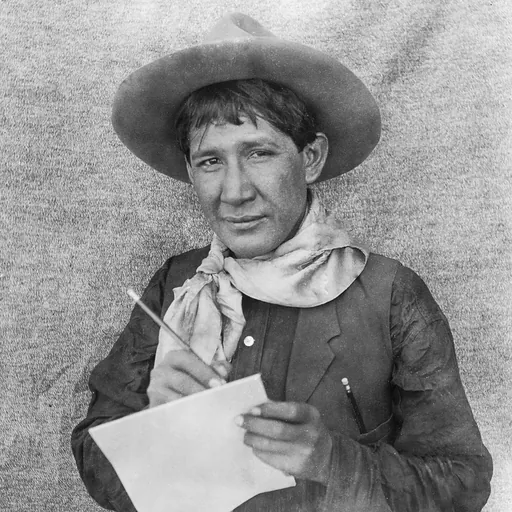
About Ernest Spybuck
Lived 1883 – 1949 (aged 65–66). Ernest Spybuck was a painter.
Earnest Spybuck (January 1883 – 1949) was an Absentee Shawnee Native American artist, who was born on the land allotted the Shawnee Indians in Indian Territory and what was to later become Pottawatomie County, Oklahoma, near the town of Tecumseh.
After his collection of his art by anthropologist Mark Raymond Harrington, Spybuck's work was received positively by both Native American and non-native artistic communities. Many of his works are now held by the Smithsonian's National Museum of the American Indian.
Early life Ernest Spybuck was born on his Shawnee Tribal Allotment near what was later to become Tecumseh, Oklahoma, to the White Turkey Band of the Absentee Shawnee, of the Rabbit clan. His parents were Peahchepeahso and John Spybuck. His Shawnee name was Mathkacea or Mahthela.
By the time he was born the Absentee band of Shawnee, like many tribes originally residing east of the Mississippi River, had been forcibly removed to Indian Territory by the U. S. government. Many different tribal peoples were settled in close proximity to each other so Spybuck grew up with the neighboring Sauk and Fox, Kickapoo, and Citizen Pottawatomie people.
Spybuck attended school at the Shawnee Boarding School near his home and at Sacred Heart Mission in south-central Pottawatomie County. According to his teacher, when he was eight years old, Spybuck would do nothing but draw and paint pictures with subjects drawn from his life. His education never went beyond the McGuffey's Third Reader.
At the age of 19, Spybuck married his wife Anna Scott, and the couple had four children, Thomas, Flindie, Hewitt and Virgie Louise. The family lived the entire time on Spybuck's allotment in the Brinton Township, west of Tecumseh, Oklahoma, near the Little Axe community among other Shawnee Tribal members. Harrington also interviewed Spybuck for a work on the Shawnee tribe which was never published, but he deposited his notes and Spybuck's paintings with the Museum of the American Indian, which is now the Smithsonian National Museum of the American Indian.
Artistic style Reportedly Spybuck told Harrington that he preferred painting cowboys, livestock and range scenes, and some say through Harrington's patronage, Spybuck's style evolved in his choice of subjects and the way he painted them. His style was representational, featuring local scenes of ceremonies, games, social gatherings and the home life he was familiar with and often participated in. His style could be called Plains Flatstyle Representative Art, in which individuals could be identified by the meticulous details of dress and accoutrement, set in a simplified three-dimensional setting with well-defined foreground and background.
However, he took the representational depiction of the figures and settings in a new direction that was uniquely his own. He developed his own unique techniques, such as painting a cross-section "window" in lodge where a ceremony would take place to show the activity inside, while also showing the landscape and time of day outside. Other reviewers recognize Spybuck as an Indian artist who is a recorder and preserver of traditional practices in the midst of social change.
In Spybuck's lifetime, works by Native American artists were beginning to become exhibited as art rather than ethnographic specimens. Then in 1991, Shared Visions: Native American Painters and Sculptors in the Twentieth Century was an exhibit that opened at the Heard Museum, Phoenix, Arizona and toured to four major museums in the United States. The exhibition brought together three generations of artists to trace the history of the Native American Fine Art Movement. Together with Arapaho artist Carl Sweezy, the exhibit placed Spybuck in the earliest stage of the movement, Early Narrative Style, in which Native artists documented the upheavals in Indian Country in the late 19th century and early 20th century. They adopted and adapted western techniques of art and ethnography to produce works that documented the transformation of traditional ways.
Later life Spybuck worked as a farmer, painter, and historical informant.
Publications that include Spybuck art
Major exhibitions Shawnee Home Life: The Paintings of Earnest Spybuck Opened at the Museum of the American Indian, New York, New York in 1987, then toured to several museums, including Mabee-Gerrer Museum of Art, Shawnee, Oklahoma October 21 to December 14, 1986 The Oklahoma Historical Society Museum, Oklahoma City, Oklahoma Bacone College Museum, Muskogee, Oklahoma
Shared Visions: Native American Painter and Sculptors in the Twentieth Century Opened at the Heard Museum, Phoenix, Arizona, on April 13, 1991, then toured to The Eiteljorg Museum of American Indians and Western Art, Indianapolis, Indiana The Thomas Gilcrease Institute of American History and Art, Tulsa, Oklahoma The Oregon Art Institute, Portland Art Museum, Portland, Oregon The National Museum of the American Indian, Smithsonian Institution, The U.S. Custom House, New York, New York
Collections Mabee-Gerrer Museum of Art, Shawnee, Oklahoma (home county to Spybuck) National Museum of the American Indian, Smithsonian Institution, Washington, D. C. Gilcrease Museum, Tulsa, Oklahoma Heard Museum, Phoenix, Arizona Oklahoma Historical Society Museum, Oklahoma City, Oklahoma Fred Jones Jr. Museum of Art, Norman, Oklahoma
Don’t just read it —
keep it.
Full-length biographies made to live with: read them, listen on the way to work, watch them tonight.
- E-book
- Audio
- Video
Instant download · yours to keep · every purchase keeps this site free
Important facts
People in Ernest Spybuck's life
Named in this biography and alive at the same time




Related people
Same field, nearest in time

Contemporaries
People whose lives overlapped Ernest Spybuck's

Frequently asked questions
Who was Ernest Spybuck?
Shawnee genre artist (1883-1949)
When was Ernest Spybuck born?
Ernest Spybuck was born in 1883 in Indian Territory.
When did Ernest Spybuck die?
Ernest Spybuck died in 1949 in Dawes Act.
What was Ernest Spybuck's occupation?
Ernest Spybuck was a painter.
What nationality was Ernest Spybuck?
Ernest Spybuck's recorded nationality: Absentee Shawnee.
Sources & further reading
Cite this page
APA: Biography.guide. (2026). Ernest Spybuck. https://biography.guide/ernest-spybuck/
MLA: "Ernest Spybuck." Biography.guide, https://biography.guide/ernest-spybuck/.
Chicago: "Ernest Spybuck." Biography.guide. https://biography.guide/ernest-spybuck/.
Data last updated: 2026-09-22 · Spot an error? Report a correction.
Portrait: Wikimedia Commons · author & licence
Page generated 2026-09-27 05:02 UTC