
About Erna Lendvai-Dircksen
Lived 1883 – 1962 (aged 78). Erna Lendvai-Dircksen was a German photographer.
Erna Lendvai-Dircksen (born Erna Katherina Wilhelmine Dircksen, 31 May 1883 – 8 May 1962) was a German photographer known for a series of volumes of portraits of rural individuals from throughout Germany. During the Third Reich, she also photographed for eugenicist publications and was commissioned to document the new Autobahn and the workers constructing it.
Career Born in Wetterburg, now part of Bad Arolsen, Erna Dircksen studied painting at the Kunsthochschule Kassel from 1903 to 1905, and photography at the Lette-Verein from 1910 to 1911. She may have opened a photographic studio in Hellerau, near Dresden, in 1913. From 1916 to 1943, she had a portrait studio in Berlin. By 1918 she had a growing reputation, particularly for her nude photography, and was increasingly using a highly realistic style. Beginning in 1917, she made a series of photo-portraits of Germans of different regions, a selection of which won first prize at an exhibition in Frankfurt in 1926.
Das deutsche Volksgesicht Lendvai-Dircksen published her portraits of rural Germans as Das deutsche Volksgesicht (The Face of the German Volk) in 1932. It was continued in multiple volumes portraying different regions of the Reich beginning in 1942, both under that title and as Das germanische Volksgesicht (The Face of the Germanic Volk), now including volumes on, for example, Flanders and Norway.
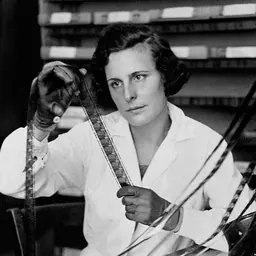
Autobahn Under the Third Reich she received state commissions, notably one from Fritz Todt for portraits of Autobahn construction workers, originally commissioned for the Schaffendes Volk exhibition of 1937 as part of Todt's effort to have the best photographers in the Reich artistically reproduce the new autobahn. Todt specifically required her to "photographically [depict] the visages of his Reich autobahn workers from the various regions of the Fatherland". The book appeared in 1937 and in a revised edition in 1942. Presumably Todt chose her on the basis of her work in Das deutsche Volksgesicht, and the autobahn book follows a similar plan, following the course of the construction from North Germany south into the Alps, and in each region following illustrations of the landscape and the autobahn, especially the bridges, with depictions of local men working on the project. Her pictures of the new bridges emphasise the stonework and the aesthetics of the arches, in some cases using compositional techniques reminiscent of New Objectivity, in others situating the gigantic constructions in nature and in tradition, suggesting their lengthy future existence; in one image, a farmer ploughing with a team of oxen is shown beneath an autobahn bridge. Those of the workers, which dominate the book, heroicise them by depicting them individually, in tight close-up and from beneath; she makes use of the "cult of the beautiful body" as in Leni Riefenstahl's Olympia. Only occasionally does she pose them looking at the camera, and she rarely shows their tools and then only as illustrations of strength or elements of the composition; she also emphasises hand-work, giving the impression the autobahn was built using very little heavy machinery. Captions such as "After years of unemployment, I am once again earning honest bread for seven sons and a daughter" emphasise the importance of the autobahn as a means of reducing unemployment, and ignore the reality of forced labour and the bad conditions in the workers' camps reported by eyewitnesses in favour of the propaganda message.
Volk und Rasse She was also the main photographer of children for the eugenicist periodical Volk und Rasse, posing them in traditional dress and under harsh lighting to clearly capture their desirable racial characteristics.
Later career In 1943, to escape the bombing of Berlin, she moved to Upper Silesia; in 1945 she lost her archives fleeing from there, and settled in Coburg, where from the 1950s she began to concentrate on landscape photography in colour. The Gesellschaft Deutscher Lichtbildner awarded her their highest honour, the David Octavius Hill Medal, in 1958.
Critical reception Lendvai-Dircksen's portraits of farmers suited the Nazi ethos except that in her initial publication, almost all her subjects were old, and indeed she clearly portrayed the damage to their bodies as a sign of authenticity. She later widened her focus to include children. She never, however, photographed sport, whether for technical reasons or because of her personal philosophy.
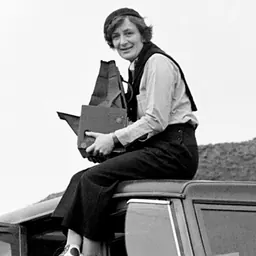
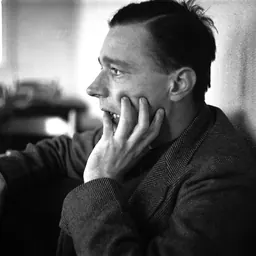
Although Lendvai-Dircksen has been referred to as "brown Erna" for the promotion of Nazi ideals in her work under the Third Reich, her portrait photography can be compared to the work of Dorothea Lange or Walker Evans as documentation of impoverished people, and Margaret Bourke-White also photographed labourers in a heroic light. was shared by Weimar-era photographers such as the progressive August Sander, in his Antlitz der Zeit (Face of Our Time).
Private life Dircksen was married from 1906 to 1910 to Adolf Göschel, with whom she had a daughter, She died in 1962 in Coburg.
Selected publications Lendvai-Dircksen published at least twenty photographic albums which sold some 250,000 copies and of which at least six were reprinted. These included: Das deutsche Volksgesicht. Berlin: Kulturelle Verlagsgesellschaft, 1932. Unsere deutschen Kinder. Text by Paul Seelhoff. Berlin: Schönfeld, 1932. Das Gesicht des deutschen Ostens. Berlin: Zeitgeschichte. Bergmenschen. Deutsche Meisteraufnahmen 4. Munich: Bruckmann, 1936. Nordseemenschen. Deutsche Meisteraufnahmen 9. Munich: Bruckmann, 1937. Arbeit Formt das Gesicht. Aus dem Archiv der Henschel Flugzeug-Werke AG. 1938. Reichsautobahn. Mensch und Werk. Gedichte und Sprüche [Verses and epigrams], Emil Maier. Generalinspektor für das deutsche Straßenwesen. Berlin: Volk und Reich, 1937. Reichsautobahn. Mensch und Werk. 99 Aufnahmen. 2nd ed. Worte und Gedichte [Words and verses], Emil Maier-Dorn. Geleitwort [Forward], General-Inspektor für das deutsche Straßenwesen Dr.-Ing. Fritz Todt. Bayreuth: Gauverlag, 1942. Das deutsche Volksgesicht / Das germanische Volksgesicht. Bayreuth: Gauverlag, multiple volumes, 1942–44. Das deutsche Volksgesicht: ein Bildwerk in 145 Bildnissen von Erna Lendvai-Dircksen. Selection ed. Helmut Schröcke. Tübingen: Grabert, 2003. Urgestalt in Kreide und Granit: in zwei Bildkapiteln. Essen: Burkhard-Verlag Heyer, 1960. Ein deutsches Menschenbild; Antlitz des Volkes. Frankfurt: Umschau, 1961.
She published an essay on her approach to photography: "Zur Psychologie des Sehens". Das Deutsche Lichtbild 1931 (n.p.)
Don’t just read it —
keep it.
Full-length biographies made to live with: read them, listen on the way to work, watch them tonight.
- E-book
- Audio
- Video
Instant download · yours to keep · every purchase keeps this site free
Important facts
People in Erna Lendvai-Dircksen's life
Named in this biography and alive at the same time

Related people
Same field, nearest in time




Contemporaries
People whose lives overlapped Erna Lendvai-Dircksen's



Frequently asked questions
Who was Erna Lendvai-Dircksen?
German photographer (1883-1962)
When was Erna Lendvai-Dircksen born?
Erna Lendvai-Dircksen was born on 31 May 1883 in Bad Arolsen.
When did Erna Lendvai-Dircksen die?
Erna Lendvai-Dircksen died on 8 May 1962 in Coburg.
What was Erna Lendvai-Dircksen's occupation?
Erna Lendvai-Dircksen was a photographer.
What nationality was Erna Lendvai-Dircksen?
Erna Lendvai-Dircksen was German.
Sources & further reading
· Wikipedia: Erna Lendvai-Dircksen
· DBpedia: Erna Lendvai-Dircksen
Cite this page
APA: Biography.guide. (2026). Erna Lendvai-Dircksen. https://biography.guide/erna-lendvai-dircksen/
MLA: "Erna Lendvai-Dircksen." Biography.guide, https://biography.guide/erna-lendvai-dircksen/.
Chicago: "Erna Lendvai-Dircksen." Biography.guide. https://biography.guide/erna-lendvai-dircksen/.
Data last updated: 2026-09-22 · Spot an error? Report a correction.
Page generated 2026-09-27 05:25 UTC