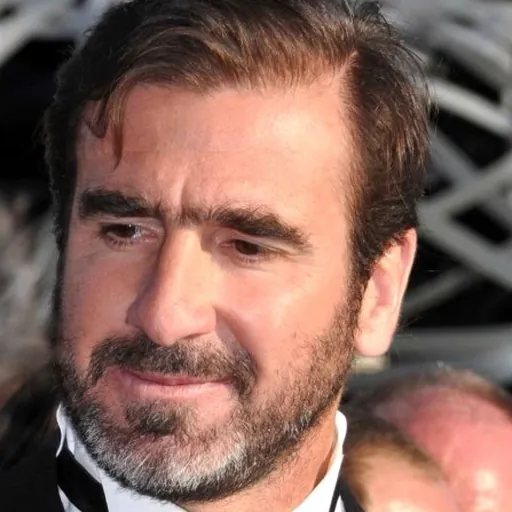
Eric Cantona
French footballer and actor (born 1966)
About Eric Cantona
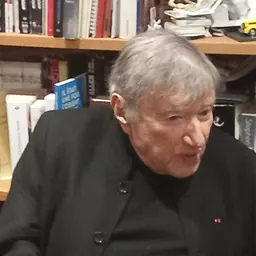
Born 1966. Eric Cantona is a French association football player, actor, stage actor, film actor, executive producer and television actor.
Éric Daniel Pierre Cantona (; born 24 May 1966) is a French actor and former professional footballer. In his football career, Cantona was a physically strong and technically skilful player with both creative and goalscoring ability. Mostly utilised as a deep-lying forward, he was also capable of playing as a centre-forward, a dedicated striker, an attacking midfielder, or a central midfielder. Regarded as one of the greatest players of his generation, he was named by Pelé in the FIFA 100 list of the world's greatest living players in 2004.
Cantona played for Auxerre, Martigues, Marseille, Bordeaux, Montpellier, Nîmes and Leeds United, before ending his career at Manchester United, with whom he won four Premier League titles in five years, including two League and FA Cup Doubles. He wore the iconic number 7 shirt at Manchester United and was known for turning up his collar. He is affectionately nicknamed "King Eric" by Manchester United fans. Cantona won league championships in England and France in seven of his last eight full seasons as a professional, and at least one trophy in eight of his last nine. At international level, he played for the France national team and scored 20 goals in 45 matches. He appeared at UEFA Euro 1992 and, in preparation for Euro 96, was appointed captain in 1994.
In 2003, Cantona was voted as Manchester United's greatest-ever player by Inside United magazine. He was an inaugural inductee into the English Football Hall of Fame in 2002. At the Premier League 10 Seasons Awards in 2003, he was voted the Overseas Player of the Decade. Cantona was inducted into the Premier League Hall of Fame in 2021. Charismatic and outspoken, Cantona's achievements in football were set against fallings out with coaches and team-mates, and a poor disciplinary record throughout his career, including a 1995 conviction for an assault on an abusive spectator, for which he received a two-week prison sentence, reduced to community service on appeal, and an eight-month suspension from footballpreventing him from participating at Euro 96.
In 1997, Cantona unexpectedly announced his retirement from football just before his 31st birthday. He then moved into a career in cinema, including roles in the films Elizabeth (1998), French Film (2008), Looking for Eric (2009) and The Killer (2024). In 2010, he debuted as a stage actor in Face au Paradis, a play directed by his wife, Rachida Brakni. Cantona took an interest in the sport of beach soccer; as player-manager of the France national beach soccer team, he won the 2005 FIFA Beach Soccer World Cup.
Early life Eric Daniel Pierre Cantona was born in Marseille on 24 May 1966, the son of dressmaker Éléonore Raurich, and nurse and painter Albert Cantona. His mother was Spanish and came from Barcelona, while his paternal grandfather was Italian and had emigrated to Marseille from Ozieri in Sardinia. While fighting the armies of General Franco in the Spanish Civil War in 1938, Cantona's maternal grandfather, Pere Raurich, suffered a serious injury to his liver and had to retreat to France for medical treatment with his wife. They stayed in Saint-Priest, Ardèche, before settling in Marseille.
Club career Early career Cantona began his football career with SO Caillolais, his local team and one that had produced such talent as Roger Jouve and had players such as Jean Tigana and Christophe Galtier within its ranks. Originally, Cantona began to follow in his father's footsteps and often played as a goalkeeper, but his creative instincts began to take over and he would play up front more and more often. In his time with SO Caillolais, Cantona played in more than 200 matches.
Auxerre Cantona's first professional club was Auxerre, where he spent two years in the youth team before making his debut on 5 November 1983, in a 4–0 league victory over Nancy. In 1984 his footballing career was put on hold as he carried out his national service. On 14 May 1985, Cantona scored his first goal for Auxerre, scoring an open goal to put his team 2–0 up against Rouen in an important match to put pressure on Monaco. On the final matchday of the season, Auxerre played Strasbourg, with Auxerre needing one point to secure qualification for the following season's UEFA Cup. Trailing 1–0 at half-time, Cantona scored the equalising goal from 25 yards out and showed his talent to a wider audience for the first time. After his discharge he was loaned out to Martigues and shortly after he transferred to Marseille for a French record fee (FF22m). Cantona had grown up as a Marseille fan.
Marseille In January 1989 during a friendly game against Torpedo Moscow he kicked the ball at the crowd, then ripped off and threw away his shirt after being substituted. His club responded by banning him for a month. Just a few months earlier, he had been banned from international matches for one year after insulting the national coach Henri Michel on TV.
Loans to Bordeaux and Montpellier
Having struggled to settle at Marseille, Cantona moved to Bordeaux on a six-month loan and then to Montpellier on a year-long loan. At Montpellier, he was involved in a fight with team-mate Jean-Claude Lemoult and threw his boots in Lemoult's face. The incident led to six players demanding that Cantona be sacked, but with the support of team-mates such as Laurent Blanc and Carlos Valderrama, the club retained his services, although they banned him from the ground for ten days. Cantona was instrumental as the team went on to win the French Cup and his form persuaded Marseille to take him back.
Return to Marseille, transfer to Nîmes Back at Marseille, Cantona initially played well under coach Gerard Gili and his successor Franz Beckenbauer. However, the Marseille chairman Bernard Tapie was not satisfied with the results and replaced Beckenbauer with Raymond Goethals; Cantona was continually at odds with Goethals and Tapie and, despite helping the team win the French Division 1 title, he was transferred to Nîmes the following season, for a fee of ten million francs, signing a three-year contract.
In December 1991, during a match for Nîmes, he threw the ball at the referee, having been angered by one of his decisions. He was summoned to a disciplinary hearing by the French Football Federation and was banned for one month. Cantona responded by walking up to members of the hearing committee in turn and calling each of them an "idiot". His ban was increased to two months and Cantona subsequently announced his retirement from football on 16 December 1991. The France national team coach, Michel Platini, was a fan of Cantona and persuaded him to make a comeback. On the advice of Gérard Houllier, as well as his psychoanalyst, he moved to England to restart his career: "He [my psychoanalyst] advised me not to sign for Marseille and recommended that I should go to England."
Departure and move to England On 6 November 1991, after Liverpool's 3–0 victory over Auxerre in a UEFA Cup second round, second leg tie at Anfield, Liverpool manager Graeme Souness was met by Frenchman Michel Platini at the end of the game, who told him that Cantona was available for sale to Liverpool. Souness thanked Platini, but declined the offer, citing dressing room harmony as his reason. After being turned down by Liverpool, Cantona was given a trial at Sheffield Wednesday when Wednesday manager Trevor Francis was approached by Platini and Francis' former agent, Dennis Roach. In a 2012 interview, Francis explained that he had agreed to take Cantona on as a favour to Roach and Platini, who he knew from his time playing in Italy, and that it was intended as an opportunity for Cantona to put himself in the "shop window": Wednesday had only recently been promoted back to the top flight, with most of the squad still being on Second Division-level wages, and the club could not afford to sign him. Cantona spent two days with Wednesday, training and playing in an indoor tournament at the Sheffield Arena.
Leeds United 1991–92 season Cantona's arrival at Leeds United was announced in January 1992. Leeds would pay £100,000 to Nîmes to take him on loan until 15 April, after which they would have to pay another £900,000 to sign him permanently. Cantona made his debut for Leeds in a 2–0 loss at Oldham Athletic on 8 February 1992. At Leeds, he was part of the team that won the final Football League First Division title before it was replaced by the Premier League as the top division in English football. He made 15 appearances, and despite only scoring three goals, he contributed to their title success, primarily with assists for leading goalscorer Lee Chapman. Cantona scored his first goal for Leeds in a 2–0 win at home to Luton Town on 29 February and set up the other goal for Chapman. Having played little football in the six weeks before signing for Leeds, Cantona struggled to find a place in an established line-up, with manager Howard Wilkinson preferring to put him on against tiring defences. Against Tottenham Hotspur at White Hart Lane on 7 March, Cantona came off the bench to set up a goal for Gary McAllister, securing a win that moved Leeds two points ahead of Manchester United, who had a game in hand, in the title race. Cantona was deployed as a part of a front three, along with Chapman and Rod Wallace, in a 5–1 thrashing of Wimbledon at Elland Road on 14 March, scoring Leeds' fourth goal of the game.
Leeds' title ambitions survived the difficult tests of Arsenal at Highbury (a 1–1 draw with Cantona denied a late winner by David Seaman) and West Ham (a 0–0 draw with Cantona being denied a first-half goal through a dubious offside decision); however, they lost 4–0 to Manchester City on 4 April at Maine Road, allowing Manchester United to take pole position in the title race again. Against Chelsea on 11 April, Cantona came on for Wallace with 20 minutes to go and Leeds leading 1–0; he then set up Chapman's 20th goal of the season before rounding off the scoring with a lob over Chelsea defender Paul Elliott. Two days later, Wilkinson announced that Leeds intended to complete Cantona's transfer from Nîmes for £900,000. Cantona was paid a generous £7,000 a week, a huge cost in an era without television or European football revenue. Starting with that Chelsea match, Leeds went unbeaten in their final five games, securing the league title on the penultimate weekend with a 3–2 win over Sheffield United after Manchester United had lost to Liverpool.
1992–93 season In the 1992 FA Charity Shield that August, with Leeds missing several key players, Cantona scored a hat-trick in a 4–3 victory over Liverpool, the first hat-trick in the Charity Shield since Tommy Taylor in 1957. Cantona's hat-trick places him among the small group of players to have scored three or more goals in games at Wembley. Leeds started their title defence with a 2–1 win over Wimbledon on 15 August; Cantona started alongside Chapman up front, but had a quiet game, although he did pick up his first yellow card in English football, after 17 games. After Cantona scored his first league goal of the season in a 4–1 defeat at Middlesbrough, he followed it up with another hat-trick, the first in the newly created Premier League in a 5–0 win over Tottenham on 25 August. Cantona then flew to Paris to join the France national team for a friendly against Brazil on the very same day, due to newly installed manager Gérard Houllier's desire to have the whole squad present for his first match.
Leeds slipped towards mid-table with a pair of 2–2 draws despite excellent performances by Cantona, drawing two excellent saves from a young David James against fellow title challengers Liverpool on 29 August and scoring a brace against Oldham Athletic three days later. Leeds then fell 2–0 to Manchester United at Old Trafford on 6 September, with Cantona coming off the bench and nearly scoring with a bicycle kick. Leeds' first foray into the European Cup since 1974–75 started poorly with a 3–0 defeat at Stuttgart on 16 September; Cantona, struggling with a hamstring injury, had a pass intercepted that led to Stuttgart's opening goal, exacerbating a growing rift with manager Wilkinson. Cantona missed the next two games, a 1–1 draw at Southampton and a 4–1 win over Scunthorpe United in the League Cup, through injury, but returned immediately to help Leeds win their first league game in six, a 2–0 victory over Everton on 26 September.
Four days later, Leeds faced Stuttgart in the return leg of the European Cup. Dubbed the 'Mission Impossible', Cantona and Gordon Strachan combined to set up Gary Speed, who scored with a left-footed volley. Andreas Buck equalised for Stuttgart in the 34th minute, the away goal meaning that Leeds needed another four to progress. McAllister scored a penalty just before half-time to make it 2–1 to Leeds before Cantona's looping shot in the 66th minute was deflected into his own net by Günther Schäfer. Chapman's header at the near post made it 4–1 in the 78th minute but Stuttgart remained firm and denied Leeds the decisive fifth goal. However, Leeds received a stroke of luck when it emerged after the match that Stuttgart's coach, Christoph Daum, had fielded four 'foreign' players, one more than allowed. Leeds were awarded a 3–0 victory by UEFA and a play-off match was ordered at the neutral Camp Nou in Barcelona on 9 October.
An exhausted Leeds then stumbled to a 4–2 defeat at Ipswich Town, with Cantona's form dipping through fatigue and injury. He had a poor game, as Leeds won the play-off against Stuttgart 2–1. A return to national duty then saw Cantona and Jean-Pierre Papin score in a 2–0 victory over Austria. He brought his revived form back to England, helping in a 3–1 victory against Sheffield United in October. This game would, however, be Cantona's last win while with Leeds.
Leeds were drawn against Rangers in the European Cup, a tie billed as 'The Battle of Britain' by the press. Despite McAllister's first-minute goal, Cantona and Leeds struggled and fell 2–1 amid a hostile Ibrox crowd. Cantona walked straight to the dressing room after being substituted, which was interpreted by Wilkinson as disrespectful to the other players. Leeds also lost the return leg 2–1, Rangers scoring through Mark Hateley and Ally McCoist, before Cantona scored a late consolation goal. In between the two games, Cantona was an unused substitute when Leeds travelled to Queens Park Rangers as Wilkinson, favouring a more direct approach, found no room for him. Leeds lost 2–1, with Cantona leaving for France after being granted leave on the morning of the match. Wallace was preferred to start over Cantona in a fighting 2–2 draw at home to Coventry City. Managing just one win in four, Leeds' title defence had imploded in October, just as Arsenal's had in the previous season.
Cantona did however start in the 4–0 defeat at Manchester City on 7 November, but put in a hapless performance along with the rest of the team. Cantona was then guilty of "two dreadful misses" as Watford knocked them out of the League Cup on 10 November. Despite suffering along with his team, Wilkinson, rather than Cantona, was held responsible, after having to reinvigorate a side with a number of ageing stars. Despite Cantona scoring (with his shoulder) for France against Finland four days later, Wilkinson kept him out of the team, citing an unconvincing excuse of a "groin strain", as Leeds pulled off an improbable but resounding 3–0 win over Arsenal, ending the Gunners' six-game winning run. Furious at being dropped, Cantona refused to report for training and faxed a transfer request to the club on 24 November, stating a preference to join Manchester United, Liverpool or Arsenal.
Manchester United Transfer from Leeds United The news of Cantona's impending transfer from Leeds to fierce rivals Manchester United was met with hostility from Leeds fans. The transfer was, however, seen as a good piece of business by most football pundits, removing a turbulent player from the team.
Cantona left Leeds for Manchester United for £1 million on 26 November 1992. Leeds chairman Bill Fotherby had telephoned Manchester United chairman Martin Edwards to enquire about the availability of Denis Irwin. Edwards was in a meeting with manager Alex Ferguson at the time and both agreed that Irwin was not for sale. Ferguson had identified that his team was in need of a striker, having failed to secure the services of Alan Shearer that summer, and after new signing Dion Dublin was injured a few games into the season, had failed in his attempts to sign David Hirst, Matt Le Tissier and Brian Deane. Ferguson instructed his chairman to ask whether Cantona was for sale. Fotherby had to consult with Wilkinson, but within a few days the deal was complete.
1992–93 season
quote="The Frenchman waltzed into The Cliff, United's old training ground, and had team-mates in his thrall with barely a word. In his first season, the first of the Premier League era, he cultivated what would become the hallmarks of United for two decades: attacking football, ingenuity, aggression and an utter insistence on winning. As Paul Ince recalled: "He just had that aura and presence. He took responsibility away from us. It was like he said: 'I'm Eric, and I'm here to win the title for you'." — —FourFourTwo magazine, "How Cantona transformed Manchester United, the Premier League, and a Christmas Carol" United only lost twice in the league after Cantona's arrival and finished the season ten points clear at the top of the table, finishing as champions for the first time in 26 years, which made Cantona the first player to win consecutive English top-division titles with different clubs. He had won a domestic league title with different clubs for three successive seasons, having helped Marseille win the French league title in 1991.
1993–94 season
Cantona was named as United's captain for the 1996–97 season following the departure of Bruce to Birmingham City. United retained the league in the 1996–97 season; Cantona had won four league titles in five years with the team, and six in seven years including those won with Marseille and Leeds, the exception being the 1994–95 season which he had missed the second half of through suspension. United also reached the semi-finals of the Champions League (European Cup) - their best run of form in the competition for 28 years.
On 18 May 1997, shortly after the end of the 1996–97 season, Cantona caused a major shock when he announced his retirement from football. The decision was announced at a press conference at Old Trafford, at which he was not present, and came following several weeks after media reports suggested that he might soon be leaving the club. United manager Alex Ferguson later revealed in his autobiography that Cantona had in fact informed him of his intention to quit football the previous month.
His final competitive game came against West Ham on 11 May 1997, and his final appearance before retiring was five days later on 16 May in a testimonial for David Busst (whose career had been ended by an injury suffered against United the previous year) against Coventry City at Highfield Road. Cantona had scored a total of 64 league goals for United, 13 in domestic cup competitions, and five in the Champions League, bringing his tally to 82 goals in less than five years.
After leaving In 1998, the Football League, as part of its centenary season celebrations, included Cantona on its list of 100 League Legends. Cantona's achievements in the English League were further marked in 2002 when he was made an inaugural inductee of the English Football Hall of Fame. Later in 1998, Cantona organised a match of Manchester United players against other players from around the world in what was originally designed to be a memorial for the victims of the Munich air disaster in 1958 and their families, but which was merged with a testimonial for Cantona himself.
In his 1999 autobiography Managing My Life, Alex Ferguson claimed that Cantona had informed him of his decision to retire from playing within 24 hours of Manchester United's Champions League semi-final defeat to Borussia Dortmund, though the decision was not made public for almost a month afterwards. During that time, there had been speculation about his future at Manchester United, including talk of a move to Real Zaragoza of Spain. Returning to Britain in 2003 to pick up the Overseas Player of the Decade Award at the Premier League 10 Seasons Awards, Cantona said of his premature retirement: "When you quit football it is not easy, your life becomes difficult. I should know because sometimes I feel I quit too young. I loved the game but I no longer had the passion to go to bed early, not to go out with my friends, not to drink, and not to do a lot of other things, the things I like in life." In 2004, Cantona was quoted as saying: "I'm so proud the fans still sing my name, but I fear tomorrow they will stop. I fear it because I love it. And everything you love, you fear you will lose."
He was interviewed in a "Number 7s" issue of Manchester United's official magazine, United, in August 2006, stating he would only return to United as 'Number 1' (meaning not return as assistant manager or coach) and would create a team like no other and play the way he thinks football should be played; however, Cantona opposed the ownership of Manchester United by the Glazer family and stated that he would not return to the club, even as a manager, while they were in charge.
In March 2014, Cantona was arrested and cautioned for an act of common assault on Regent's Park Road in Camden, North London. The victim did not require medical attention.
Cantona received the UEFA President's Award in August 2019. Dressed in a flat cap, he began by quoting William Shakespeare's King Lear – "As flies to wanton boys we are for the gods" – before referencing science, war and crime.
International career Cantona was given his full international debut against West Germany in August 1987 by national team manager Henri Michel. In September 1988, angered after being dropped from the national team, Cantona referred to Michel as a "bag of shit" in a post-match TV interview and was indefinitely banned from all international matches. However, Michel was sacked shortly after that, having failed to qualify for the 1990 FIFA World Cup. The new coach was Michel Platini and one of his first acts was to recall Cantona. Platini stated that, whilst he was coach, Cantona would be selected for France as long as he was playing competitive top-class football; it was also Platini who had initiated Cantona's move to England to restart his career. France qualified for UEFA Euro 1992 held in Sweden, but failed to win a single game despite the strike partnership of Cantona and Jean-Pierre Papin. Platini resigned after the finals to be replaced by Gérard Houllier.
Under Houllier, France failed to qualify for the 1994 FIFA World Cup in the United States after losing their final qualifying game 2–1 at home to Bulgaria, when a draw would have sufficed. Houllier resigned and Aimé Jacquet took over. Jacquet began to rebuild the national team in preparation for Euro 96 and appointed Cantona as captain. Cantona remained captain until the Selhurst Park incident in January 1995 that led to his ban and captaincy being stripped. In addition, he lost his place to Zinedine Zidane, as Jacquet had revamped the squad with new players. Cantona, Papin and David Ginola lost their places in the squad and were never selected for the French team again, thus missing Euro 96.
Though there was media criticism about Cantona's omission, as he was playing his best football in the Premier League, Jacquet stated that the team had done well without Cantona and that he wanted to keep faith with the players who had taken them so far. In a 2015 interview with French radio network France Info, Cantona stated that, had he still been involved with the national side, he would have extended his career to feature in the 1998 FIFA World Cup, held in Cantona's home nation. Cantona still harbours resentment for the people at the head of his national team, but also admiration for his adopted football country; at UEFA Euro 2004 and the 2006 FIFA World Cup, he supported England and not France.
Post-playing career
Acting career Cantona (far right) at the premiere of Ken Loach's film Looking for Eric (2009) at the 2009 Cannes Film Festival. Cantona focused his later career mostly as an actor in French cinema, having had his first role as a rugby player in Le bonheur est dans le pré, shot during his 1995 suspension from football. In the late 1990s, he accepted a role as a French ambassador in the English film Elizabeth (1998). In 2002, he directed a short film, Apporte-moi ton amour. He guest-starred as a mysterious barroom philosopher in independent British film Jack Says, released to DVD in September 2008. He co-starred as director Thierry Grimandi in French Film (2009), and was co-producer and a lead actor in Ken Loach's Palme d'Or-nominated film Looking for Eric (2009). He stars as The Corsican in the Danish western The Salvation, which premiered at the 2014 Cannes Film Festival on 17 May 2014.
In January 2020, Cantona played The King in the music video for Liam Gallagher's single "Once". He subsequently returned to feature films, starring in the action thrillers AKA (2023) and The Killer (2024). In 2026, he made a double appearance at the Cannes Film Festival, starring as a wine merchant in the comedy film Marvellous Mornings and featuring as the subject of the biographical documentary film Cantona.
Work with Nike and other companies
Cantona has frequently appeared in commercials for the sportswear company Nike. In 1994, he was involved in a Nike advertising campaign which featured a black and white image of himself in front of the English flag, with the caption: "'66 was a great year for English football. Eric was born."
Since his retirement from professional football in 1997, Cantona has continued to appear in Nike commercials, often in a non-playing role. In 1997, he starred in Nike's "Park Life" commercial, set to the song "Parklife" by Blur, in which a group of pub league players playing amateur football at Hackney Marshes in east London are suddenly joined by top Premier League footballers, including Cantona, Ian Wright, David Seaman and Robbie Fowler. In 2000, "Park Life" was ranked number 15 in Channel 4's poll of the 100 Greatest TV Ads.
In a global Nike advertising campaign in the run-up to the 2002 FIFA World Cup entitled "Secret Tournament", Cantona starred as the organiser of "underground" games (branded by Nike as "Scorpion KO") in a commercial directed by Terry Gilliam, featuring prominent football players such as Thierry Henry, Ronaldinho, Francesco Totti, Roberto Carlos and Hidetoshi Nakata. In a Nike campaign ahead of the 2006 FIFA World Cup, Cantona appeared as the lead spokesman for the Joga Bonito organisation, an association attempting to eliminate acting and fake play from football. He also starred in a Eurostar commercial in 1996, and an Irish EuroMillions advertisement in 2004. In 2009, he featured in a British television advertisement for a new model of the Renault Laguna.
Beach soccer Shortly after his departure from Manchester United in 1997, Cantona became captain of the France national beach soccer team, gaining an interest in the sport through his brother Joel who was already a part of the France national side travelling the world to play matches. Cantona continued his interest in beach soccer games in southern Asia and at the Inaugural Kronenbourg Beach Soccer Cup in 2002, in Brighton, England.
As a recognisable figure, Cantona was key to beach soccer's growth during the sports early years, being a magnet for drawing in fans to beach soccer events, and also helping to promote the sport, saying in 2002, "Physically it is difficult, technically it is difficult, and tactically it's difficult too. We must work very hard, and train regularly together. Beach Soccer has got everything needed to be a great sport."
He found considerable success as he managed and played in the French team which won their first European title at the 2004 Euro Beach Soccer League. At the inaugural FIFA Beach Soccer World Cup in Rio de Janeiro in 2005, he was player-manager of the team and scored one goal in a 7–4 win against Spain. France ended up winning the tournament. This was Cantona's final year as a player. However, he continued to coach the France national team at the 2006 Beach Soccer World Cup, which finished third. In 2007, Cantona enjoyed another successful year as manager, taking France to fourth place in the World Cup and narrowly missing out on a second European title, finishing runners-up to Portugal after a 7–6 loss in the final of the 2007 Euro Beach Soccer League. The World Cup was held in France for the first time in 2008; however, Cantona was unable to make the top four after losing to Italy in the quarter-finals.
After failing, as manager, to qualify France to the World Cup for the first time in 2009, Cantona's demise as head coach was sealed in 2010 as not only did France fail to qualify for the upcoming World Cup again, but Cantona also lead the national team to relegation from the top division of the Euro Beach Soccer League down to Division B. These series of disappointments lead to Cantona resigning as manager of France in 2011, after almost 15 years involved in the team. In 2019, the magazine France Football placed Cantona fourth in an article named "10 Legends of Beach Soccer".
Brief stint with New York Cosmos
New York Cosmos announced the Frenchman's return to football as their Director of Soccer on 18 January 2011. On arrival, Cantona described his role to the press as to help Cosmos "regain the number one position in the United States and then... to become one of the best clubs in the world over the coming years." Cantona was later fired by the club after a confrontation with a photographer, and in May 2015, he sued the Cosmos for nearly $1 million in back pay and a promised 4% equity share. Cosmos rejected his claims, insisting that his role as Director of Soccer was largely ceremonial and that Cantona's true job was as "a promoter and brand ambassador". The two parties later agreed to dismiss the lawsuit, though terms of a settlement were not disclosed.
Style of play He was renowned for his vision, passing, intelligence and playmaking skills, in addition to his eye for goal and powerful and accurate striking ability, which often saw him score from spectacular strikes and volleys. As such, he often played in a free, creative role between the midfield and forward lines throughout his career, acting as a deep-lying forward behind the main striker, due to his tendency to drop deep into midfield to retrieve the ball and orchestrate attacking plays, as well as his ability both to score goals and provide assists for team-mates. However, Cantona was also capable of playing as a centre-forward, due to his ability to hold-up the ball with his back to goal, although this was not his favoured position, as an out–and–out striker, as an attacking midfielder, or even as a central midfielder on occasion. He was also an accurate penalty and free kick taker.
Due to his height, physique, positional sense and heading accuracy, he was strong in the air. When asked about the reason behind his famous on-field appearance, he commented: "I didn't plan it. During one game it was cold and my collar just stayed up. We won, so it became a habit to play with my collar up."
Cantona was a hard-working player, who also stood out for his defensive contribution off the ball, as well as his ability to start attacking plays after winning back possession. Despite his talent and ability, he was also notorious for his aggression, confrontational behaviour, volatile temper and lack of discipline on the pitch, as well as his tendency to commit hard challenges, which made him a highly controversial figure in world football. While was known for being outspoken on a number of issues, he was also accused in the media of being arrogant. When he was asked whether Zidane or Platini was the greatest French player of all time, for example, he said: "No, it is me." for his disappointing performances at international level and in European club competitions, as well as his lack of significant speed, which was particularly evident in his later career with his advancing age.
Political views Cantona called for a social revolution against the banks and encouraged customers of the major retail banks to withdraw their money on 7 December 2010 in protest at the 2008 financial crisis. This proposal became the basis of an online campaign calling for a bank run.
In January 2012, Cantona began trying to gather the 500 signatures from elected officials necessary for a bid for the French presidential election that year, in order to draw support for the homeless charity and campaign group Emmaus.
Palestine In June 2012, he signed a petition for the release of Palestinian footballer Mahmoud Sarsak, imprisoned without conviction by Israel in July 2009 and released on 10 July 2012. In September 2025, Cantona made an appearance at the Together For Palestine charity fundraising event where he called for Israel to be suspended by FIFA and UEFA and urged clubs to refuse to play against teams from Israel. He signed an open pledge with Film Workers for Palestine pledging not to work with Israeli film institutions "that are implicated in genocide and apartheid against the Palestinian people".
Personal life Cantona married Isabelle Ferrer in 1987. They have two children together. They divorced in 2003. He married actress Rachida Brakni in 2007. They have two children together.
Cantona's brother, Joël, is a former footballer who retired at a young age and went into acting as well. His cousin, Sacha Opinel, was also a footballer.
Career statistics Club
International
Scores and results list France's goal tally first, score column indicates score after each Cantona goal.
+ List of international goals scored by Eric CantonaNo.DateVenueOpponentScoreResultCompetition 1 12 August 1987 Olympiastadion, Berlin, Germany 1–2 1–2 Friendly 2 16 August 1989 Malmö Stadion, Malmö, Sweden 1–1 4–2 Friendly 3 4–2 4 11 October 1989 Parc des Princes, Paris, France 2–0 3–0 1990 FIFA World Cup qualification 5 24 January 1990 Kazma SC Stadium, Kuwait City, Kuwait 1–0 3–0 Friendly 6 2–0 7 28 February 1990 Stade de la Mosson, Montpellier, France 2–1 2–1 Friendly 8 28 March 1990 Népstadion, Budapest, Hungary 1–0 3–1 Friendly 9 2–1 10 5 September 1990 Laugardalsvöllur, Reykjavík, Iceland 2–0 2–1 UEFA Euro 1992 qualifying 11 20 November 1991 Parc des Princes, Paris, France 2–0 3–1 UEFA Euro 1992 qualifying 12 3–0 13 14 October 1992 Parc des Princes, Paris, France 2–0 2–0 1994 FIFA World Cup qualification 14 14 November 1992 Parc des Princes, Paris, France 2–0 2–1 1994 FIFA World Cup qualification 15 17 February 1993 Ramat Gan Stadium, Ramat Gan, Israel 1–0 4–0 1994 FIFA World Cup qualification 16 28 April 1993 Parc des Princes, Paris, France 1–1 2–1 1994 FIFA World Cup qualification 17 2–1 18 28 July 1993 Stade Michel d'Ornano, Caen, France 2–0 3–1 Friendly 19 17 November 1993 Parc des Princes, Paris, France 1–0 1–2 1994 FIFA World Cup qualification 20 26 May 1994 Kobe Universiade Memorial Stadium, Kobe, Japan 1–0 1–0 1994 Kirin Cup
Honours Auxerre Cup of the Alps: 1986–87
Marseille Division 1: 1988–89, 1990–91
Montpellier Coupe de France: 1989–90 FA Cup: 1993–94, 1995–96 Most assists in the Premier League: 1992–93, 1996–97 Ballon d'Or third place: 1993 BBC Sport Goal of the Month: February 1994, December 1996 PFA Premier League Team of the Year: 1993–94 PFA Players' Player of the Year: 1993–94 Onze d'Or: 1996 ESM Team of the Year: 1995–96 Premier League 10 Seasons Awards (1992–93 to 2001–02) Football League 100 Legends Golden Foot Legends Award: 2012 10th French Player of the Century UEFA President's Award: 2019 Premier League Hall of Fame: 2021
Filmography Film
Documentaries Les rebelles du foot (2012) Looking for Istanbul (2012) Foot et immigration, 100 ans d'histoire commune (2014) Looking for Rio (2014) Looking for Athènes (2013) The Stone Roses: Made of Stone (2013) Manchester United: The Official History 1878–2002 (2002)
Stage Face au paradis (English title: Faced with Paradise) – 2010 (stage production directed by Rachida Brakni)
Discography Albums Cantona Sings Eric: First Tour Ever (2024), Barclay/Universal Perfect Imperfection (2026), Barclay/Universal
Singles and EPs I'll Make My Own Heaven (2023), Barclay/Universal "I Love You So Much" (2024), Barclay/Universal
Don’t just read it —
keep it.
Full-length biographies made to live with: read them, listen on the way to work, watch them tonight.
- E-book
- Audio
- Video
Instant download · yours to keep · every purchase keeps this site free
Important facts
Family & relationships
People in Eric Cantona's life
Named in this biography and alive at the same time



Related people
Same field, nearest in time


Contemporaries
People whose lives overlapped Eric Cantona's


Frequently asked questions
Who is Eric Cantona?
French footballer and actor (born 1966)
When was Eric Cantona born?
Eric Cantona was born on 24 May 1966 in Marseille.
What is Eric Cantona's occupation?
Eric Cantona is an association football player, actor, stage actor, film actor, executive producer and television actor.
What nationality is Eric Cantona?
Eric Cantona is French.
Sources & further reading
Cite this page
APA: Biography.guide. (2026). Eric Cantona. https://biography.guide/eric-cantona/
MLA: "Eric Cantona." Biography.guide, https://biography.guide/eric-cantona/.
Chicago: "Eric Cantona." Biography.guide. https://biography.guide/eric-cantona/.
Data last updated: 2026-09-22 · Spot an error? Report a correction.
Portrait: Wikimedia Commons · author & licence
Page generated 2026-09-27 05:04 UTC