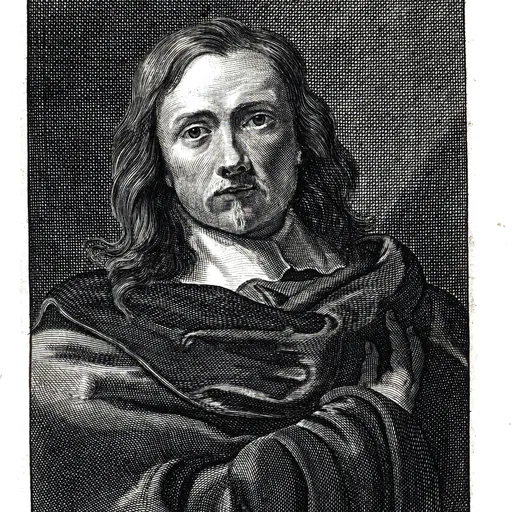
About Erasmus Quellinus II
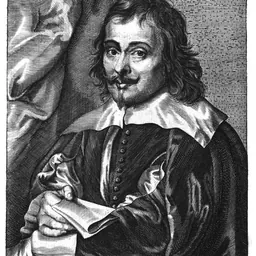
Lived 1607 – 1678 (aged 70). Erasmus Quellinus II was a Belgian painter, printmaker, draftsperson, etcher and copper engraver.
Erasmus Quellinus the Younger or Erasmus Quellinus II (November 19, 1607 – November 11, 1678) was a Flemish painter, engraver, draughtsman and tapestry designer who worked in various genres including history, portrait, allegorical, battle and animal paintings. He was a pupil of Peter Paul Rubens and one of the closest collaborators of Rubens in the 1630s. Following Rubens' death in 1640 he became one of the most successful painters in Flanders. He was a prolific draughtsman who made designs for decorative programmes in the context of official celebrations, for publications by the local publishers and for tapestries and sculptures realised by the local workshops. His work reveals the Classicist trend in the Baroque.
Life Quellinus was born in Antwerp as the son of Erasmus Quellinus I and Elisabeth van Uden. The Quellinus family became one of the leading artistic families in Antwerp, producing sculptors, painters and printmakers who would develop careers in Flanders and abroad. Father Erasmus Quellinus I, a sculptor, had moved from Sint-Truiden to Antwerp. The brothers of Erasmus Quellinus the Younger were both artists: Artus (1609–1668) was a leading Baroque sculptor and Hubertus (1619–1687) an engraver.
Quellinus commenced his apprenticeship with Jan Baptist Verhaeghe, an obscure artist, in 1633. He became a master of the Antwerp Guild of Saint Luke in 1633–1634. In 1634 Erasmus II married Catharina de Hemelaer, a niece of Jan de Hemelaer, the deacon of Antwerp Cathedral. Their son Jan Erasmus followed in his father's footsteps and became a painter.
Quellinus became a regular collaborator of Rubens starting from 1635. He first worked on the decorations for the Joyous Entry into Antwerp of the new governor of the Habsburg Netherlands Cardinal-Infante Ferdinand. Rubens was in overall charge of this project. Quellinus made decorative paintings after designs by Rubens of which six have survived. In the period 1636-1638 Rubens' workshop received a large commission to make mythological decorations for the hunting pavilion Torre de la Parada of the Spanish king Philip IV near Madrid. For this project Quellinus painted decorations after oil sketches by Rubens some of which have been preserved (Prado Museum).
His first wife died in 1662. On 9 November 1663, Erasmus Quellinus II married Françoise de Fren. De Fren was the daughter of the well-off André de Fren, secretary of the Council of Brabant, and the sister of Isabella de Fren, who was married to the court painter David Teniers II.
Quellinus collaborated on garland paintings with still life specialists, such as his brother-in-law Jan Philip van Thielen, Daniel Seghers, Jan Pieter Brueghel, Frans Ykens, Peter Willebeeck and Jan Anton van der Baren. These collaborators painted the flower garland while Quellinus painted the figures and architectural setting. An example is the Holy Family in a Wreath of Flowers in the Hermitage Museum, a collaboration with Frans Ykens. Quellinus further collaborated with the animal and still life painter Jan Fyt on portraits such as the Portrait of a young boy (Royal Museum of Fine Arts Antwerp) of c. 1650. Quellinus also collaborated with animal painters Peter Boel and genre painter Jan van Kessel the Elder.
Tapestry designs Quellinus executed various tapestry designs. In 1649 he produced the designs for a tapestry series depicting the History of the Thurn and Taxis Family (Royal Museums of Fine Arts of Belgium, Brussels). These designs are executed in his classicizing style.
Graphic designs
In addition to the frontispieces he produced for the Plantin Press, he made designs for various publications for the Antwerp publishers. This includes his designs for the Den methamorphosis ofte Herscheppinge van P. Ovidivs Naso: verdeelt in XV boecken, versiert met figueren, a translation into Dutch of Ovid's Metamorphoses by Seger van Dort. For this book, which Geeraerdt van Wolsschaten published in Antwerp in 1650, Erasmus made the designs for the illustrations which were engraved by Pieter de Jode II. He also contributed a poem to the introduction of the publication. Sculptural designs Quellinus came from an artistic family whose predominant activity was the design and execution of sculptures and architectural decorations. His father, older brother and cousin as well as his brother-in-law Pieter Verbrugghen I were all prominent sculptors who worked for a local and international clientele. It is therefore no surprise that Erasmus was a prolific designer of sculptures and decorative projects. The inventory of his estate lists hundreds of drawings, of which at least 43 are for architecture, which would have included altarpieces and large-scale sculptures as well as others for sculpture and decoration. He is believed to have contributed designs for the organs in the Antwerp cathedral and Saint Paul's Church in Antwerp, as well as several altarpieces, executed by his brother-in-law Pieter Verbrugghen I. A drawing by Erasmus has been identified as being a study for a group of three music-making angels on one of the organs, although none corresponds exactly to the angels now on the organs. It seems that in these designs he did not attempt to create a precise three-dimensional model to be followed by the sculptor but rather an outline from which the sculptor executing the sculpture could work freely.
Don’t just read it —
keep it.
Full-length biographies made to live with: read them, listen on the way to work, watch them tonight.
- E-book
- Audio
- Video
Instant download · yours to keep · every purchase keeps this site free
Important facts
more
Jr. Erasmus Quellinus, Rasmus Collini, Erasmus, II Quellinus, Erasmus Quellinus, Erasmus Quellin, Erasmus Quellinus (II), Erasme Quellin, Erasme Quellin (II), Quellenus, Quirin, Erasmus Quellynus, Erasme Quellinus, E. Quillin, Erasmus Quillenus, Quilenus, Hubert quellinus, E. Quellyn, Er. Quelinus, E. Quelyn, E. Quellin, Erasme Quilinus, Erasmus Quellinus d. Jüngere, Quillin, ErPeople in Erasmus Quellinus II's life
Named in this biography and alive at the same time



Related people
Same field, nearest in time

Contemporaries
People whose lives overlapped Erasmus Quellinus II's






Frequently asked questions
Who was Erasmus Quellinus II?
Flemish painter (1607-1678)
When was Erasmus Quellinus II born?
Erasmus Quellinus II was born on 19 November 1607 in Antwerp.
When did Erasmus Quellinus II die?
Erasmus Quellinus II died on 7 November 1678 in Antwerp.
What was Erasmus Quellinus II's occupation?
Erasmus Quellinus II was a painter, printmaker, draftsperson, etcher and copper engraver.
What nationality was Erasmus Quellinus II?
Erasmus Quellinus II was Belgian.
Sources & further reading
· Wikipedia: Erasmus Quellinus II
· DBpedia: Erasmus Quellinus the Younger
Cite this page
APA: Biography.guide. (2026). Erasmus Quellinus II. https://biography.guide/erasmus-quellinus-ii/
MLA: "Erasmus Quellinus II." Biography.guide, https://biography.guide/erasmus-quellinus-ii/.
Chicago: "Erasmus Quellinus II." Biography.guide. https://biography.guide/erasmus-quellinus-ii/.
Data last updated: 2026-09-20 · Spot an error? Report a correction.
Portrait: Wikimedia Commons · author & licence
Page generated 2026-09-27 04:58 UTC