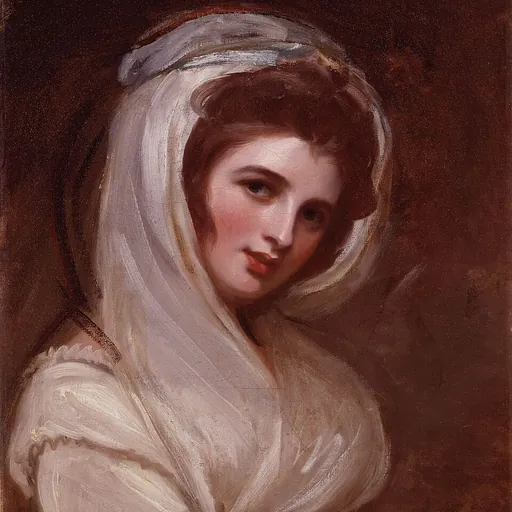
About Emma, Lady Hamilton
Lived 1765 – 1815 (aged 49). Emma, Lady Hamilton was a British singer, art model, mime artist, model, actor and artist, known for Mistress (lover).
Emma, Lady Hamilton (born Amy Lyon; 26 April 176515 January 1815), was an English courtesan, remembered as the mistress of naval hero Lord Nelson and the muse of artist George Romney.
Emma was born in the village of Ness in Cheshire, the daughter of a blacksmith. Her father died soon after her birth and she was raised by her mother and grandmother in the nearby village of Hawarden. At the age of twelve, she followed her mother to London and, after briefly working as a domestic servant, drifted into the capital's demi-monde. By the age of fifteen she was the mistress of a young aristocrat, Sir Harry Fetherstonhaugh, who abandoned her when she became pregnant. She and her mother were taken in by Charles Francis Greville, who set them up in a house off the Edgware Road. Emma became known as Emma Hart and her mother as Mrs Cadogan. Emma's daughter was sent to Hawarden to be raised by her great-grandmother. It was during this period that Emma sat for numerous portraits by George Romney.
After a few years, Greville tired of Emma and sent her and her mother to his uncle, Sir William Hamilton, British ambassador to the Kingdom of Naples. She became Hamilton's mistress and a society hostess, famed for her performances of "Attitudes" where she struck poses from antiquity. In 1791, Hamilton and Emma were quietly married in St Marylebone Parish Church. With her new-found respectability as the ambassador's wife, she was able to attend the court in Naples and she became a friend of Queen Maria Carolina. Nelson arrived in Naples after his victory at the Battle of the Nile in August 1798 and soon embarked on an affair with Emma. The Hamiltons and Nelson returned to England in 1800 and set up a ménage à trois in London and at a country house in Merton bought by Nelson. Emma gave birth to Nelson's daughter, Horatia, in 1801. William Hamilton died in 1803, but Nelson and Emma were unable to marry as Nelson was still married to his wife Fanny. After Nelson's death at the Battle of Trafalgar in 1805, Emma, who had been provided for in the wills of both her husband and her lover, continued an extravagant lifestyle and fell into debt. In 1814, in order to escape her creditors, she fled to Calais with Horatia and died there six months later.
Although largely ignored during the rest of the nineteenth century, Emma was the subject of biographies in 1888 and 1905. In more recent years, her rags to riches story and love affair with Nelson has inspired historical fiction, drama and films as well as further biographies.
Early life Emma was born Amy Lyon on 26 April 1765 in the mining village of Ness on the Wirral Peninsula. She was baptised on 12 May 1765 in St Mary's and St Helen's Church in Neston. Her father, blacksmith Henry Lyon, died when she was two months old, and her mother, Mary Kidd, took Emma to live with her family in Hawarden, across the River Dee from Ness. She was raised by her mother and her grandmother, Sarah Kidd, who ran a carrier's business. Little is known of Emma's childhood, but at the age of twelve she began work as an under-nursemaid at Hawarden, in the household of local doctor John Thomas, father of Honoratus Leigh Thomas
London 1777-1785 In late 1777, after several months working in Hawarden, Emma followed her mother to London and worked as a nursery maid at the house of Dr Richard Budd in Chatham Place, Blackfriars. Also working as a servant in the household was the future actress Jane Powell. Emma's positions in London after leaving the Budd household become more difficult to establish with any certainty. According to the reminiscences of Henry Angelo, written in 1828 and not considered reliable, she was for a time a servant in the Linley household. Her work took her to Drury Lane theatre in Covent Garden, where Mrs Linley was costume mistress. Angelo then claims that Emma worked at a brothel run by Mrs Kelly in St James's. There was also a story, denied by Emma's friends, that she had worked for a time at the Temple of Health of Dr James Graham. While Emma's exact route into the demi-monde of London remains obscure, her life from 1781, when she became a "kept woman", is well documented.
Greville installed Emma and her mother in a house at Edgware Row in Paddington Green, London, at that time a village on the outskirts of London. Emma changed her name to "Mrs Emma Hart" at the request of Greville while her mother, who acted as housekeeper and chaperone, adopted the name of "Mrs Cadogan". Greville provided Emma and her mother with two maids and a gardener. He expected Emma to abandon her former "giddy" ways and lead a modest and retired life. There were music lessons for Emma, and occasional supper parties with Greville's brother, Colonel "Wellbred" Greville, and friends. In 1784, Greville's uncle Sir William Hamilton visited and referred to Emma as "The Fair Tea-Maker of Edgware Row".
Greville lived on an inheritance from his mother of £500 a year, supplemented by dealing in art and antiquities. He commissioned a series of portraits of Emma from his friend, the portrait painter George Romney, in the hope of being able to sell the paintings at a profit. This hope never materialised and most of the paintings remained in Romney's possession. Emma first sat for Romney in the spring of 1782, soon after the birth of her daughter. On this occasion she posed as a figure from Greek mythology, Circe. Romney was impressed by Emma's beauty and ability to assume theatrical poses. Emma became Romney's muse and, over the next nine years, he completed over seventy paintings and sketches of her. Prints of Romney's portraits reached a wide audience and Emma became well-known. She was also painted by other artists, including Joshua Reynolds, John Hoppner, Thomas Lawrence and Élisabeth Vigée Le Brun.
After a few years, Greville tired of Emma and saw her as an obstacle to his search for an heiress to marry, a search that was ultimately unsuccessful. He devised a plan to pass Emma on to his widowed uncle William Hamilton, who was the envoy extraordinary to the Kingdom of Naples. Hamilton was initially reluctant to agree to Greville's plan. While admiring Emma's beauty, he thought that, at the age of fifty-four, he was too old for her and offered an alternative, writing to Greville from Naples in June 1765: "My regard for E. is such that if she leaves you and retires to the country, which I suppose she would do was you to marry, I wou'd willingly make her an allowance of £50 a year till your circumstances eable you to provide better for her." Greville insisted, and Emma and her mother, who had recovered from a stroke, set off for Naples in March 1786. Emma had not been privy to the discussions between Greville, with whom she was still and love, and his uncle. She was under the impression that her stay in Naples would be a temporary one while Greville attended to business in Scotland, and that he would collect her from Naples in October.
Naples 1786-1791
Emma and her mother set off for Naples on 13 March 1865. After crossing the Channel, they travelled overland and arrived in Naples on Emma's birthday six weeks later. Hamilton provided Emma and her mother with their own apartment in his ambassadorial residence, the Palazzo Sessa. He arranged for her to sit for portraits and to have lessons in languages and music, took her sailing, and introduced her to Neapolitan society and English visitors. In spite of her realisation that Greville had no intention of coming to collect her in October, she refused Hamilton's advances, writing pleadingly to Greville that she was broken-hearted without him, and would never consent to be Hamilton's lover. Eventually, before the end of the year, she had a change of heart and became Hamilton's mistress.
Emma moved into Hamilton's apartment in the Palazzo Sessa and spent the winter months in his country house near the Royal Palace of Caserta where King Ferdinand and Queen Maria Carolina spent the hunting season. Hamilton accompanied the king on hunting expeditions, but Emma could not be presented at court due to her status as a mistress. It was at Caserta that Emma and Hamilton developed her "Attitudes", a performance in which she draped herself in shawls and took up poses from classical art. One of the first visitors to describe the performance was Goethe:
[Hamilton] has had a Greek costume made for her which becomes her extremely. Dressed in this, she lets down her hair and, with a few shawls, gives so much variety to her poses, gestures, expression, etc., that the spectator can hardly believe his eyes. He sees what thousands of artists would have liked to express realized before him in movements and surprising transformations.... The old knight idolizes her and is quite enthusiastic about everything she does. In her he has found all the antiquities....
Over the next few years the relationship between Emma and Hamilton flourished. She did the honours at the Palazzo Sessa, entertaining large numbers of guests. She became fluent in Italian and, under the tutelage of a music master, developed her singing voice. She performed the Attitudes in front of selected guests. There were trips to Rome and the countryside and an expedition to Mount Vesuvius. There were afternoons at Hamilton's villa on the beach at Posillipo, which he renamed Villa Emma. In 1790, Hamilton commissioned several portraits of Emma from the French artist Élisabeth Vigée Le Brun.
Marriage By 1791, Hamilton had resolved to marry Emma. They were married on 6 September 1791 at St Marylebone Parish Church, then a plain small building, having returned to England for the purpose and Sir William having gained the King's consent. She was twenty-six and he was sixty. Although she was obliged to use her legal name of Amy Lyon on the marriage register, the wedding gave her the title Lady Hamilton which she would use for the rest of her life. Hamilton's public career was now at its height and during their visit he was inducted into the Privy Council. Shortly after the ceremony, Romney painted his last portrait of Emma from life, The Ambassadress, after which he plunged into a deep depression and drew a series of frenzied sketches of Emma.
The newly married couple returned to Naples after two days. After the marriage, Greville transferred the cost of Emma Carew's upkeep to Sir William, and suggested that he might move her to an establishment befitting the stepdaughter of an envoy. However, Sir William preferred to forget about her for a while.
Meeting with Nelson As wife of the British Envoy, Emma welcomed Nelson (who had been married to Fanny Nisbet for about six years at that point) after his arrival in Naples on 10 September 1793, When he set sail for Sardinia on 15 September after only five days in Naples, it was clear that he had already fallen a little in love. She acted as a go-between, conveying messages from the queen to Nelson and from Nelson to the queen.
Life in London and at Merton Nelson's recall to Britain shortly afterwards coincided with the government finally granting Hamilton's request for relief from his post in Naples. Emma must have become pregnant around April 1800. Emma continued to display her Attitudes to audiences, and at this point of her life grew obese and her drinking intensified. In April 13, Joseph Farington wrote in his diary;
After the Treaty of Amiens on 25 March 1802, Nelson was released from active service, but wanted to keep his new-found position in society by maintaining an aura of wealth, and Emma worked hard to live up to this dream. Nelson's father became seriously ill in April, but Nelson did not visit him in Norfolk, staying home to celebrate Emma's 37th birthday on the very day Edmund died; the son did not attend his father's funeral.
Nelson had been offered the position of commander-in-chief of the Mediterranean Fleet, and they rushed to have Horatia christened at Marylebone Parish Church before he left. On her baptism record, her name was recorded as Horatia Nelson Thompson, and her date of birth falsely recorded as 29 October 1800 in order to continue the pretence that she had been born in Naples and was godchild of Emma and Nelson, according to Kate Williams and based on an unpublished letter; Nelson later wrote a letter explaining that the child was an orphan "left to his care and protection" in Naples. the same day as Nelson's early morning departure to fight in the Napoleonic Wars, leaving Emma pregnant with their second child (although neither knew it at this time). For most of 1811 and 1812 she was in a virtual debtors' prison, and in December 1812 either chose to commit herself (her name does not appear in the record books) per the system whereby genteel prisoners could buy the rights to live "within the Rules", a three-square-mile area around the prison.
In early 1813, she petitioned the prince of Wales, the government and friends, but all of her requests failed, and she was obliged to have an auction of many of her possessions, including many Nelson relics, at low prices. However she continued to borrow money to maintain appearances. Public opinion turned against her after the Letters of Lord Nelson to Lady Hamilton were published in April 1814. Emma was buried in Calais
Lady Hamilton's death incentivized her creditors to submit an application to Robert Fulke Greville, the trustee of her annuity and the person she sought for financial assistance. To enable the creditor to collect his reward, Greville got a copy of the death certificate from the Calais Mairie. Colonel "Wellbred" as he was called finally closed all his former aunt in law's debts.
Henry Cadogan cared for the 14-year-old Horatia in the aftermath of Emma's death and paid for her travel to Dover. The Matchams took her in to care for their younger children until she was sent to live with the Boltons two years later, Susanna having died in 1813.
Honours and heraldry Emma Hamilton is generally known by the courtesy title of Lady Hamilton, to which she was entitled from 1791 as the wife and then widow of Sir William Hamilton. In 1800, she became a member of the Order of Malta. This was an unusual honour, awarded to Lady Hamilton by the then Grand Master of the Order, Paul I of Russia, in recognition of her role in the defence of the island of Malta against the French.
Subsequently, she used her new title in formal circumstances, and was acknowledged as Dame Emma Hamilton in official British contexts; most notably, this was the title under which she was formally granted her own coat of arms by the English College of Arms in 1806, Per pale Or and Argent, three Lions rampant Gules, on a chief Sable, a Cross of eight points of the second. The lions evidently refer to her maiden surname of Lyons, and the addition of the Maltese Cross, which has puzzled heraldic scholars unaware of her connection to the Order.
In popular culture
The 1919 silent British film The Romance of Lady Hamilton directed by Bert Haldane and starring Malvina Longfellow as Hamilton and Humberston Wright as Nelson. The 1921 silent German film Lady Hamilton directed by Richard Oswald with Liane Haid as Hamilton and Conrad Veidt as Nelson. The 1926 operetta Lady Hamilton by the German composer Eduard Künneke. The operetta was revived in Cologne in 2004. The 1929 Vitaphone part-silent film The Divine Lady. Corinne Griffith played Lady Hamilton and Victor Varconi played Admiral Nelson. The 1941 film That Hamilton Woman starring Vivien Leigh as Emma and Laurence Olivier as Horatio. Leigh took publicity photos for the film arranged in poses very similar to paintings of Emma. The film is said to have been a favourite of Winston Churchill. The 1951 opera Nelson by Lennox Berkeley. The 1953 Soviet film Attack from the Sea. Emma Hamilton was portrayed by Yelena Kuzmina. The 1968 film Emma Hamilton. Emma Hamilton was portrayed by Michèle Mercier. The 1973 film Bequest to the Nation (released in the United States as The Nelson Affair). Emma Hamilton was portrayed by Glenda Jackson, and Peter Finch plays Nelson. Susan Sontag's 1992 novel The Volcano Lover: A Romance is a fictionalised portrait of Lady Emma and the times in which she lived.
Biographies
Gallery
Don’t just read it —
keep it.
Full-length biographies made to live with: read them, listen on the way to work, watch them tonight.
- E-book
- Audio
- Video
Instant download · yours to keep · every purchase keeps this site free
Important facts
more
Emma HamiltonFamily & relationships
People in Emma, Lady Hamilton's life
Named in this biography and alive at the same time


Related people
Same field, nearest in time


Contemporaries
People whose lives overlapped Emma, Lady Hamilton's




Frequently asked questions
Who was Emma, Lady Hamilton?
Mistress of Lord Nelson (1765-1815)
When was Emma, Lady Hamilton born?
Emma, Lady Hamilton was born on 26 April 1765 in Neston.
When did Emma, Lady Hamilton die?
Emma, Lady Hamilton died on 15 January 1815 in Calais.
What was Emma, Lady Hamilton's occupation?
Emma, Lady Hamilton was a singer, art model, mime artist, model, actor and artist.
What was Emma, Lady Hamilton known for?
Emma, Lady Hamilton was known for Mistress (lover).
What nationality was Emma, Lady Hamilton?
Emma, Lady Hamilton was British.
Sources & further reading
· Wikipedia: Emma, Lady Hamilton
· DBpedia: Emma, Lady Hamilton
Cite this page
APA: Biography.guide. (2026). Emma, Lady Hamilton. https://biography.guide/emma-lady-hamilton/
MLA: "Emma, Lady Hamilton." Biography.guide, https://biography.guide/emma-lady-hamilton/.
Chicago: "Emma, Lady Hamilton." Biography.guide. https://biography.guide/emma-lady-hamilton/.
Data last updated: 2026-09-20 · Spot an error? Report a correction.
Portrait: Wikimedia Commons · author & licence
Page generated 2026-09-27 04:57 UTC